Greenhouse Film Calculator
Estimate greenhouse plastic for hoop houses, gothic bows, gable roofs, lean-to structures, and low tunnels with roll width, seam overlap, edge allowance, end walls, film thickness, and finished weight.
Choose a real growing layout to fill the calculator, then adjust dimensions, film thickness, roll width, or overlap for your site.
Film Estimate
Results include main roof and side cover, selected end walls, overlap loss, film layers, edge allowance, end flaps, roll width, and cutting buffer.
| Roll width | Best greenhouse use | Typical one-piece cover width | Notes |
|---|---|---|---|
| 16 ft | Low tunnels, benches | Up to 14-15 ft | Leaves room for side allowance |
| 24 ft | 10-14 ft hoops | Up to 22-23 ft | Common for caterpillar tunnels |
| 32 ft | 16-20 ft high tunnels | Up to 30-31 ft | Often covers roof and sides in one sheet |
| 40 ft | 24-30 ft houses | Up to 38-39 ft | Reduces seams on wide spans |
| 48 ft | Large gothic houses | Up to 46-47 ft | Heavy roll handling required |
| Style | Cover width method | End-wall method | Best use |
|---|---|---|---|
| Round hoop | Circular arc from span and rise | Rectangular sidewall plus arc segment | Quonset and movable hoops |
| Gothic | Peaked slope with 8% curve factor | Gable area with 5% curve factor | Snow shedding high tunnels |
| Gable | Two straight roof slopes | Rectangle plus triangle | Wood or pipe-frame retrofits |
| Lean-to | Single sloped roof plus tall wall | Average-height rectangle | Wall-attached growing bays |
| Low tunnel | Half-circle arc, no sidewall | Half-circle end cap | Row covers and caterpillar tunnels |
| Detail | Typical input | Why it matters | Calculator use |
|---|---|---|---|
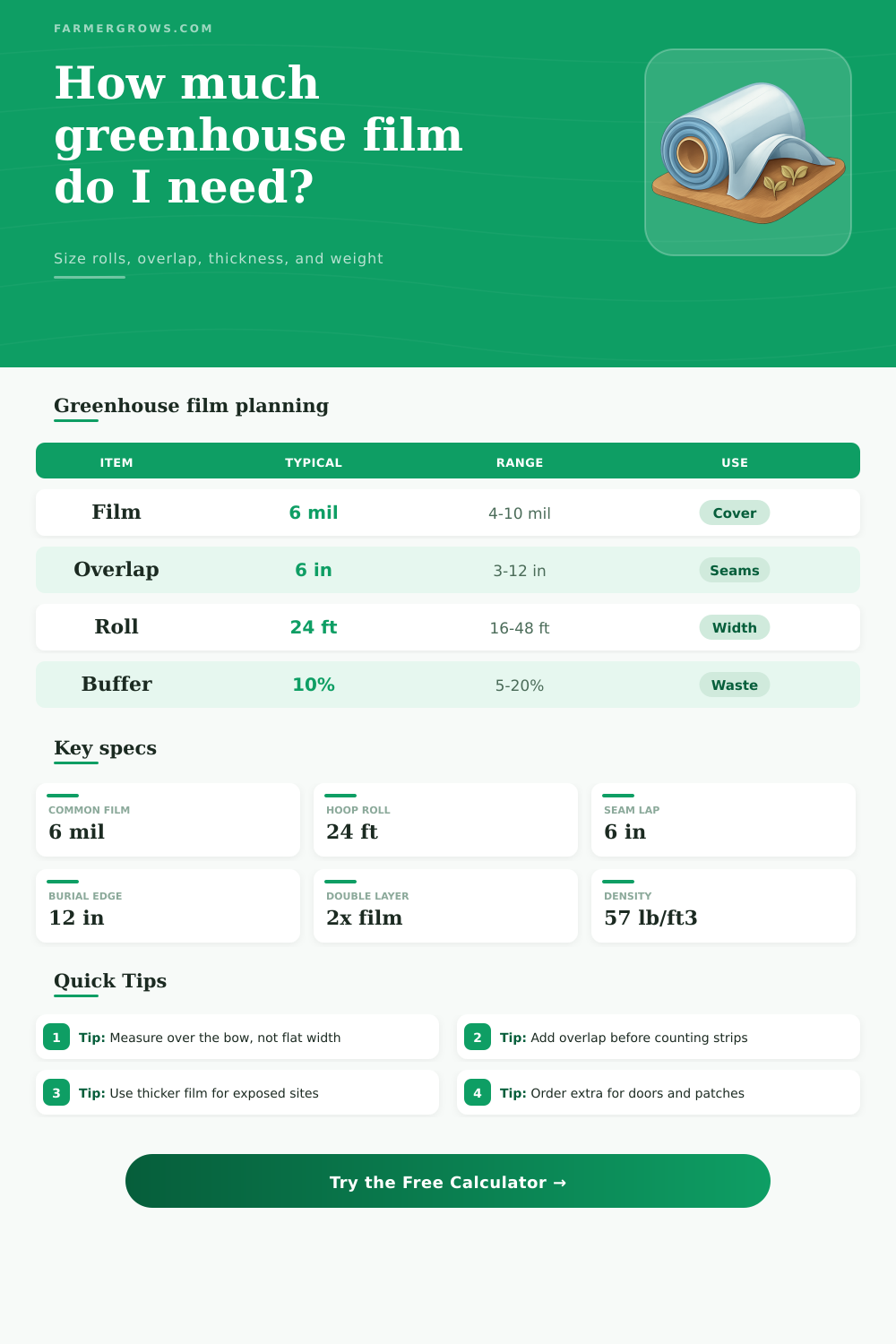
| Seam overlap | 3-12 in | Lost width where strips overlap | Reduces effective roll coverage |
| Side edge allowance | 8-18 in | Extra plastic for baseboards or burial | Added to both sides of main cover |
| End flap | 12-36 in | Extra length for pulling and fastening | Added to both ends of roof sheet |
| Repair buffer | 5-20% | Covers cuts, doors, vents, and patches | Applied after layers and end walls |
| House size | Typical cover width | Common roll | Film note |
|---|---|---|---|
| 10 x 20 hoop | 22-24 ft | 24 x 50 ft | One-piece roof and sides |
| 14 x 100 caterpillar | 28-32 ft | 32 x 110 ft | Extra length for tied ends |
| 20 x 48 gothic | 32-36 ft | 40 x 100 ft | Leaves margin for base fastening |
| 26 x 72 winter house | 40-44 ft | 48 x 100 ft | Often ordered as double poly |
| 30 x 96 high tunnel | 44-48 ft | 48 x 110 ft | Wide roll reduces roof seams |
When calculating how much polyethylene film is required for a greenhouse, there are a few things to consider. Many growers will calculate how much polyethylene film is required by measuring the floor of the greenhouse. This measurement, however, dont account for the distance that the polyethylene film will travel over the curves of the hoops of the greenhouse roof, or the peaks of the roof, as well as the distance that the polyethylene film will travel down the sidewall of the greenhouse to reach the ground.
Thus, the amount of polyethylene film required will require a length of film that is more longer than the greenhouse floor measurements. In addition to measuring the length of polyethylene film that is required to cover the greenhouse, you must also account for the amount of tension that the polyethylene film will experience within the greenhouse structure. If the polyethylene film isnt pulled tight to the greenhouse structure, the polyethylene film may flap against the wind, which can lead to the film tear.
How Much Plastic Film You Need for a Greenhouse
In addition to accounting for the length of the polyethylene film required to cover the greenhouse, the length of the burial edge of the polyethylene film must also be accounted for. The burial edge prevents the wind from move underneath the polyethylene film that covers the greenhouse; if the wind does move underneath the polyethylene film, the wind will lift the film, which can potentially lead to the greenhouse structure being destroyed. In addition to measuring the length of the polyethylene film, the thickness of the polyethylene film must be considered.
Four mil polyethylene film is thin and easy to handle when placing into the greenhouse structures, but the film will not last as long as thicker polyethylene films. Six mil polyethylene film is the standard thickness for polyethylene greenhouse coverings. Eight mil and ten mil reinforced films is used in areas where the snow load and wind strength is high.
Ten mil reinforced polyethylene film is much heavier than four mil polyethylene film, and can better withstand the weight of snow that may fall on the greenhouse structures. The shape of the greenhouse roof can impact the amount of polyethylene film that is required to cover the greenhouse. Rounded hoop roof structures are different than greenhouse structures that have gothic style roofs.
Gothic roofs have a peak structure in the middle of the greenhouse roof. This peak increases the amount of surface area of the greenhouse roof that must be covered by the polyethylene film. Thus, the gothic greenhouse roofs require more polyethylene film than rounded hoop covered greenhouses of the same width.
Additionally, if the polyethylene film is to cover a gable roof greenhouse, the dimensions of the gable roof must be calculated. Such measurements a greenhouse film calculator can calculate, eliminating the need to manually calculate these values. If you provide the polyethylene film to cover the greenhouse in strips, the dimensions of the strips must account for the overlap of the edges of the strips.
The polyethylene film strip may not be wide enough to cover the greenhouse with a single strip of film. In this instance, the two edges of the film strips will need to be joined together, but you must provide an overlap of the edges of the strips of film so that the edges can be seal together. If this overlap is not accounted for in the estimation of the length of the polyethylene film to be used for the greenhouse, there will not be enough film to cover the far side of the greenhouse structure.
The end walls of the greenhouse must also have sufficient amount of polyethylene film provided to each end of the greenhouse. It isnt recommended to use scraps of polyethylene film to cover these end walls, as the film scraps may not be wide enough to cover the end walls of the greenhouse. An end flap of polyethylene film should be provided to each end of the greenhouse to allow the film to be pulled tight against the end walls of the greenhouse structure.
A cutting buffer should be included in the total amount of polyethylene film to be measured for the greenhouse. A cutting buffer is an additional ten percent of film that is provided to account for any tear in the film, or mistakes in cutting the film with a utility knife. Finally, the weight of the polyethylene film should be considered.
Rolls of ten mil reinforced polyethylene film are very heavy. The weight of the polyethylene film should be known before the delivery of the polyethylene film to the greenhouse; otherwise, it may be difficult to move the heavy roll of polyethylene film. It is easier to move the polyethylene film when it is still on the pallet upon delivery than it is to move it onto the field to the greenhouse structure.
Thus, by considering each of these factor in the greenhouse, the amount of polyethylene film that is required will ensure that the polyethylene film reaches the ground correctly.