Carrot From Seed Growth Time Calculator
Plan a carrot crop from dry seed to harvest by adjusting for variety, sowing date, soil temperature, seed tape or broadcast sowing, row spacing, thinning timing, harvest target, moisture, and season.
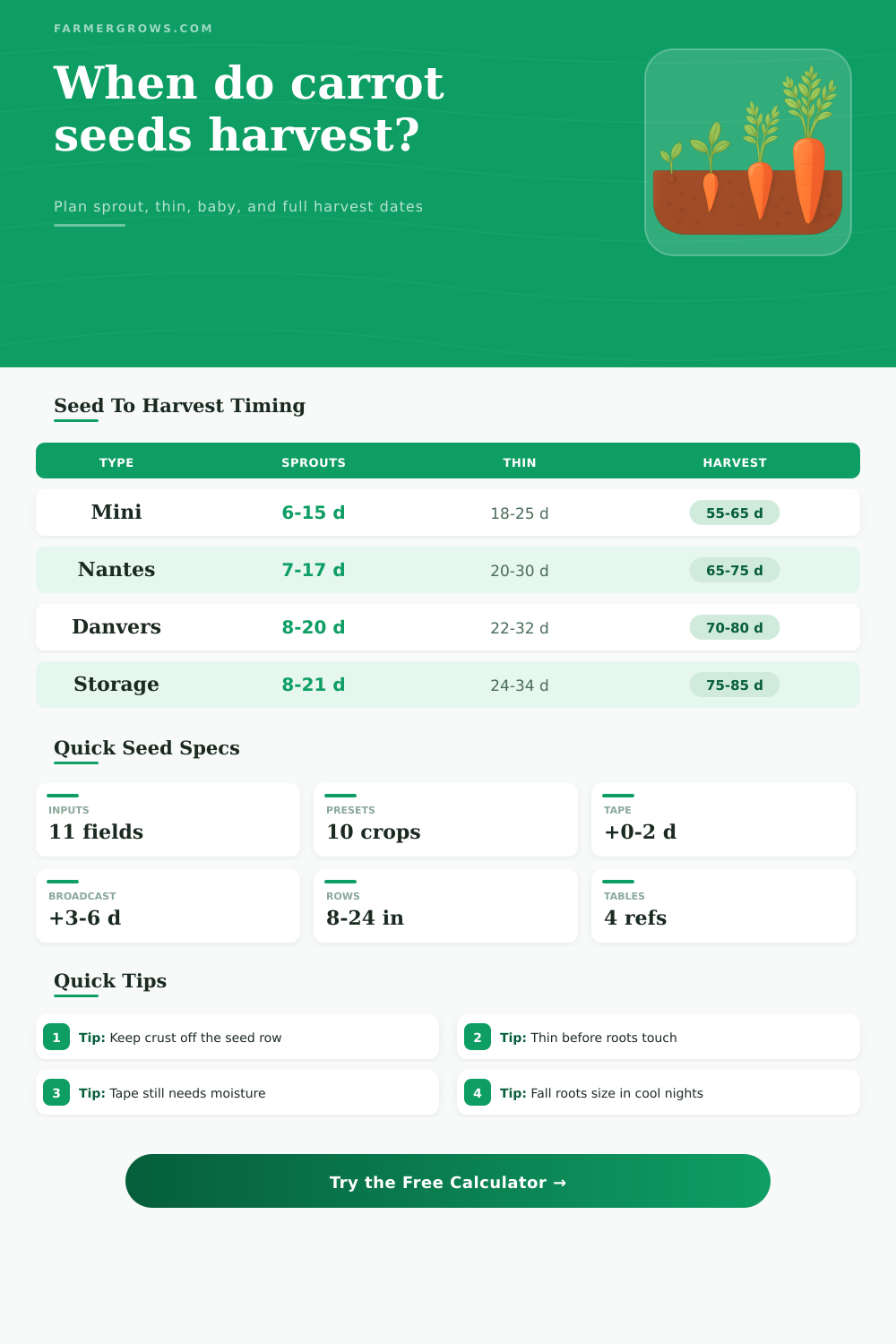
Carrot seed timing is less predictable than transplanted crops. This planner separates emergence, thinning, baby pulls, and final harvest so you can see where a slow seedbed changes the schedule.
Best when you want tidy spacing and fewer pulled seedlings.
Fast to sow, but final roots depend on careful early thinning.
Easier placement, with a small delay if pellets dry out.
Good for market beds, flame weeding, and repeated sowings.
Works best with mini, round, or blunt-rooted varieties.
Carrot Seed Timeline
Your carrot seed plan will appear here after calculation.
| Seed germination condition | Likely emergence | Schedule effect | Seedbed action |
|---|---|---|---|
| 40 to 44°F soil | 14 to 28 days | Large delay and uneven stand | Use row cover, wait, or sow extra seed |
| 45 to 54°F soil | 10 to 21 days | Slow but usable spring start | Keep crust broken and moisture steady |
| 55 to 64°F soil | 7 to 16 days | Reliable garden timing | Cover lightly and water with a fine rose |
| 65 to 75°F soil | 6 to 12 days | Fastest practical carrot range | Check moisture daily in raised beds |
| 76 to 85°F soil | 7 to 15 days | Fast if the row never dries | Shade or board-cover until sprouting |
| Above 85°F soil | Erratic | Higher failure risk | Sow in cooler weather or use shade cloth |
| Thinning stage | Timing from sowing | Plant cue | What to do |
|---|---|---|---|
| First look | At emergence | Threadlike leaves visible | Confirm the row before hoeing or mulching |
| Early thin | 18 to 25 days | Tops near 1 inch tall | Clip extras if roots are too close to pull |
| Main thin | 24 to 35 days | Tops 1 to 2 inches tall | Leave 1.5 to 2 inches for most fresh carrots |
| Late rescue | 35 to 45 days | Shoulders begin crowding | Thin harder and expect some forked small roots |
| Spacing setup | Row spacing | Final in-row gap | Best use |
|---|---|---|---|
| Intensive raised bed | 6 to 8 in | 1.5 to 2 in | High yield, hand weeding, frequent moisture |
| Standard garden rows | 12 to 18 in | 2 to 3 in | Easy thinning, hoeing, and full-size roots |
| Market bed bands | 3 to 4 row band | 1.5 to 2 in | Precision sowing and repeated harvest passes |
| Storage carrots | 18 to 24 in | 2.5 to 3 in | Larger roots, easier lifting, better airflow |
| Container mini carrots | 4 to 6 in grid | 1 to 1.5 in | Little Finger, Paris Market, shallow mixes |
| Harvest size | Root diameter | Days from sowing | Kitchen or storage use |
|---|---|---|---|
| Baby pull | 3/8 to 3/4 in | 45 to 60 days | Fresh salads, bunching, spacing relief |
| Fresh full size | 3/4 to 1 1/4 in | 60 to 80 days | Everyday harvest and best texture |
| Large storage | 1 to 1 1/2 in | 75 to 95 days | Fall lifting, cellar storage, soups |
| Overheld roots | Above 1 1/2 in | 90+ days | May become woody unless held cool and moist |
For steadier emergence: Water the row before sowing, press seed into fine soil, cover lightly, and protect the surface from crusting until the first green threads show.
For better harvest timing: Mark one short test section and pull a few roots before the main date. Carrots can be ready underground before the tops look dramatic.
The carrot seed is small, slow to wake up and tossed about easy by even slight shifts in the seedbed. Many gardeners has patchy rows as a result, or roots that never get anywhere near as big as expected. When it comes to carrot-growing success, timing decisions made before a speck of green shows itself can make all the difference between a thin row and a good one.
The speed of germination depend on soil temperature (warmer is faster but less even across the row); cooler soil lengthens the process with a correspondingly longer window. But a hot soil may also bake surface before all seed has germinated. How fast the soil dries out next matter, too. Evenly moist conditions promote even sprouting; yet a surface that crusts or swings between wet and dry can trap or desiccate the tiny seedling.
How to Time Your Carrot Seeds
Enter your soil temperature plus your sowing method and moisture pattern into the calculator above, and the math will do the rest, no guessing which shift in factor will change the timing. The result is a product of not only your soil and moisture conditions, but also its spacing: How far apart do you plan to space the plants? And how wide are your rows?
If they’re tight, there will be more competition (for both light and water), and the resulting roots remains relatively small unless you thin out early and repeatedly. Space them farther apart, however, and each one have more room to grow, but with a lower total yield per square foot. Those spacing decisions affect your harvest date. Use the tool to see how that affects your desired results, like having many small root or fewer full-size ones.
Most folks don’t think of thinning until they try to pull apart roots that are already crowded belowground. This forces them to yank out plant that might have stayed, leaving behind a mess of stalled or forked roots. For best results, thin when seedlings is still relatively simple to spot but haven’t yet touched shoulders. That’s somewhere in between sowing day and the calculator guesses at it based off your conditions and sowing date so you can plan ahead to do the job before things tangle up.
There’s another variable: seasonal influences. Sowings in cool spring ground progress slow, but you’ll get tasty roots. Those made later in summer take off quickly and must be kept well watered because it’s still hot out there. Cool fall nights favor good flavor, but crops develops more slowly. You can see those changes reflected in the delayed harvest dates the tool calculates.
That page include reference tables showing how soil temperature affects the rate of germination. It also provides timing intervals based on growth stages so you know when to start thinning. Additionally, it lists spacings for various objectives, such as storage rows and intensive bed. Scan through to see where your inputs get you those dates, and tweak the next sowing if the first one got off to an early or late start.
It’s not a drama queen. Carrot seed is one of those things that responds more to consistent conditions and a patient attitude than drastic measures, it could of been easier if timing was perfect. And once you understand what all those changing, factors (like moisture, temperature, spacing) do to the schedule, it makes planning the rest of the season possible. It just expresses those connections in terms of dates for your calendar.