Midwest Ground Cover Plant Calculator
Estimate plant count, flats or pots, spacing density, slope-adjusted coverage, deer risk, and planting timing for Midwest ground covers in USDA zones 3 through 7.
Use this as a planning estimate for nursery orders and bed layout. The calculator scores Midwest site fit, then converts slope-adjusted bed area and center spacing into plants, order units, fill-in timing, and replacement buffer.
Midwest Ground Cover Plan
Your plant count, flat order, and suitability score will appear here.
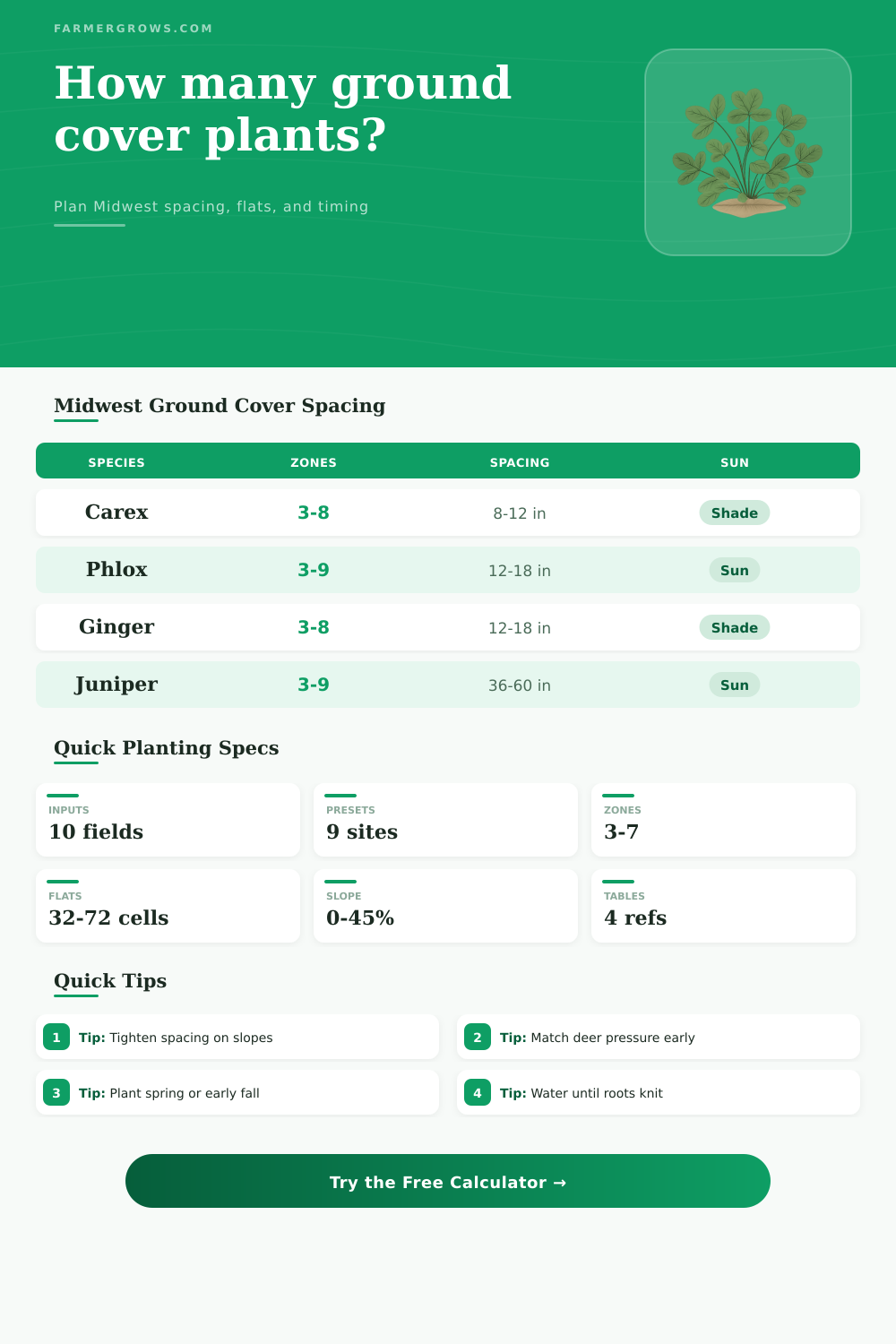
| Midwest species | Best spacing | Mature spread | Plants per 100 sq ft | Best use |
|---|---|---|---|---|
| Pennsylvania sedge | 8 to 12 in | 12 to 18 in | 115 to 260 | Dry shade lawn substitute |
| Wild ginger | 12 to 18 in | 18 to 24 in | 51 to 115 | Woodland shade carpet |
| Barren strawberry | 10 to 14 in | 15 to 18 in | 85 to 166 | Part-shade edging |
| Creeping phlox | 12 to 18 in | 18 to 24 in | 51 to 115 | Sunny dry borders and walls |
| Golden ragwort | 12 to 18 in | 18 to 30 in | 51 to 115 | Moist swales and naturalized beds |
| Creeping juniper | 36 to 60 in | 48 to 96 in | 5 to 13 | Sunny banks and erosion cover |
| Species | Typical zones | Upper Midwest note | Lower Midwest note | Winter concern |
|---|---|---|---|---|
| Pennsylvania sedge | 3 to 8 | Reliable in zone 3 to 5 shade | Needs shade and less reflected heat | Protect first-year plugs from heaving |
| Creeping phlox | 3 to 9 | Excellent drainage is important | Afternoon heat can thin mats | Avoid wet crowns in freeze-thaw soil |
| Wild ginger | 3 to 8 | Very hardy once rooted | Needs mulchy woodland soil | Slow first year, so weed early |
| Foamflower | 4 to 8 | Use sheltered shade in zone 4 | Needs moisture in hot summers | Leaf scorch if winter-dry |
| Bearberry | 2 to 6 | Strong choice for sandy cold sites | Struggles in humid heavy clay | Needs sharp drainage |
| Green-and-gold | 5 to 8 | Best in protected zone 5 spots | Good part-shade cover | Can thin in exposed cold wind |
| Species | Sun tolerance | Moisture range | Deer resistance | Slope use |
|---|---|---|---|---|
| Pennsylvania sedge | Part shade to shade | Dry to average | Good | Gentle to moderate slopes |
| Creeping phlox | Full sun | Dry to average | Fair | Low walls and open banks |
| Wild ginger | Shade | Average to moist | Fair | Gentle shaded slopes |
| Barren strawberry | Part sun to shade | Average | Good | Edges and low banks |
| Golden ragwort | Sun to part shade | Average to moist | Fair | Moist swale sides |
| Creeping juniper | Full sun | Dry to average | Good | Steep sunny erosion banks |
| Region / zone | Spring window | Fall window | Avoid | Planting note |
|---|---|---|---|---|
| Upper Midwest, zones 3 to 4 | Late April to June | Late August to mid September | Frozen soil, July heat | Fall planting needs 6 weeks before hard freeze |
| Central Midwest, zone 5 | April to early June | September to early October | Hot dry spells | Best balance of root growth and soil moisture |
| Lower Midwest, zones 6 to 7 | March to May | Late September to November | Mid-summer drought | Fall is often easiest for woody and evergreen covers |
| Wet swales and rain edges | After spring soil drains | Before cold rains | Standing water after planting | Firm plugs well so crowns do not float loose |
| Sunny slopes | Cool cloudy spring stretch | Early fall with mulch pins | Dry windy weeks | Use temporary jute or erosion blanket above 20% slope |
Plant the slope, not just the map. A bank has more surface area than its flat footprint. Tighten spacing and add replacement buffer where runoff, mulch slide, or deer trails cross the bed.
Do a site match before ordering flats. Zone-hardiness alone is not enough in the Midwest. Winter drainage, summer humidity, shade from maples, and deer pressure often decide whether a ground cover closes.
Selecting ground cover for your Midwest yard is about finding plants whose habit fits your site conditions. You must consider if you have shade from maples, severe weather like winter heaving, a steep slope, or deer trails. Those are variables that can makes something work. Or not.
You fill them into the calculator up top; it crunches numbers based off the species and slope and area you input. But first you’ve got to know what they mean; and then you’re ready to pull out your credit card and hit order.
How to Use the Calculator for Your Yard
People begin with zone maps and then they quit. Even if your bed is rated for zones three through eight, that doesn’t mean it’s suitable if soil is heavy clay and the location is full sun all afternoon. The calculator asks about each of those mismatches and deer pressure so you can test-fit it. A poor fit generate a low number. This means “this one will require some special care until the cover knits in,” which is better information than any plant-count. Because it saves you from the repetitive cycle of planting same bed every other spring.
Flat measurements don’t show what slope changes. On a plan, even a ten percent grade begins to add surface area your eye doesn’t see. Steeper banks multiply the difference… And the likelihood of mulch sliding before roots anchor. Adjusting the planting area for slope (and adding a buffer that increases with grade) is the calculators trick. It is not just about adding more plants, but also a reminder that for slopes above fifteen percent, spacing and erosion control has to works together.
So it’s with deer. If your only green thing in March is new ground cover, and everything else was browsed hard, even something cataloged as deer resistant will get browsed to heck. They raise the buffer for that species to match the deer setting in the calculator. This usually translates into having to order an extra plug or two instead of just sitting back and waiting for survivors to fill the gaps. It’s an extra little bit of cost up front, but a big one from avoiding disappointment at seeing a half-mat vanish overnight in some hard winter.
Most planting guides acknowledge timing. Fall planting works if there are six solid weeks of time left in the bed before it hard-freezes. Spring planting allows for longest growing-season headstart against possible freeze-thaw cycles. But they do calculate this: With a given slope, spacing, and fit score, how long will it take to fill in?
The calculator sizes your fill-in window to accommodate tighter or looser spacings, and higher or lower slopes. It could be that a tight spacing on a marginal site appears “finished” sooner on paper; but crowding slows root spread when moisture isn’t consistent. The window tells you whether to live with slower coverage, or tweak the design prior to digging.
Most of us aren’t doing math at planting time… When we’re picking which plants to buy. Instead, those reference tables are most helpful for seeing how popular Midwest plants compares across different factors like mature size, spacing, and slope tolerance. For instance: Pennsylvania sedge can take drier shade then wild ginger…but requires tighter centers so it won’t look as though it was planted accidentally. Creeping juniper is up to steeper sun banks that no sedge can handle, but with wider spacing it’ll allow much more area to weed out before canopy shuts it down.
Because it considers that kind of tradeoff ahead of time, the calculator doesn’t generate a number for something that wouldn’t work in that bed anyhow. But it’s not about a perfect number on each input. It’s about an achievable snapshot of the number of plants you’ll want to purchase and how quickly they’ll knit. It’s also about what the place will probably ask for in the first couple of years.
Then they are no longer just abstract numbers, but figures that actualy help create a planting plan that works. You should of used this earlier to avoid mistakes with furnitures.