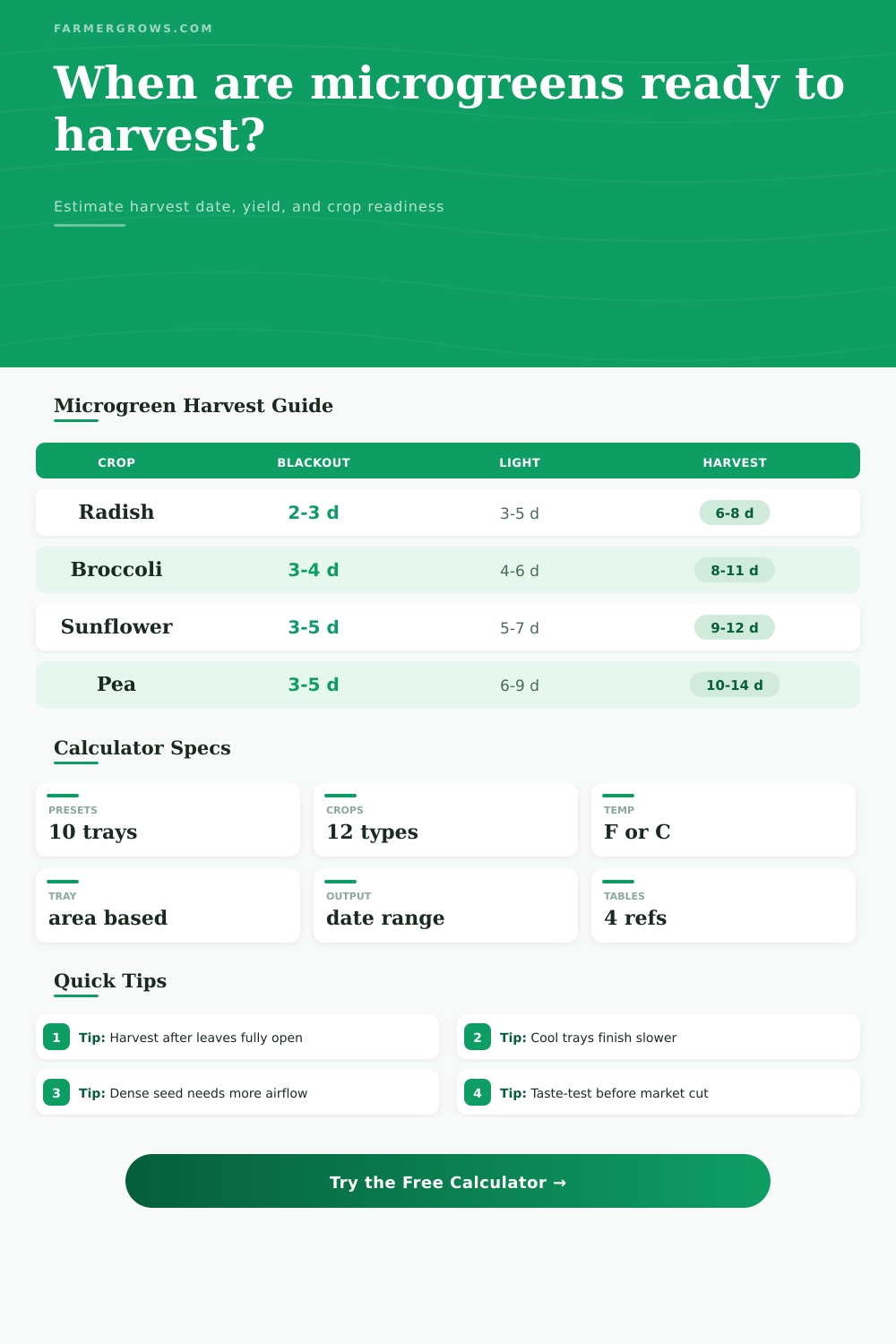
Microgreen Harvest Time Calculator
Estimate microgreen harvest dates, crop stage, blackout timing, light days, expected yield, and quality risk from crop type, tray size, temperature, density, and grow-room conditions.
Choose a real tray plan, then adjust crop, temperature, tray area, seeding rate, blackout length, light strength, and harvest target for your grow rack.
Microgreen Harvest Estimate
Your microgreen tray schedule will appear here.
| Crop | Typical blackout | Light days | Common harvest cue |
|---|---|---|---|
| Radish | 2 to 3 days | 3 to 5 days | Leaves open, stems crisp, spicy flavor is clean |
| Broccoli | 3 to 4 days | 4 to 6 days | Cotyledons spread flat before first true leaves dominate |
| Sunflower | 3 to 5 days | 5 to 7 days | Most hulls released and stems still succulent |
| Pea shoots | 3 to 5 days | 6 to 9 days | Stems are 4 to 7 inches with young tendrils |
| Basil | 4 to 6 days | 12 to 18 days | First true leaves beginning and strong aroma present |
| Cilantro | 5 to 7 days | 7 to 11 days | Seed coats mostly off and cotyledons expanded |
| Temperature band | Effect on timing | Quality concern | Adjustment habit |
|---|---|---|---|
| 55 to 60°F | Adds 1.5 to 3 days | Slow germination and uneven canopy | Warm water and keep trays off cold floors |
| 61 to 67°F | Adds 0.5 to 1.5 days | Brassicas stay compact | Use normal blackout but check daily |
| 68 to 74°F | Baseline timing | Most crops finish predictably | Cut by taste and leaf opening |
| 75 to 80°F | Can finish 0.5 to 1 day faster | Mold pressure rises in dense trays | Increase fan time and remove domes quickly |
| Over 80°F | Fast but risky | Leggy stems, sour media, damping-off | Thin seeding and harvest earlier |
| Tray size | Area | Yield scale | Planning note |
|---|---|---|---|
| 10 x 20 tray | 200 sq in | 1.00x | Standard reference size for most crop rates |
| 10 x 10 tray | 100 sq in | 0.50x | Useful for slower herbs and test runs |
| 5 x 10 tray | 50 sq in | 0.25x | Good for small shares or variety sampling |
| 5 x 5 tray | 25 sq in | 0.13x | Best for seed-lot checks and new crop trials |
| Harvest decision | What to inspect | Cut now if | Wait if |
|---|---|---|---|
| Cotyledon crop | Leaf opening | Leaves are flat and color is strong | Many seedlings still wear hulls |
| Tall shoot crop | Stem tenderness | Stems bend without stringiness | Stems are short for the order size |
| First true leaf | Flavor and leaf shape | True leaves just begin and flavor improves | Canopy still pale from weak light |
| Market pack | Dryness after watering | Canopy is dry and clean at cutting time | Leaves are wet or heat-stressed |
Move trays to light when shoots lift the cover evenly and color is still pale but stems are upright.
Most crops need several full light cycles after blackout before flavor, color, and leaf expansion settle.
Heavy seeding may boost yield but can delay dry-down and raise mold pressure near harvest.
For delivery work, plan a tasting cut one day early and harvest the full tray when texture is right.
Use the date as a window, not a command. Microgreen harvest timing shifts with seed lot, tray warmth, airflow, and light distance. Confirm with leaf opening, stem texture, hull drop, and flavor before cutting.
Harvest dry when possible. Watering just before harvest makes packed greens wilt faster. Bottom-water earlier, run airflow, and cut when leaves are clean, dry, and cool.
When to harvest microgreens is more of an art form then a science; not that timing isn’t partly determined by counting days since you planted. But part of it’s determined by how good your seed was (the better, the faster) and what the temperature was like in the space you grew them (the warmer, the faster). It’s also affected by whether they got some air circulating around their foliage… so a simple chart based off dates may not work.
There are no “ideal” conditions in your garage or kitchen, as there might be in a grow room. The estimation tool fill in the blanks between textbook time and real-time growing at home. Small differences make a big difference in calculations.
How to Know When to Harvest Microgreens
You might think that “two degrees doesn’t sound like much,” but to a radish seed, a two-degree shift is the difference between sprinting and shuffling. Because cells divide more slowly at cooler temperatures, slower metabolism means slower overall plant growth in a tray. With 55 as an average room temperature, the plants takes longer to develop. The calculator uses your room’s temperature (enter what yours is) to account for when heat will delay or hasten growth and tweaks the estimate accordingly.
That way, you won’t harvest prematurely if you thought your plants would mature as quickly as the ones mentioned in your handbook. Second: Pay attention to blackout times. That’s the dark stage when the seed is planted and covered, forcing the stem to get strong before it encounters sunlight. It’s one of the steps many grower mess up.
Some uncover them too soon, which results in pale and weak stems that cannot hold up leaf. Others keep them covered too long, which leads to excessively long stems and a higher chance of disease. Depending on your crop, the tool will calculate correct length of this stage for you. For instance, radishes grows quickly and need less darkness, while sunflower plants require strong stems to lift their heavy seeds and need more darkness. Get this timing right, and the harvest will be not just delicious but structurally sound.
Another factor is how densely you sow seed. A thick canopy will take longer to dry out. The moisture that stays between its leaves becomes an invitation for mold. Opting for a heavy seeding rate? The calculator will adjust the harvest time frame to match.
It’s one of those tradeoffs. Sure, you’ll have heavier trays, but the plants is at greater risk and will also mature more slowly. Depending on whether you’re selling the greens or growing them for your own consumption, it may be worthwhile. For yourself, it’s safer (and easier) to go with standard density.
It will help with yield estimation, which can inform meal planning or sales. For example, how many ounces does a typical tray yield? Scale accordingly. You should of be able to tell the chef who wants 10 trays of pea shoots on Tuesday whether it’s possible today, based on seed stockpiles and growing space.
Instead of giving them an exact day, the tool gives a range. That range takes into account the fact that not every plant in the tray will mature at exactly the same rate; some will be slightly faster or slower. It accounts for the worst- and best-case scenario. The date is only a guideline, not an absolute command.
Examine the leaves; are they all unfurled (seed leaves)? Is there any flavor yet? Taste a leaf before you cut the whole tray. Is it spicy like it’s supposed to or still mild? Wait another half-day until it’s right. Are the stems starting to go woody? Harvest then and all.
You’re the ultimate judge, using your taste buds, and yes, science; to know when to cut down. Paying attention and waiting will tell you when the plants are ready. Attention often makes the difference between a great harvest and a good one.