Microgreen Growth Time Calculator
Estimate tray crop timing from sowing to harvest using crop type, tray size, seed density, germination, blackout, light days, room temperature, media, airflow, light strength, harvest height, rinse method, and weekly production targets.
Choose a common microgreen crop setup, then tune the tray details to match your rack, seed lot, and harvest standard.
Microgreen tray plan
Adjust inputs to calculate harvest timing, seed, yield, and schedule needs.
Broccoli, cabbage, kale, mustard, and radish finish quickly when kept near 68 to 74 F with steady moisture.
Pea and sunflower use much more seed per tray and usually need a longer weighted blackout to push even stems.
Amaranth, beet, and chard are slower, more sensitive to overwatering, and often harvested shorter for garnish work.
Basil and cilantro take longer, but higher flavor value can justify a slower tray turn in a small rack plan.
| Crop | Typical blackout | Typical light days | Harvest cue |
|---|---|---|---|
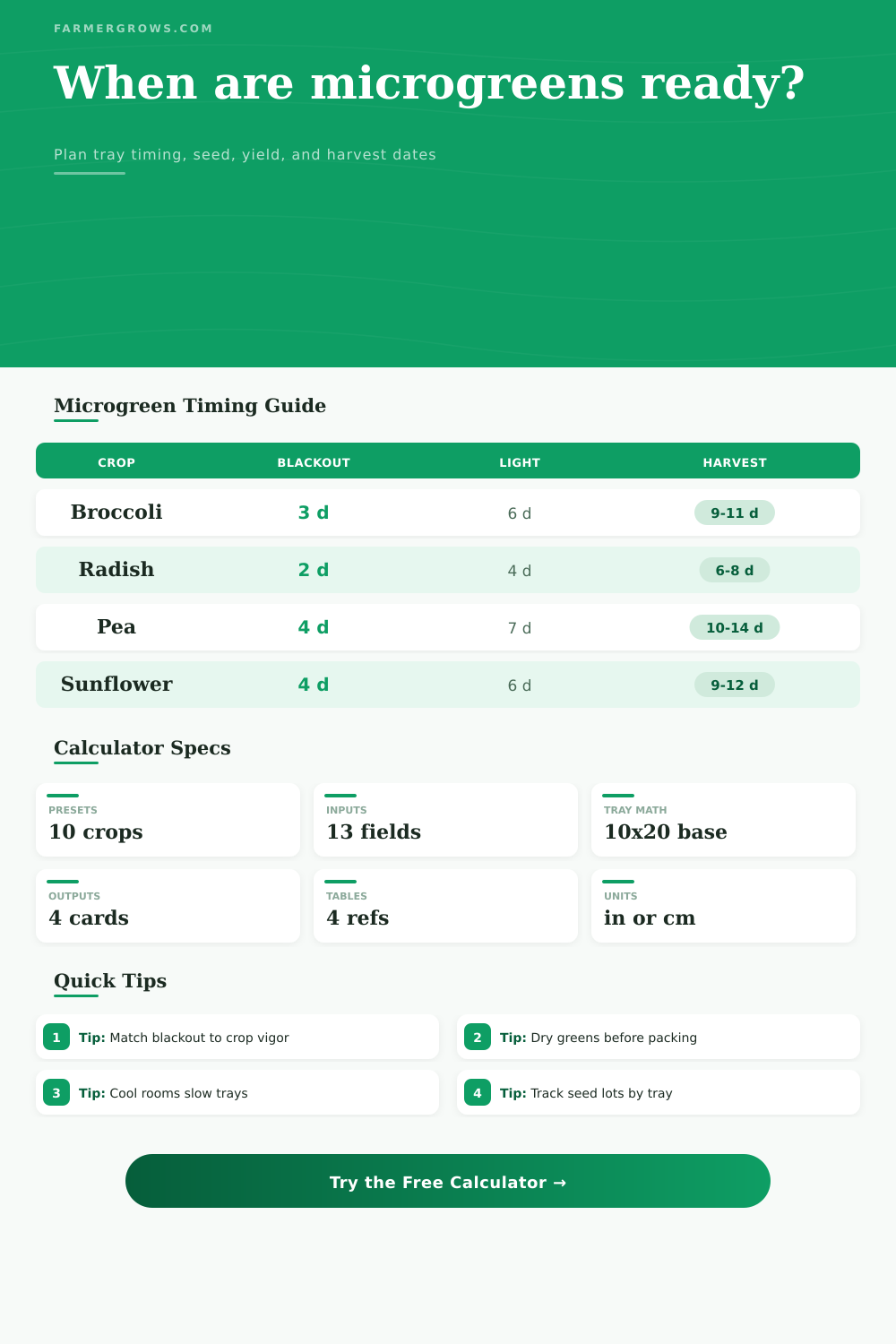
| Broccoli or brassica blend | 2 to 4 days, often weighted | 5 to 8 days | Open cotyledons, 2 to 3 inches tall |
| Radish or daikon | 1.5 to 3 days, weighted lightly | 3 to 5 days | Crisp stems before heat becomes harsh |
| Pea shoots | 3 to 5 days, weighted or stacked | 6 to 9 days | 4 to 6 inch shoots before tendrils toughen |
| Sunflower shoots | 3 to 5 days, weighted | 5 to 8 days | Hulls mostly shed, leaves still tender |
| Basil | 3 to 5 days, warm and humid | 10 to 16 days | Small true leaves just starting |
| Crop group | Seed per 10 x 20 tray | Finished yield range | Density note |
|---|---|---|---|
| Broccoli, kale, cabbage | 18 to 24 g | 8 to 12 oz | Dense enough to canopy, not so dense that stems mat. |
| Radish and mustard | 20 to 32 g | 8 to 14 oz | Fast crops tolerate higher density with good airflow. |
| Pea shoots | 180 to 250 g | 12 to 20 oz | Pre-soak and spread in a single crowded layer. |
| Sunflower | 90 to 140 g | 10 to 16 oz | Hull shedding is easier with even moisture and weight. |
| Herb microgreens | 8 to 18 g | 3 to 8 oz | Slow crops use lower density to avoid damping off. |
| Condition | Fast range | Slower range | Planning effect |
|---|---|---|---|
| Room temperature | 68 to 74 F for most crops | Below 62 F or above 80 F | Cold slows germination; heat raises stretch and disease risk. |
| Light strength | Bright shelf LEDs after blackout | Weak window light | Weak light adds time and can make stems leggy. |
| Media | Clean soil or coir with even moisture | Thin dry mats or saturated trays | Moisture swings reduce yield and widen the harvest window. |
| Airflow | Gentle fan, leaves dry by night | Still humid shelves | Poor airflow shortens shelf life and can force early harvest. |
| Production style | Tray rhythm | Best crops | Use case |
|---|---|---|---|
| Home salad rack | 1 to 3 trays weekly | Broccoli, radish, pea | Small fresh harvests with little storage. |
| Chef garnish batch | Stagger 2 to 4 trays twice weekly | Amaranth, mustard, basil | Color and flavor variety for short orders. |
| Market rotation | Sow every 2 to 3 days | Brassicas, radish, sunflower | Consistent cut weight for market days. |
| Juice production | Wheatgrass every 3 to 4 days | Wheatgrass | High biomass trays cut close to service. |
Keep the timing flexible. Plan around a harvest window, not one exact hour. Crop variety, seed age, room temperature, and how quickly trays dry after watering can shift harvest by a day or two.
Weigh real harvests. After two or three rounds, replace the default yield numbers with your own tray weights. Your shelves, lights, media, and knife height matter more than any generic benchmark.
Why do most people begin growing microgreens? They crave fresh greens on their countertop.
But then they become confused and ultimatelty frustrated when they approach each seed as if it were a radish. In fact, one (like broccoli) will follow an entirely different biological clock than another (like basil). Broccoli may take only a week to reach harvest, whereas a basil require almost three weeks to form true leaves. Try to treat them similarly with the same instinct, and you’ll either harvest the former too-early, getting nothing, or the latter too-late, until it’s all watery and tasteless.
How to Grow Microgreens Successfully
Once you input your specific environmental conditions and the crop itself into the calculator above, it’ll do the math for you so that you don’t have to guess at coefficients and convert units in your head.
The second variable that tricks novices is the blackout period. This is the dark stage immediately following sowing when we conceal the seed to trigger its upward thrust, or what biologists call “stem elongation.” Sounds counter-intuitive: Why would we want to hide our harvest? Well, the darkness is what forces the stems to push upward and elongate.
The darker the better: Kale and broccoli, which are brassicas, typically require between three and four days; some quickies such as radishes may reach maturity after just two. Sunflowers and peas sometimes benefit from being weighed down for four or five days of darkness so they can thicken stems enough to hold their heads up high once time comes to open. Too little darkness, or skipping it altogether, will result in thick, short stems (with no hope of the canopy opening). Too much darkness causes excessive stretching, which makes the plants floppy. It is a narrow window, but it is the foundation of the whole thing.
Duration isn’t everything; the quality of light matters too. When they finally get to see daylight after being under the blackout cover, the seedlings go from chasing light to trying to catch it. A blast of strong LED light encourages good open cotyledons and sturdy stems. Pale, gangly greens that break off at the slightest touch are grown in weak window light. To reflect this, the tool allows you to set an adjustment for the light’s strength. It also knows that things go faster on a bright production rack than on a dimmed corner shelf.
Temperature also supports this: Generally speaking, most microgreens prefer temperatures between sixty-eight and seventy-four degrees Fahrenheit. If your room is cold, it will prolong the germination time by a day or two. If it’s hot and there’s not great airflow, heat can make things go faster…but increase the danger of mold.
Intuition will also mislead us about how many seeds to sow in each spot. More is better, right? Not necessarily. Too much can result in a dense planting. This makes it likely to catch damping off disease, which is caused by a moist microclimate close to the soil surface.
The information referenced gives guidelines for what to expect when sowing certain amounts of seed by weight in a given amount of space (per tray). It takes into account how well each plant grows and the size of the final canopy. Arugula seeds, for example, are large; because peas must be harvested with their first few leaves and stems, the data calls for far less pea seed by weight in a tray than arugula seed. The calculator factors in your germination rate and your tray sizes to make sure it doesn’t suggest you wind up with a matted mess of stems that won’t be harvestable, or worse yet, half a tray of nothing but bare ground.
Expectations differ widely with each crop, too. You may get just eight ounces of trimmed greens from a typical ten by twenty inch tray of radishes. Perhaps a tray of basil, slower to grow and cut back when it’s time to use the actual leaves? You may get four ounces, but they are more flavorful and worth more in terms of price. Using these weight profiles, the tool helps you decide what to sow and how often to do it, which shows how your weekly harvest will look.
Need sixteen ounces of mixed greens per week? Try sowing two trays of quick-grow brassicas each week; or maybe one tray of slower herbs every other week.
That leaves us with the final piece: the weekly schedule. Growing microgreens isn’t only science, it’s rhythm. When will you sow what? To maintain a consistent supply, you’ll want to know how many trays to sow each week. The calculator tells you how many trays, so that you can keep up steady production. It turns a messy garden into a steady production line. Suddenly, you no longer fret over when to harvest; you trust the process.
And really, that’s where most people stumble. Each crop has its own timer; understand that, and tune in to the environment by matching it to the timer.
Begin by growing just radishes or maybe broccoli. These plants can teach you the rhythm of the system. A forgiving crop like radish (fast) builds confidence. A steady, dense plant like broccoli (reliable), teaches you how to manage a canopy. When you’ve mastered them, branch out: Try some basil, or peas? Timing comes from the data; knowing when something’s ready comes from what you see (eyes, not brain). Watch for bright color and open cotyledons. Believe the numbers, but check yourself. It’s less “forcing” than “negotiating” with nature. You set up the conditions and let the seed do the work. The calendar advises when to say no thanks.