Microgreen Germination Time Calculator
Estimate first sprout timing, blackout removal, light date, and expected germination from crop choice, soak hours, tray density, temperature, humidity, media, seed age, and stacking method.
Choose a common microgreen crop, then fine-tune seed age, soak, temperature, humidity, tray density, media, and blackout style to match your current tray.
Microgreen Germination Estimate
Your tray estimate will appear here after calculation.
Encourages even rooting and hull push, but needs daily inspection so pressure does not trap tall stems.
Works well for broccoli, radish, cabbage, and kale when the surface stays damp without standing water.
Useful for basil, beet, cilantro, and cool rooms. Monitor the tray floor so seed does not dry out.
Can suit shallow amaranth or test trays, but most crops germinate more evenly with a dark, humid start.
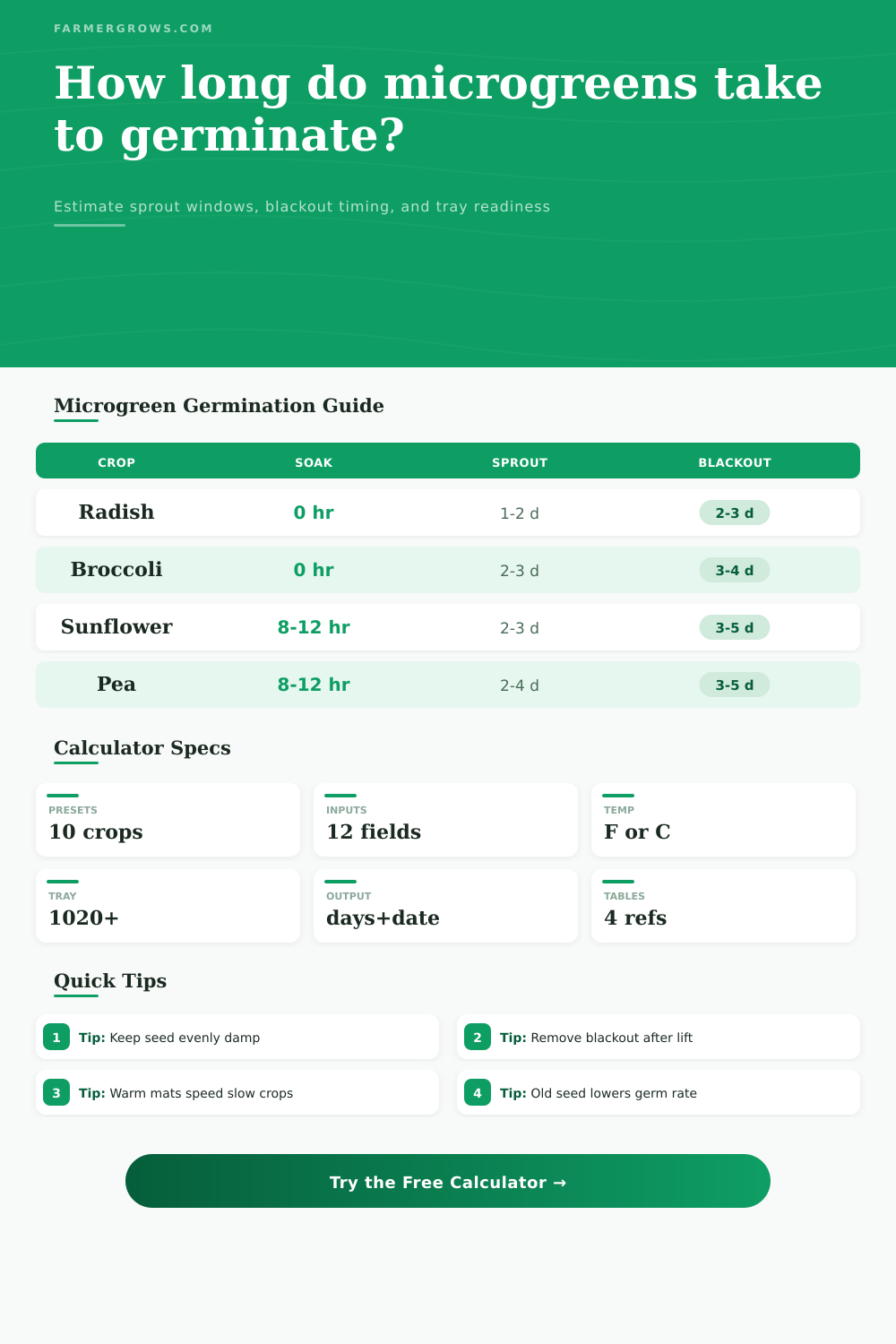
| Crop | Typical soak | First sprout | Blackout time |
|---|---|---|---|
| Broccoli and brassicas | 0 hours | 2 to 3 days | 3 to 4 days |
| Radish | 0 hours | 1 to 2 days | 2 to 3 days |
| Sunflower | 8 to 12 hours | 2 to 3 days | 3 to 5 days |
| Pea shoots | 8 to 12 hours | 2 to 4 days | 3 to 5 days |
| Basil | 0 hours | 4 to 6 days | 5 to 7 days |
| Cilantro, split seed | 6 to 10 hours | 4 to 7 days | 5 to 8 days |
| Temperature range | Effect on timing | Risk | Best action |
|---|---|---|---|
| 55 to 60°F | 20% to 45% slower | Patchy trays | Use gentle bottom heat |
| 65 to 75°F | Normal to fast | Low risk | Keep moisture even |
| 76 to 80°F | Fast start | Mold if wet | Vent daily and avoid puddles |
| Above 82°F | May stress seed | Sour trays | Cool the shelf or shorten blackout |
| Tray choice | Approx area | Broccoli seed | Sunflower seed |
|---|---|---|---|
| 5 by 5 tray | 25 sq in | 0.13 oz | 1.0 oz |
| 1010 half tray | 100 sq in | 0.5 oz | 4.0 oz |
| 1020 tray | 200 sq in | 1.0 oz | 8.0 oz |
| Custom tray | Your entry | Scales by area | Scales by area |
| Observation | What it suggests | Timing change | Next check |
|---|---|---|---|
| Seed coats cracked | Germination has started | Stay on schedule | 12 to 24 hours |
| Tray lifts cover | Roots and stems are pushing | Move toward light | Same day |
| Dry tray corners | Edges may lag | Add 0.5 to 1 day | Mist edges now |
| Sour smell or fuzz | Too wet or stale air | Shorten blackout | Vent immediately |
Check the tray surface, not just the dome. Condensation can look reassuring while corners dry out. Lift the cover briefly and mist only the areas that are losing moisture.
Use the blackout end as a crop cue. Remove weight or domes when the tray lifts evenly, not when only the fastest corner is tall. That keeps stems more uniform.
Looking at those wet seeds huddled in the darkness can make you antsy. “It’s been an hour and all I see is some wetness on the surface,” you think. “I guess there’s nothing more to do then wait until it sprouts.” Lift the lid a little too soon? Don’t move too fast; the seed hasn’t woken up yet. That’s why the above calculator attempts to stop that panic by providing a reasonable time frame for you, not some arbitrary internet-wide average based off a typical set-up, but yours.
Growing microgreens revolves around that blackout phase, which has been misinterpreted as “just wait.” Instead, it’s the part where biology go to work. Why? Because the seed has to strain to get its shoot up and its root down, an act of strength. When you take away the dome or the weight early, what happens? The plant will stretch out weakly toward the light before anchoring itself with a good root system. That’s the moment… The magic lift, that the tool allows you to locate. It makes you shift from guesswork to close observation of physical indications: the tray pushing on the cover.
Why You Should Use the Microgreens Calculator
The second part of this haggling process, perhaps even more than most expect, is the temperature. The temperature, whether it is a heated mat or a cool 60-degree concrete floor, affects the rate of progress: One tray on a warm surface will advance much faster then another on a cold one. Because that temperature environment is also part of equation in the sprouting window, the calculator takes it into account and adjusts the predicted start date to match. Why? Because you want to know when those initial roots has anchored so you can plan your harvest moment. And if you think it’ll be three days like with broccoli (or whatever), but your room’s chilly, you may have to wait until some of those sprouts is still snoozing.
Another rookie mistake is moisture: Keep it moist (not soggy) all the time. Any condensation under the dome appears as if something is happening, but may be masking some really dry areas where nothing happen. The device adapts to your setup, whether the seed is under a weighted stack, in a sealed plastic dome, or just loosely covered. It considers how you control humidity and how that affects airflow and drying speed on the surface. This is a factor in success or failure. If one edge goes dry it’s a dead end. With this tool you know when an edge is likely to get that way…before it gets there. Misting then saves the day.
There’s also one other silent killer to the hobby: seed age. A fresh packet of seed, straight from its package, will do what we expect it to. But if you’re using old seed from your pantry, where it has warmed during some part of the year, you’ll need to be patient (and you’ll probably get a patchy-looking canopy). You can account for this in the calculator by choosing “older” seed… Which reduces the assumed germination percentage. It’s a nice dose of reality. Remind yourself to manage expectations before cracking the tray open, because a germination rate of ninety percent are an ideal, not a promise.
A quick glance through the reference tables on the page gives you insight into what to expect from various crops: Peas and sunflowers, for example, are marathon runners (requiring a good soak), whereas brassicas such as broccoli and radish is sprinters. Then there’s basil, which is all its own animal and requires patience and warmth that seems extreme than the speedy radish. Knowing those baselines will help you plan when to plant things. If you want some radish and some basil ready to harvest within the same week, you don’t want to start the radish at the same time as the basil because radish grows faster.
But ultimately it’s a rhythmic process; one where after setting a baseline with the calculator, you start to rely on your eyes more. What does “healthy looking” mean when checking arugula? What about a sunflower? How many times should I wait until the soil dries out again between drinks? Does it matter if some spots is still dark (or not)? That’s how you learn to build strong stems, right? It’s the livig tray that shows you where it’s going, the numbers provide the map, but the observation provides the destination.
Believe the data. But always have your hand in the reality of the emerging green, the damp soil. You should of checked the moisture levels first.