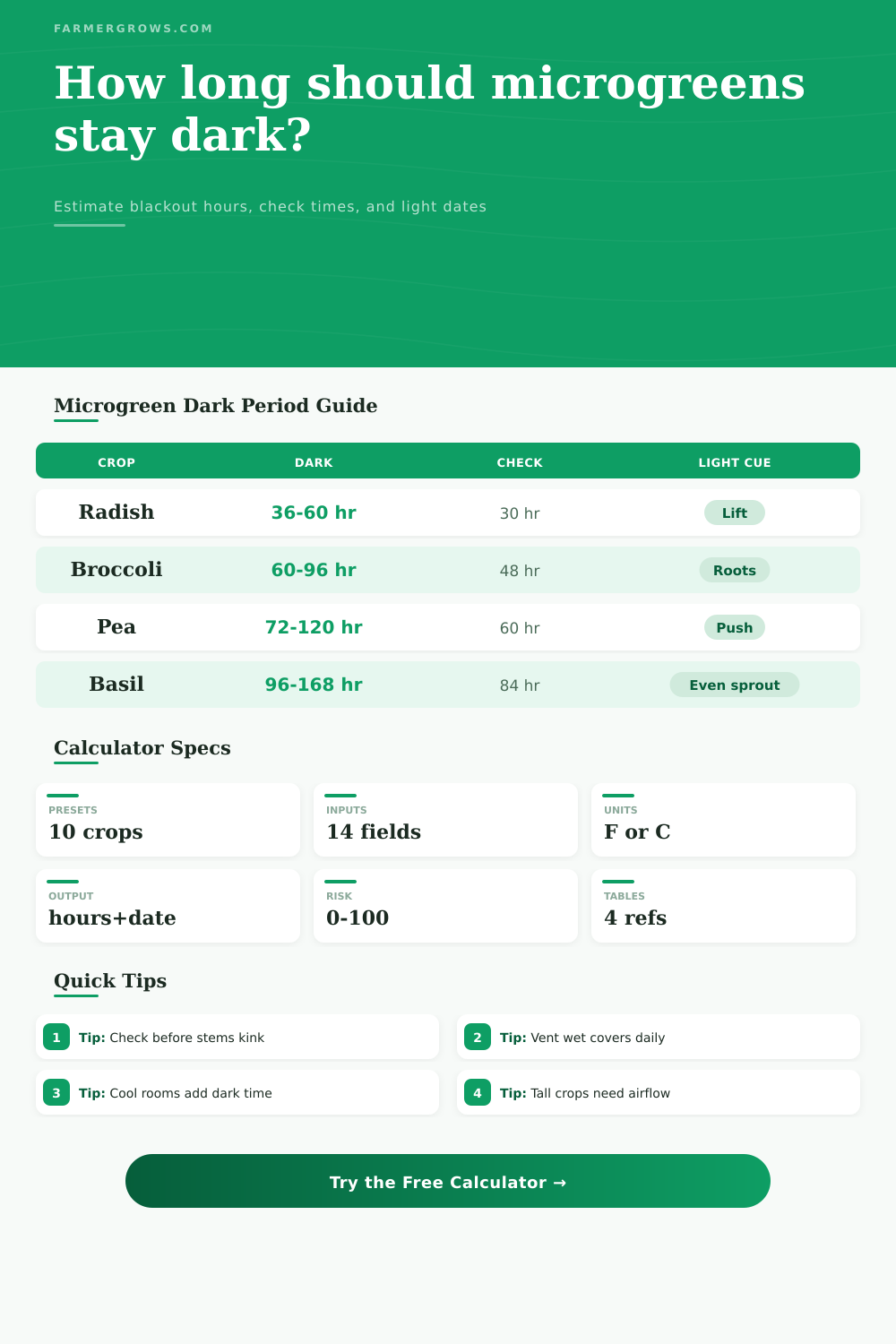
Microgreen Dark Period Calculator
Estimate when to check, uncover, and move microgreen trays into light using crop type, seeded time, room temperature, cover method, tray moisture, seed density, soak quality, and target stem style.
Pick a common tray plan, then adjust the exact conditions for your rack. The calculator estimates a practical blackout window, not a guarantee; uncover based on the tray cues in the result.
Dark period plan
Enter tray details to estimate the blackout window.
| Crop group | Usual dark period | First check | Best uncovering cue |
|---|---|---|---|
| Radish and mustard | 36 to 60 hours | About 30 hours | Canopy lifting cover, roots visible, stems not curling. |
| Broccoli, kale, cabbage | 60 to 96 hours | About 48 hours | Most seeds cracked with short pale stems and even surface lift. |
| Pea shoots | 72 to 120 hours | About 60 hours | Roots anchored, shoots pushing the tray, no sour smell. |
| Sunflower shoots | 72 to 120 hours | About 60 hours | Hulls lifting, roots knit into media, stems thick and pale. |
| Basil and slow herbs | 96 to 168 hours | About 84 hours | Small seedlings are even enough to light without drying. |
| Method | Timing effect | Best use | Watch for |
|---|---|---|---|
| Blackout dome or inverted tray | Neutral timing | Most small-seeded crops | Condensation, dry corners, uneven lift. |
| Weighted stack or nested tray | Slightly faster, stronger roots | Pea, sunflower, radish, wheatgrass | Compressed stems if left too long. |
| Loose dark cover | Often slower and less even | Small home trays and delicate seed | Light leaks and dry edges. |
| No true blackout | Shorter dark phase, weaker stretch | Emergency starts or very bright shelves | Uneven germination and short harvest stems. |
| Condition | Typical effect | Dark-period change | Handling note |
|---|---|---|---|
| 68 to 74 F shelf | Most crops germinate evenly | Use crop baseline | Check once daily unless trays are very wet. |
| Below 62 F shelf | Roots and shoots slow down | Add 12 to 36 hours | Use gentle bottom heat or expect a wide window. |
| Above 80 F shelf | Fast stretch and disease pressure | Check earlier | Vent covers and move to light before stems kink. |
| Heavy condensation | Moisture risk rises | Do not simply extend | Open briefly, drain puddles, and smell the tray. |
| Production style | Dark-period habit | Best crops | Planning use |
|---|---|---|---|
| Home salad tray | Check once daily after first sprout | Broccoli, radish, pea | Flexible harvest where exact stem height is less critical. |
| Chef garnish crop | Shorter blackout for color control | Mustard, arugula, amaranth | Move to light early for compact stems and stronger color. |
| Market tray rotation | Standardized check windows | Brassicas, sunflower, radish | Keep rack timing repeatable across seed lots. |
| Juice or shoot crop | Longer weighted dark start | Pea, wheatgrass, sunflower | Encourage root grip before high-biomass light growth. |
Use the result as a check window. Microgreens should leave darkness when the crop cue is present. If roots are weak, stems are curled, or the tray smells sour, adjust before chasing the exact hour.
Record each seed lot. Note room temperature, soak time, cover method, and the actual light date. After two or three trays, your own dark-period records become more useful than any generic chart.
Most microgreen failures happen in the first forty-eight hours, and most of those failure occur in the dark. No, the dark time’s no waiting game; it’s a calculated sprint.
Seeds bursts free of their coats and send down rootlets to anchor themself. They reach up to reach out to light, light they can’t yet see. Get your timing off and you’re stuck with fungal mats or weak leggy stems.
How to Time the Dark Period for Microgreens
A calculator (above) do the math for you, but knowing what that math means will save harvest. With all that information as input, the tool calculate how many hours of darkness is required. Remember: every tray are unique; what works for me may not work for you. How much moisture? What’s the temperature of room? What kind of cover are you using? Are the seeds old or fresh?
Metabolism increases with heat. If you leave those seeds cozy-warm but fail to extend darkness period accordingly, you’ll end up with puny exposed shoots. By the time they’re bathed in light, they’ve overgrown their seed leaf armor. The calculator compensate for thermal differences, so you don’t need to guesstimate an additional day here or there.
The other key is moisture. Why are the inputs asking about your condensation levels? And why does it matter how much cover you use? Putting a black-out dome over them is like creating greenhouse. That humidity will help those seeds swell and split apart. But if that humidity never escapes, what then? It’s also a perfect breeding ground for mold.
Check out the reference table on the page; it shows how different cover methods impacts timing. A weighted stack keeps stems upright and roots downward. Typically this speed things up different than using a loose cover that allows light to seep through.
Why? If there’s any light leaking in, the seed doesn’t know whether it’s still day or night; it figure the sun has risen, so it stops stretching and begins hardening off prematurely. The result is short and fat. This is good for certain salads, though it is not good for pea shoots, which you want to be tender and tall.
Most gardeners don’t think about another variable: seed age, until it’s too late. Seeds will sprout predictably fast, and with vigor if fresh. Stored at room temperature (as mine were when I kept some in my warm garage), old seeds is slow to gather their stashed energies.
To make up for it, the calculator adds seed age as a factor in prolonging its estimate of required dark time. It’s not a penalty, but simply patience. Two-year-old basil seeds, for instance, require more time to get up on their feet.
Force them into light prematurely, and your stand will be sparse and your plants will be weak. And never catch up. Better to wait just a dozen or so hours longer then risk delayed germination and lose more trays.
It gives you a number, called a risk score. It’s a warning system. It is not a guarantee. If your number are high, that means the conditions is leaning towards rot or stretch. That usually mean wet and stagnant air at higher temperatures.
In that case, the output could of advise you to vent the covers more or check sooner. All too many people think of the dark period as some sort of sealed box that they never open up.
Go look inside. Check the moisture level in real life. When you lift the corner of the tray when you go to do your check, is it dry? Too fast, you’re losing humidity. Is it dripping? Then you’re inviting disease. It’s a delicate balance.
But during the dark time, it’s about building a good base. In the dark time, the roots has to knit together. That way they’ll be strong enough to hold up the fast growth that occur under the lights. When you bring the tray out to light, you want a tight mat of seedling. Those seedlings will start making food right away.
If you wait too long, the seedlings gets spindly and pale. They’re trying to green up, but by then they may not be strong enough to support themself. Use the calculator to figure out how far along to go. You want to act when the roots is secure and the stems are barely starting to stretch upward.
Suddenly what was kind of a guessing game becomes something you can manage, something you can make a plan for. You set the conditions and then let the seeds take over. Listen to your eyes as well as the numbers.
A tray that stinks like sour milk? Time to open it and let some air in. A tray full of white and lush? Time to bring it outside. The numbers tell you what to do; your eyes tells you how it’s going.