🐔 Meat Chicken Feed Calculator
Estimate feed and bags for Cornish cross, ranger, dual-purpose cockerels, and heritage meat chickens using bird count, age window, FCR, pasture offset, target live or dressed weight, feed waste, and processing date.
Load a realistic flock plan, then adjust the age, strain, pasture credit, target carcass goal, and bag size for your farm. These presets are built for meat-chicken processing plans, not a single commercial broiler phase.
Meat Chicken Feed Estimate
Feed is calculated from live gain, strain FCR, feed phase mix, pasture offset, and waste allowance.
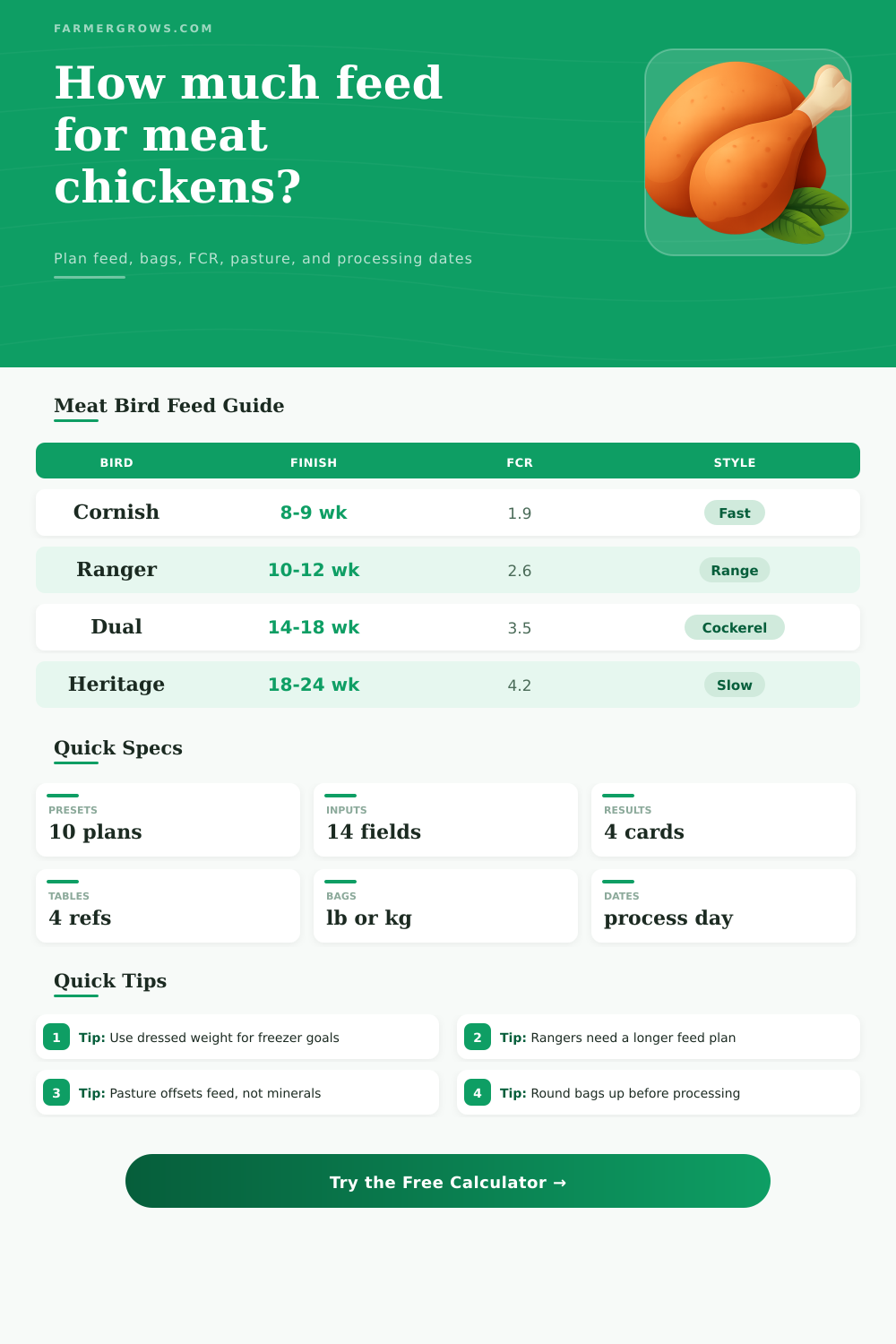
| Strain type | Typical finish age | Planning FCR | Dressed yield | Best use |
|---|---|---|---|---|
| Cornish cross | 7 to 9 weeks | 1.75 to 2.05 | 68% to 72% | Fast freezer birds with high breast yield. |
| Ranger meat birds | 10 to 12 weeks | 2.35 to 2.85 | 66% to 70% | Pasture-friendly birds with more leg activity. |
| Dual-purpose cockerels | 14 to 18 weeks | 3.20 to 3.80 | 62% to 67% | Table birds from layer or homestead hatches. |
| Heritage roasters | 18 to 24 weeks | 3.90 to 4.70 | 58% to 64% | Slow roasting birds with firmer carcasses. |
| Phase mix | Starter feed | Grower feed | Finisher feed | Typical use |
|---|---|---|---|---|
| Fast meat bird | 24% of feed, 21% to 23% protein | 38% of feed, 19% to 21% protein | 38% of feed, 18% to 20% protein | Cornish cross and heavy roasters. |
| Range bird | 20% of feed, 20% to 22% protein | 42% of feed, 18% to 20% protein | 38% of feed, 17% to 19% protein | Rangers with outdoor movement. |
| Dual-purpose | 17% of feed, 19% to 21% protein | 39% of feed, 17% to 19% protein | 44% of feed, 16% to 18% protein | Cockerels and slower table birds. |
| Heritage long finish | 14% of feed, 18% to 20% protein | 36% of feed, 16% to 18% protein | 50% of feed, 15% to 17% protein | Long growing heritage roasters. |
| Pasture setup | Feed offset | When it works | Watch point |
|---|---|---|---|
| Stationary pen, bare run | 0% to 3% | Feed is almost the whole ration. | Do not credit bare dirt as forage. |
| Daily-moved tractor | 3% to 8% | Birds get fresh green pickings and insects. | Cornish still need full ration access. |
| Ranger paddock rotation | 6% to 15% | Active birds harvest clover, grass tips, and bugs. | Wet pasture can lower intake. |
| Orchard or cover crop range | 10% to 20% | Slow strains have time to forage daily. | Balance energy and predator risk. |
| Planning item | Formula | Example | Use in the calculator |
|---|---|---|---|
| Total live gain | Birds x live gain per bird | 50 birds x 5.7 lb | Feeds the base FCR calculation. |
| Feed to buy | Gain x FCR - pasture + waste | 541 lb before rounding | Final total on the first result card. |
| Bag count | Total feed / bag size | 541 lb / 50 lb = 11 bags | Always rounded up to whole bags. |
| Feed window | Finish age - starting age | 8 weeks - 0 weeks | Back-calculates plan dates from processing day. |
Dressed-weight freezer goals are useful, but feed conversion happens against live gain. This calculator converts dressed targets back to live weight before applying FCR.
Buying all feed as one ration can miss protein needs. Use the phase breakdown to stage bags near the week each ration starts.
Calculating the amounts of feed required for meat chickens involves several variable. The variables to consider include the strain of the meat chicken, the access that the meat chicken has to pasture, the target weight of the meat chickens, and the amount of feed wastes that will occur. A meat chicken feed calculator allow an individual to account for these variable to determine the amount of feed that will be required of the meat chickens.
Furthermore, the meat chicken feed calculator can account for the different feed requirements of the various strain of meat chickens. The strain of the meat chicken will have an impact on the amount of feed that is required. For instance, Cornish cross breeds of meat chickens reach there marketable weight in approximately eight weeks.
How to Calculate Feed for Meat Chickens
However, Ranger-type breeds of meat chickens will grow more than the Cornish cross breeds but require more feed to reach their marketable weight. Additionally, heritage roaster breeds of meat chickens take longer to reach a marketable weight, requiring four or five month of feeding to the chicken to reach a usable size. The meat chicken feed calculator allows an individual to account for these different breed by selecting the breed of the meat chicken.
The meat chicken feed calculator will account for the feed conversion ratio for that particular breed of meat chicken. In addition to the type of breed of meat chicken, another variable to account for is the weight of the meat chicken. An individual may want to determine the amount of feed require to allow the meat chicken to reach a target weight.
However, that target weight can be either the live weight of the chicken or its dressed carcass weight. A dressed carcass weight is the weight of the chicken after it has been processed. Therefore, if an individual enters the target weight of the dressed carcass into the feed calculator, the calculator will convert that weight to the live weight of the chicken.
The yield of the chicken will vary depending on the breed of the chicken. For example, a Cornish cross breed may have a seventy percent yield of the live weight of the chicken, while the heritage rooster may only have a sixty percent yield. Thus, the percentage of the yield will impact the amount of feed that the chicken require to grow to reach its target weight.
The third variable to account for within the feed calculator is the access that the meat chicken has to pasture. The access of the chicken to pasture will allow the chicken some “offset” to the amount of purchased feed that is required for the chicken. This is because the meat chickens will eat the bugs and the greens on the pasture.
Thus, an individual can expect some offset of five to twelve percent of the total feed requirements for the chickens. However, the offset should not be higher than twelve percent unless the meat chicken strain have slow growth rates. This pasture offset will be deducted from the total feed requirement that is determined by the meat chicken feed calculator.
Furthermore, the feed calculator will account for feed waste that may occur during feeding or storage of the feed. This allowance will ensure that the amount of feed ordered is enough for the meat chickens. The next variable to consider with the feed calculator is the different phase that the meat chickens will be fed.
For example, the person will use starter feed for young meat chickens because it contains more protein. As the meat chickens age, grow, and gain more mass, grower feed will be used. Finisher feed will be used after the meat chickens have reached the majority of their marketable weight.
An individual should not use only starter feed to feed all of the meat chickens, as the feed is expensive. Additionally, the individual should not use only finisher feed for the meat chickens, as finisher feed does not contain the amount of protein required for the young meat chickens to grow adequately. Thus, a feed calculator will help an individual determine the proportion of each type of feed that needs to be ordered for the grow weights of the individual chickens.
The processing date of the meat chickens is another variable within the feed calculator. The processing date will help an individual to determine the timeline that is required for the growing of the meat chickens. If an individual enters the date on which the chickens are to be processed into the feed calculator, the calculator will work backwards from that date to determine when the meat chickens should hatch from their eggs and when each phase of feed should be provided to the meat chickens.
Thus, planning the feed for the chickens allows an individual to establish a schedule for feeding and slaughtering the meat chickens. Finally, another important consideration of the meat chicken feed calculator is that it will provide an individual with a planning number as to the amount of feed that will be required for the chickens. However, it will not provide any guarantee as to the amount of feed that the chickens will actualy consume.
Various factors will impact the actual feed consumption of the chickens, such as the temperature at which the chickens are raised, the height of the feeders, and the health of the meat chickens. Thus, an individual should use the feed calculator to determine the amount of feed to initially purchase for the meat chickens. Furthermore, the individual should feed the meat chickens for the first two weeks of their lives and determine how much feed is consumed.
Based off that measurement, the individual can adjust the amount of feed that is ordered for the remainder of the lives of the chickens.