Mare Breeding Calculator
Plan cover or insemination dates, optional ovulation timing, foaling windows, early pregnancy checks, vaccine reminders, foaling kit prep, and the first rebreed heat estimate.
Use this calendar with your veterinarian and mare records. Individual mares can foal outside the planning range, and twins, uterine fluid, placentitis risk, nutrition, age, transport, and farm health protocols can change real dates.
Mare Breeding Calendar Results
Dates are calculated from the cover or ovulation date, selected breed range, ultrasound timing, vaccine lead time, and first rebreed heat estimate.
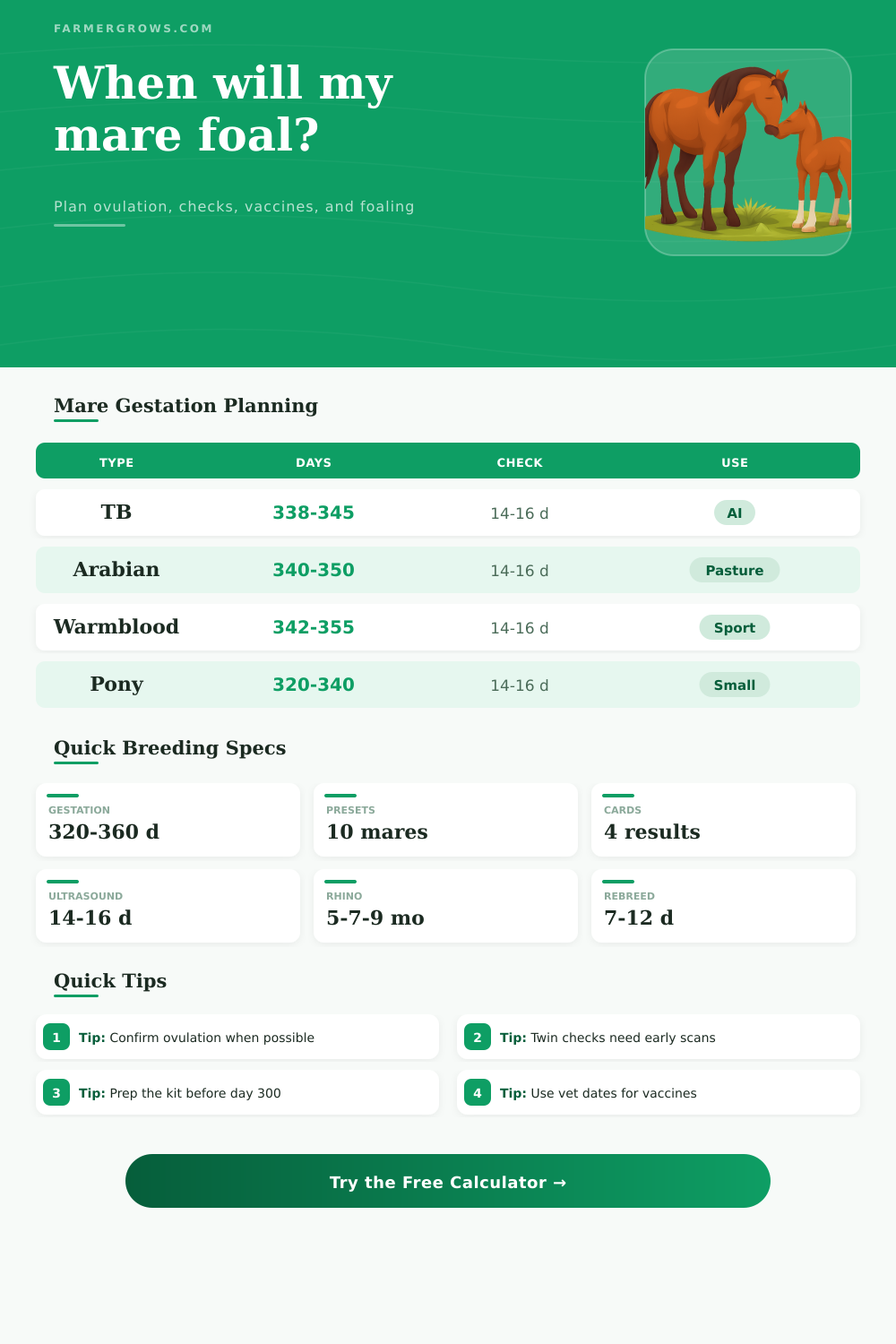
| Breed or type | Typical gestation | Planning range | Calendar note |
|---|---|---|---|
| Thoroughbred | 340 days | 320 to 360 days | Use ovulation date when breeding is closely monitored |
| Quarter Horse | 342 days | 320 to 360 days | Live cover, cooled semen, and AI records all matter |
| Warmblood | 345 days | 325 to 365 days | Sporthorse mares may be managed with longer planning buffers |
| Arabian | 345 days | 325 to 365 days | Review the mare's prior foaling history if available |
| Pony | 330 days | 310 to 350 days | Small mares can be earlier than large-horse calendars |
| Miniature horse | 325 days | 300 to 345 days | Use close surveillance because small mares can vary widely |
| Pregnancy check | Common timing | Purpose | What to record |
|---|---|---|---|
| Early ultrasound | Day 14 to 16 | Confirm pregnancy and identify twins early | Vesicle size, location, and twin status |
| Heartbeat check | Day 25 to 30 | Confirm viable pregnancy development | Heartbeat, tone, fluid, and luteal support plan |
| Recheck scan | Day 45 to 60 | Catch early loss and update due date records | Embryo status and next farm reminders |
| Optional fetal sexing | Day 60 to 70 or 110 to 130 | Performed only when requested and available | Exam date and veterinarian finding |
| Vaccine or health window | Calendar timing | Common reason | Planning caution |
|---|---|---|---|
| EHV-1 rhinopneumonitis | Months 5, 7, and 9 | Used on many farms to lower abortion risk | Follow local veterinarian protocol and product label |
| Prefoaling vaccines | 4 to 6 weeks before due date | Boost colostral antibodies before foaling | Time from the expected due date, not the late edge |
| Deworming review | Late gestation as directed | Farm parasite control and foal exposure planning | Use fecal and farm program guidance |
| Foaling area prep | By day 300 or earlier | Clean stall, cameras, supplies, and contact list | Move mares before they are close to foaling |
| Mare status | Breeding focus | Risk to watch | Management step |
|---|---|---|---|
| Maiden mare | Confirm cycles and foaling behavior | Unpredictable udder and foaling signs | Increase late-gestation monitoring |
| Open or barren mare | Find ovulation and uterine clearance | Fluid, infection, or poor timing | Scan and treat before repeated covers |
| Lactating mare | Foal heat or delayed rebreed plan | Uterus not ready after difficult foaling | Breed only after a satisfactory exam |
| Recipient mare | Match ovulation timing to embryo age | Synchronization mismatch | Use program-specific transfer records |
For date accuracy: Base the foaling calendar on confirmed ovulation whenever possible. Cover dates are useful, but ovulation timing tightens the window for ultrasound and due-date planning.
For safety: Treat this as a planning tool, not a diagnosis. Call your veterinarian for twins, discharge, colic signs, premature udder development, or any abnormal late-pregnancy change.
A breeding calculator are a tool that will help a person to plan the breeding of their mare. Planning a breeding calendar for a mare require that a person makes a decision about a variety of different factors. Each of those inputs into the breeding calculator will help to create a breeding calendar for the mare.
For instance, a person must make a decision about each of the mare related details and the breeding method details in order to ensure that the breeding calculator creates accurate date for the breeding calendar. Each of the small decisions that are made early in the breeding process will impact factors like when an ultrasound should be performed of the mare, or when vaccine should be administered to the mare. One of the factors that a person must consider when using a breeding calculator is the breeding method that will be used for the mare.
How to Use a Mare Breeding Calculator
For example, live breeding will ensure that the mare has been bred on a specific date, but the breeding of a mare on pasture will lead to uncertainty in the dating of when the mare was bred. Additionally, frozen semen breeding method will require that a person frequently monitor the mare for follicles in order to ensure that breeding with frozen semen occur at the proper time of the breeding cycle. By entering the breeding method into a breeding calculator, the breeding calculator can adjust the breeding calendar for that mare to reflect those changes.
The breed of the mare and the type of mare can also lead to changes in the length of the gestation period of the mare. For example, ponies and miniature horse tend to have shorter gestation periods than draft and warmblood horse breeds. Additionally, a mare that has foaled at least one foal prior to can often have a gestation period that is similar than those prior to gestations, while a maiden mare may exhibit different physical changes during pregnancy due to the fact that the mare has not yet foaled before.
Each of these factors can be entered into the breeding calculator, which will use the information to create a foaling window that reflects the difference between breeds and reproductive statuses of the mare. A breeding calculator will calculate the date on which the mare is expected to early foal, the date on which the mare is expected to late foal, and the typical date on which the mare will foal after entering the cover date or the ovulation date of the mare. Each of these dates will help to ensure that the mare is prepare for foaling, and that the mare is scheduled to receive prefoaling vaccines.
Prefoaling vaccines help to boost the amount of colostral antibodies in the mare’s body. The breeding calculator can also determine the date on which the mare should receive its first ultrasound, which is typically between 14 and 16 days after ovulation. Additionally, a person can schedule additional ultrasounds to detect if the mare is pregnant with twins, and the heartbeat will be visible during another ultrasound between 25 and 30 days after ovulation.
The breeding calculator will create these reminder in the schedule. In addition to planning the breeding of the mare and the afterbirth of the foal from the mare, a breeding calculator can be used to create a rebreed plan for the mare. For instance, lactating mare can become pregnant again as early as seven days after foaling their babies.
Based off the date on which the mare was expected to early foal and the date on which the mare was expected to late foal, the breeding calculator can estimate when the mare will become pregnant again. Additionally, if the mare is an older mare, or if the mare typically retains fluids in its body, additional ultrasounds may be required before breeding the mare again. Outside of the breeding calculator, however, there are still additional factors that a person must consider in regard to the breeding of the mare.
For instance, if the mare develops an udder that fills with milk prior to the early foaling date of the mare, or if the mare exhibits any signs of premature changes to its mammary system, a veterinarian should be called regardless of the dates calculated by the breeding calculator. If the mare is bred with twin foals, the births of those twins will change the plans that are established after the breeding with the semen of the stallion. Each of these additional factors have the potential to impact the pregnancy and birth of the foal of the mare, but in ways that cannot be accounted for in the breeding calculator.
Thus, the breeding calculator is more valuable in ensuring that a mare owner remembers each of these important dates, and in providing structure to the breeding owner to remove the mental load of remembering each of these dates.