Maple Trees Per Acre Calculator
Estimate maple trees per acre, plantable tree count, row layout, reserve seedlings, long-term crown fit, tappable trees, spile count, and sap flow planning from acreage and spacing.
Choose a maple planting plan, then adjust the block shape, spacing pattern, headlands, survival rate, thinning goal, crown diameter, tubing rows, and sap assumptions for your site.
Wide spacing favors large crowns, tubing access, and long-term sap production per tree.
Moderate spacing starts more stems per acre so thinning can select straight, vigorous maple crop trees.
Tighter establishment can offset browse, drought loss, and competing vegetation on open land.
Close rows increase inventory count, but the calculator separates that from mature crown spacing.
Maple Tree Spacing Results
Your maple density and order quantity will appear here.
| Maple spacing | Square grid trees/ac | Triangular grid trees/ac | Common planning use |
|---|---|---|---|
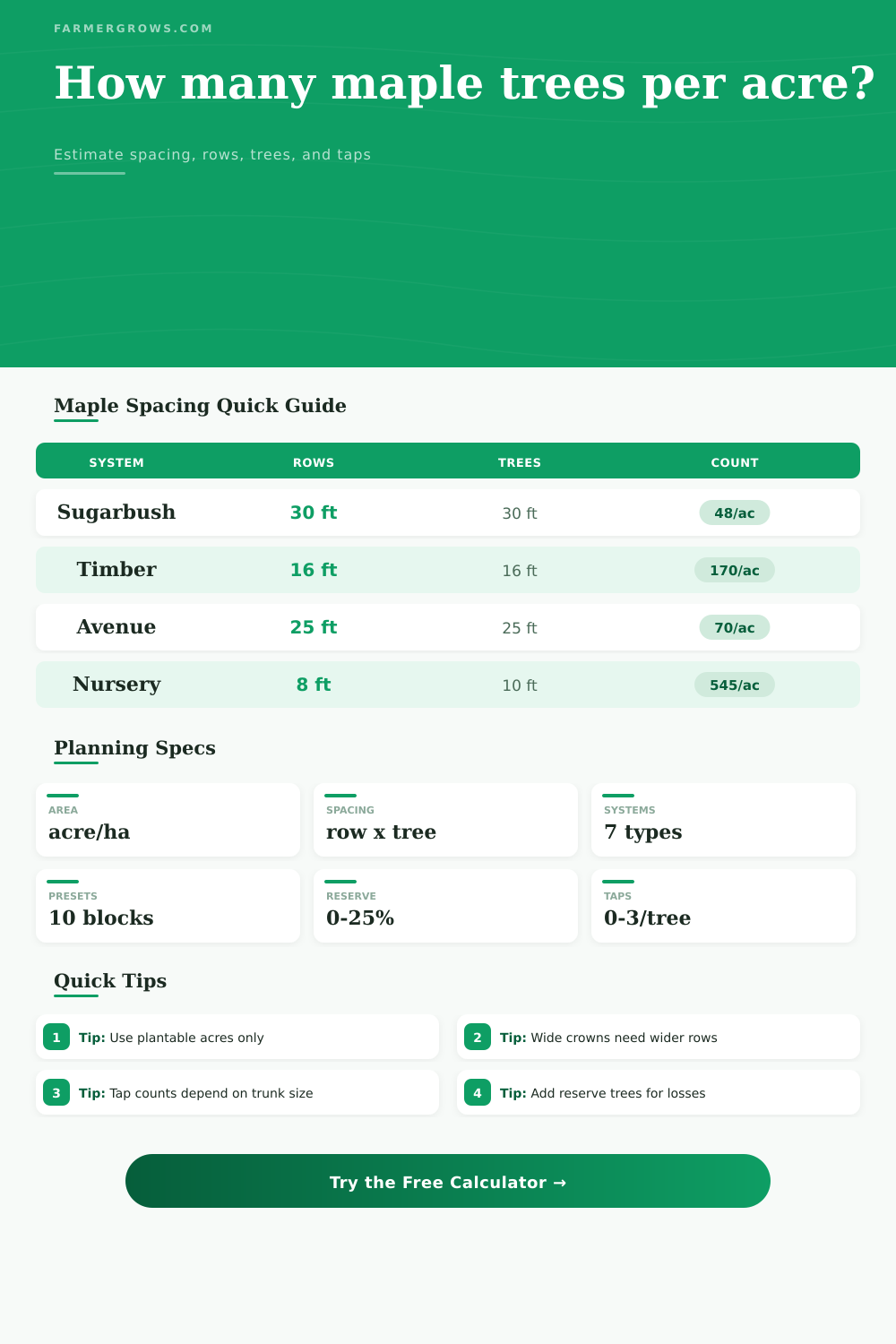
| 8 x 10 ft | 545 | 629 | Nursery liner rows or short-term transplant production. |
| 12 x 12 ft | 303 | 349 | Restoration planting, browse allowance, or early timber selection. |
| 16 x 16 ft | 170 | 196 | Timber-oriented hard maple establishment with later thinning. |
| 20 x 20 ft | 109 | 126 | Hybrid maple, open woodland, or managed mixed planting. |
| 25 x 25 ft | 70 | 81 | Open grove, shade maple, or low-density sugarbush start. |
| 30 x 30 ft | 48 | 56 | Sugarbush crown spacing with easy tubing and equipment lanes. |
| 40 x 40 ft | 27 | 31 | Specimen trees, parkland spacing, or very wide maple avenue. |
| Maple type | Typical spacing | Mature crown check | Planning note |
|---|---|---|---|
| Sugar maple sugarbush | 25 to 35 ft | 40 to 55 ft | Lower density supports larger crowns and practical tubing corridors. |
| Black maple | 28 to 35 ft | 45 to 55 ft | Similar to sugar maple where heat and drought tolerance are useful. |
| Red maple wet site | 18 to 25 ft | 35 to 45 ft | Often used where soils are wetter or sugar maple vigor is limited. |
| Silver maple riparian | 20 to 30 ft | 45 to 60 ft | Fast growth and broad crowns need generous room in permanent stands. |
| Hard maple timber | 12 to 18 ft | 35 to 45 ft | Dense starts are normally thinned before crown closure becomes severe. |
| Nursery maple liners | 6 to 10 ft | 10 to 16 ft | High density is temporary and should not be read as final field spacing. |
| Future trunk class | Average taps | Use in calculator | Practical caution |
|---|---|---|---|
| Young non-tappable trees | 0 | Lower tappable share | New plantings may take many years before tapping is appropriate. |
| Small tappable trees | 1 | Default estimate | Use conservative tap counts when diameter distribution is unknown. |
| Mixed mature stand | 1.25 to 1.5 | Moderate estimate | Works for stands with a mix of one-tap and larger two-tap trees. |
| Large-crown sugarbush | 2 to 3 | High estimate | Only use for vigorous mature trees that meet local tapping guidance. |
Separate establishment density from final sugarbush density. A tight planting can be useful early, but long-term syrup production needs crown light and workable lanes.
Use plantable acres, not deeded acres. Exclude ponds, rock ledges, stream buffers, roads, wet pockets, and turning space before ordering maple seedlings.
Growing a timber stand or a sugarbush is a long game. You need to plan in geometry; you need to be patient. You are investing your time today so that in about 20 years, when these trees has grown large enough to spread their branches, they will be soaking up the sun.
It’s easy to want to jam every last seedling onto an acre because the nursery’s price-per-tree feels like money down the drain if you don’t use all of the area. But maple trees are no diplomats: They vie for resources with one another. Plant them too thickly and you have a forest of spindly sticks, which may impress for several years until they begin to choke themselves out. It is a small detail but it is still significant. Spacing makes all the difference between a thicket and a grove.
Why Spacing is Important for Your Trees
Thirty by thirty feet are a common spacing for a traditional sugarbush. It’s quite a lot of nothin’, I know, but that’s what mature sugar maples requires to grow giant, light-catchin’ canopies that pump sap. In timber stands, they typically begin tighter, say sixteen by sixteen feet, to promote straight growth near the base.
The compromise should of been obvious. Widely spaced trees cost more at planting time (fewer acre of them), but you’ll have larger individuals that reach target volumes sooner. Tightly planted stems will add up fast, yet eventually you’ll have to cull heavily if you hope for anything bigger then middlin’. Do you want a few big champions or a crowd of middling ones?
Most first-time buyers neglect the land itself. The deed may indicate that you’ve purchased ten acres, but half of it could be wet hollows and rock outcrops and places where you can’t operate a tractor or string tubing lines. By subtracting the gross from the net, you’ll avoid a jolt of surprise once your seedlings arrives.
Survival rates matter, too. No matter how well you treat them, some seedlings is bound to die from drought, deer, or poor root development. Don’t think this means you’re being pessimistic if you order a few more trees as a cushion. Think of it as good housekeeping.
Once trees are past survival mode, then it’s all about production. In the case of syrup making, it’s time to think about taps. Not every surviving tree are a good candidate for tapping. Only those with sufficient trunk diameter and vigor will produce reliably.
Once you input your spacing and area, the rest of the math (conversions & coefficients) happens automatically with the calculator above. This way you don’t have to guess. Instead, you can get an idea of how many trees will ultimately reach tapping age… Versus being removed by thinning or turned into firewood.
Then there’s the tubing set up that makes it all complicated. The lanes has to be ample for lateral lines and other tubing infrastructure. What if your lanes are so skinny that no one can get in to tend to them, let alone fit their hands inside to try to put in plastic tubing? A twenty-five foot row width is often a sweet spot for balance: it keeps the canopy dense enough while leaving room for human intervention.
On the same page it has a chart that explains how spacing affects everything: number of trees in a nursery block or number of trees in mature timber. Eight by ten? Forty by forty? These are two completely different things. They are two different ways of looking at a shade grove versus a nursery block. They’re both good, just not the same thing. One’s for inventory and fast turnover, the other’s for individual specimen beauty and legacy.
So in the end, spacing isn’t an exercise in counting seedlings that will fit into the bag right this second. It’s a promise you’re making to the future, how much light do you want each tree to recieve when it’s thirty years old? The cost of the plants is instantaneous; the canopy closure a decade from now is more difficult to picture. But that’s what you’re actualy buying: that imaginary canopy. Work back from the mature tree to the seedling, go where the biology leads, and let the numbers catch up.