Mango Trees Per Acre Calculator
Estimate mango tree density, usable planting acres, row layout, grafted tree orders, reserve trees, canopy fit, and reverse acreage from spacing and orchard-management assumptions.
Use plantable land, not just deeded acreage. Mango blocks often lose space to drains, headlands, access roads, windbreaks, irrigation mains, contour breaks, and packing or spray lanes.
Mango density plan
Results update when you calculate.
| Mango system | Typical spacing | Clean trees/ac | Clean trees/ha | Planning note |
|---|---|---|---|---|
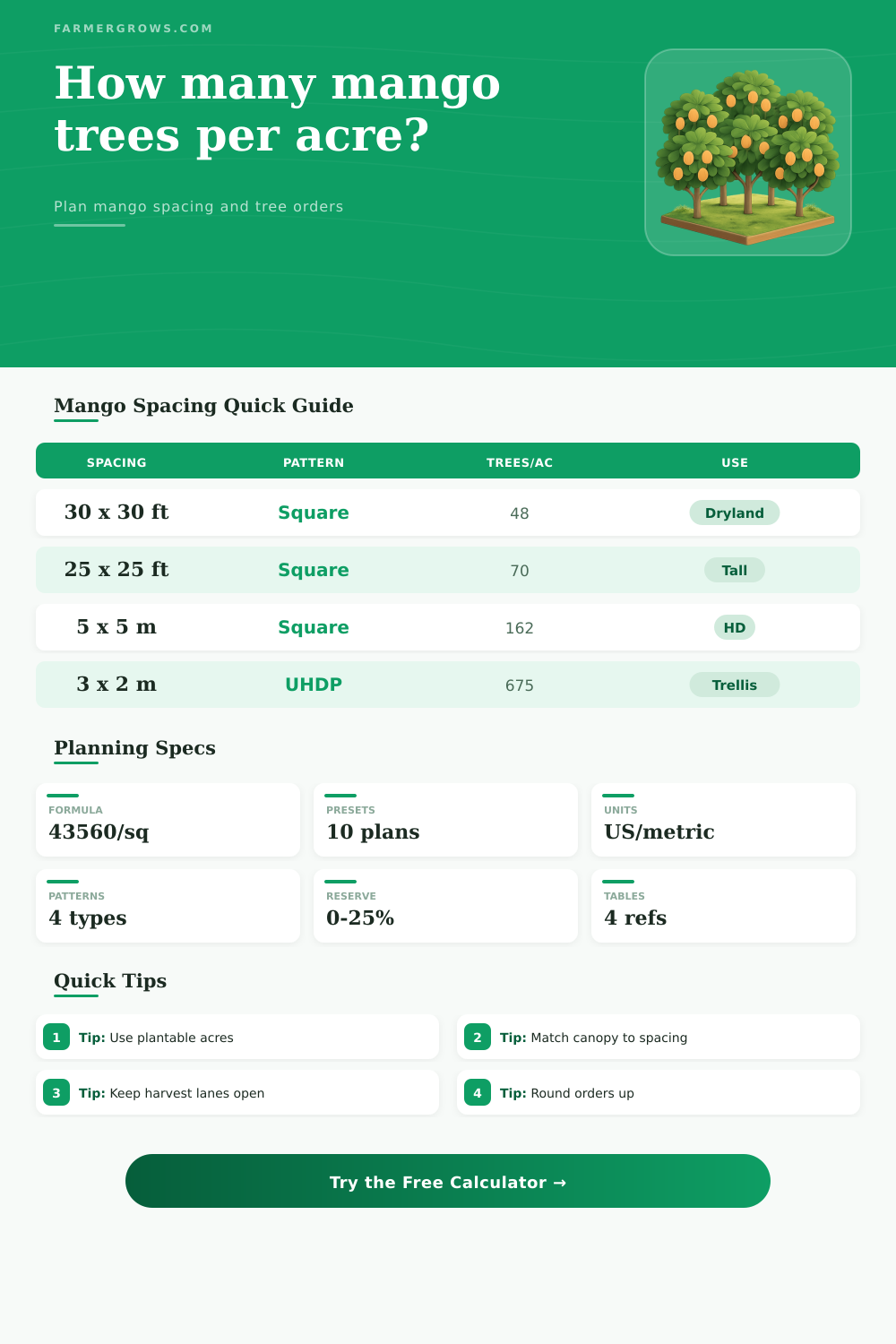
| Traditional dryland | 30 x 30 ft | 48 | 120 | Wide spacing for large canopies and limited water |
| Standard grafted | 25 x 25 ft | 70 | 172 | Common open orchard spacing with broad access |
| Medium density | 20 x 20 ft | 109 | 269 | Needs regular canopy management as trees mature |
| High density | 15 x 15 ft | 194 | 478 | Pruning and light management become central |
| Metric high density | 5 x 5 m | 162 | 400 | Useful benchmark for intensively managed mango |
| UHDP hedgerow | 3 x 2 m | 675 | 1,667 | Requires strict pruning, irrigation, and variety fit |
| Planting pattern | Calculator factor | Density effect | Use when | Watch point |
|---|---|---|---|---|
| Square or rectangle grid | 1.000 | Standard density | Most mango orchards with straight rows | Simple staking and irrigation layout |
| Triangular staggered grid | 0.866 | About 15% more trees | Dense field layouts with careful staking | Harder mowing and line layout |
| Continuous hedgerow | 0.950 | About 5% more trees | UHDP or narrow canopy wall systems | Needs disciplined side pruning |
| Wide alley or intercrop | 1.120 | About 11% fewer trees | Vegetable alleys, machinery lanes, or contour blocks | Gross acres may look less dense |
| Gross area | 25 x 25 ft | 20 x 20 ft | 15 x 15 ft | 5 x 5 m |
|---|---|---|---|---|
| 0.25 acre | 17 trees | 27 trees | 48 trees | 40 trees |
| 0.50 acre | 34 trees | 54 trees | 97 trees | 81 trees |
| 1.00 acre | 69 trees | 108 trees | 193 trees | 161 trees |
| 2.00 acres | 139 trees | 217 trees | 387 trees | 323 trees |
| 5.00 acres | 348 trees | 544 trees | 968 trees | 807 trees |
| Allowance item | Low | Typical | High | Use when |
|---|---|---|---|---|
| Headlands and roads | 5% | 8% | 15% | Tractors, sprayers, trailers, or harvest crews need turning space |
| Drains and irrigation mains | 2% | 5% | 10% | Water control lines cross the block or contour drains are wide |
| Windbreak and boundary setback | 3% | 6% | 12% | Hedges, roads, neighbors, or power lines reduce edge planting |
| Establishment replacement | 5% | 8% | 15% | Use more for hot planting windows, salinity, or wildlife pressure |
| Nursery order reserve | 3% | 7% | 15% | Extra grafted trees allow sorting, replanting, and transport damage |
Spacing is a pruning promise. A 5 x 5 m mango block can work only when height, skirt, and side growth are managed before canopies close over the row middles.
Order trees from usable acres. Deduct turn rows, drains, windbreak setbacks, pump pads, and loading areas first, then add replacements and reserve trees to the final nursery order.
How do you plan a mango orchard? Before any digging even begins, it’s an exercise in imagination: a grid drawn on paper, then a vision of rows stretching out. Each foot of space you give will affect how you operate. It is not just about tree-planting; it is a system of pruning, harvesting, and cash flow.
Enter your measurements into the mango trees per acre calculator, and let it do the math for you, no need to guess at conversions, coefficients. Avoid the mistake of underordering stock or overplanting by knowing why these figures matter.
How to Plan Your Mango Orchard
Growers typically begin with an estimate of how many they’ll need based off a set number of trees per acre, without first taking into account their land’s shape. In the real world, fields is seldom rectangles. Spaces are used as windbreaks along the edges. There are also tractor access roads and drainage ditches that don’t produce. You might have a nice-looking number of trees penciled out, but it won’t work in the field if you fail to factor those real-world situations. The calculator provides a way to subtract a percentage for the unproductive sections so you can order trees for what’s realy there rather than what’s on your deed.
How far apart? That’s a promise to yourself for the long haul. For example, with classic dryland mangoes planted at traditional spacing, such as thirty by thirty feet, the tree canopy grows freely, but water is scarce. Fewer trees up front, but if they are carrying well, you have less total fruit per acre.
With narrower spacing (below), you can create much more density. In ultra-high-density systems, you may have upwards of six hundred trees per acre. But it mean very strict pruning, to keep canopies from shading out their neighbors. You get more yield intensity at the cost of easier manageability.
Plug your dimensions into the tool, which tell you how many trees would fit in each situation. See what kind of work it is before you invest in the grafts.
Many of us don’t realize how important the pattern is. For example, a standard square layout are easy to irrigate and to stake. Triangular (with staggered rows) gets roughly fifteen percent more trees in an equal area. It also uses its row spaces well. But it’s more difficult to spray and mow in the staggered arrangement. The calculator automatically accounts for these geometric differences.
Pick the pattern that fits your equipment. Straight-line patterns? Square grids are easiest. Do you want maximum density? Do you have enough worker? Triangular works best, with more fruit per acre.
Planning turns to reality when ordering grafted trees. Land size doesn’t factor into the equation; nurseries will only sell by the tree. Add a buffer count for replacement of those that fail. Also include reserves for sorting quality stock. Mangoes, especially young ones, are prone to pests, transplant shock, or heat stress. In hot climates, it’s not uncommon to lose ten percent of a block. Adding these buffers to your base count ensures no one will come back home with empty holes and no replacements.
It provides room for separate orders of your primary cultivars from alternate varieties. That could diversify market risk or help stagger harvest times.
So, what’s a canopy to do? It must make enough room for itself without smothering things. There is too much space. It is wasted area and wasted water, with bare ground growing nothing but weeds. If there are too few leaves, they close up on themselves and deprive the fruit of sun. Too many leaves mean more disease pressure, too. Success depends on how reliably you can irrigate; how disciplined you are with your pruning; and which rootstocks you choose.
Before the first tree goes in the ground, you would of wanted a game plan that considers all those factors. How dense should a canopy be? As dense as you’re willing to manage, not as dense as you want it to look. Properly spaced, an orchard feels full, while also feeling open. It is productive but breathable.
That’s the balance that transforms a group of trees into a workable system. That balance rewards you year after year.