Mango Tree Time to Bear Fruit Calculator
Estimate when a mango tree should flower, hold its first crop, and reach a reliable harvest window using propagation, cultivar season, canopy size, dry-rest quality, climate warmth, and pollination.
🥭Mango Bearing Presets
Choose a realistic mango-growing situation or enter your own tree details. Presets fill the calculator and update the estimate immediately.
⚙Tree And Bearing Inputs
Your Mango Bearing Estimate
Enter your mango tree details to estimate first bloom, harvest timing, and fruit-set confidence.
📊Propagation Comparison Grid
Most reliable path to early bearing because the scion is already mature wood from a known cultivar.
Can flower early, but root structure and transplant recovery often decide whether fruit is held.
Often closer to the parent than monoembryonic seedlings, though bearing age still varies by vigor.
Longest and least predictable route; fruit quality and season may differ from the parent mango.
🌱Mango Bearing Factor Scores
📘Reference Tables
| Propagation | First Bloom | First Harvest | Bearing Notes |
|---|---|---|---|
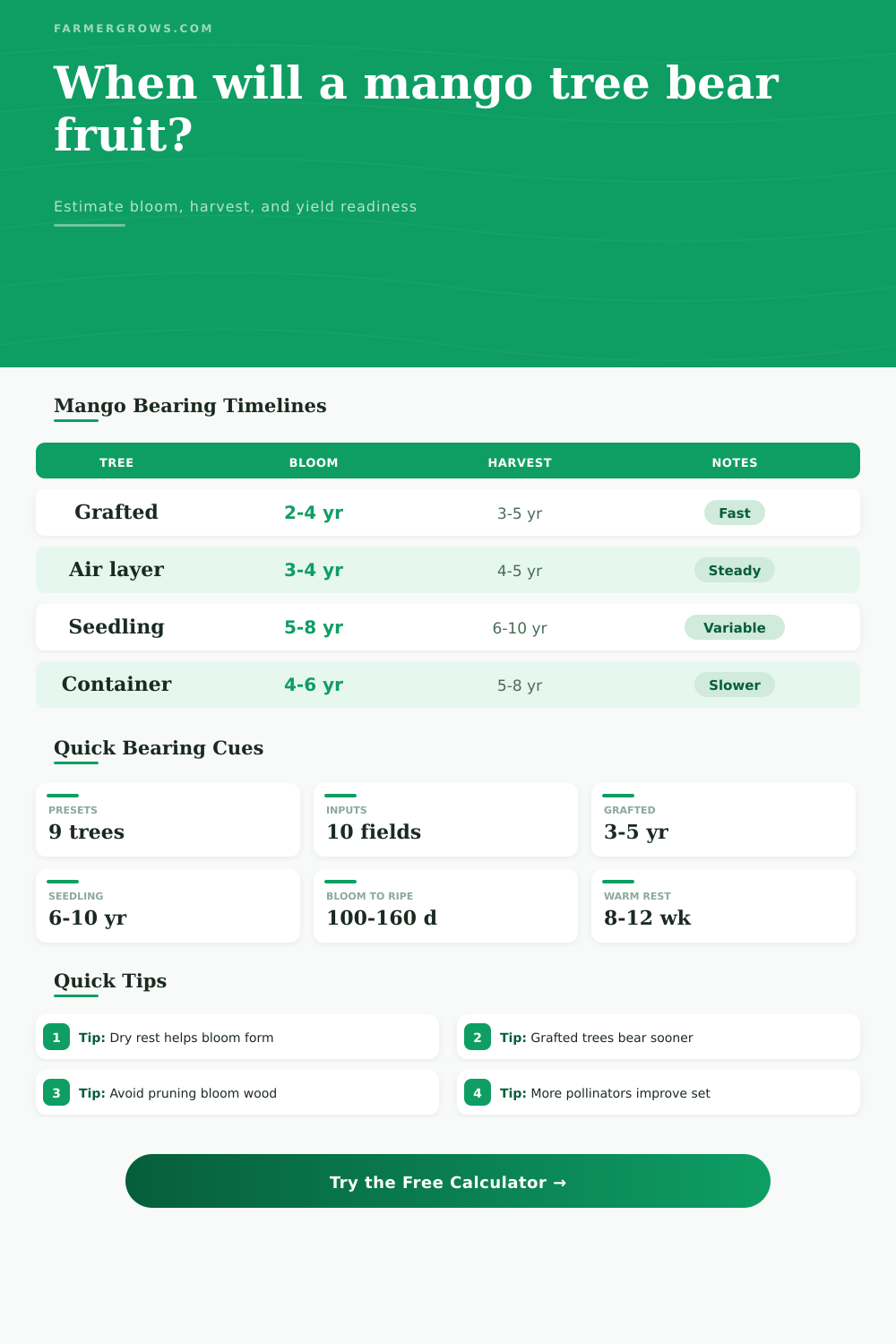
| Grafted nursery tree | 2-4 years after planting | 3-5 years after planting | Best for predictable cultivar season and earlier fruiting. |
| Veneer grafted scion | 2-4 years after planting | 3-5 years after planting | Strong if the graft union is established and canopy is not over-pruned. |
| Air-layered or marcotted | 3-4 years after planting | 4-5 years after planting | May bloom early but needs steady root recovery to keep fruit. |
| Polyembryonic seedling | 4-7 years after sprouting | 5-8 years after sprouting | Often less variable than monoembryonic seedling mangoes. |
| Monoembryonic seedling | 5-8 years after sprouting | 6-10 years after sprouting | Slowest and most variable, especially in marginal climates. |
☀Climate And Bloom Trigger Table
| Site Pattern | Bloom Effect | Likely Delay | Fruit Set Risk |
|---|---|---|---|
| Hot frost-free mango climate | Strong seasonal flush maturity | 0-3 months | Low if bloom is dry. |
| Warm subtropical site | Good bloom with cool dry rest | 3-8 months | Moderate in rainy bloom periods. |
| Cool coastal or short summer | Delayed wood maturity | 8-18 months | Higher if flowers open in cold weather. |
| Very hot dry inland site | Can bloom, then shed fruitlets | 4-12 months | High during heat spikes and drought. |
| Marginal cold-prone site | Flower buds and tips may reset | 1-3 years | High after frost or cold rain. |
📅Cultivar Season And Harvest Window
| Cultivar Group | Season Habit | Bloom To Ripe | First Crop Behavior |
|---|---|---|---|
| Early dessert types | Earlier harvest after bloom | 100-125 days | Can bear soon but may set lightly while young. |
| Mid-season classics | Balanced bloom and harvest | 115-145 days | Often gives the steadiest first useful crop. |
| Late Kent or Keitt types | Longer fruit fill period | 135-160 days | Fruit hangs longer; young limbs need enough canopy. |
| Compact condo mangoes | Earlier in containers | 110-145 days | May flower small but should not be overloaded. |
| Tropical lowland types | Warm-season dependent | 115-150 days | Humidity can reduce fruit set without dry bloom weather. |
🔍Common Mango Scenarios
| Scenario | Best Estimate | Watch Point | Calculator Signal |
|---|---|---|---|
| 3-year grafted Alphonso in warm yard | Bloom soon to 1 year | Keep mature terminal shoots | High confidence if dry rest is strong. |
| 2-year dwarf mango in 20 gal pot | 2-4 years to useful crop | Root space limits fruit holding | Medium confidence until canopy widens. |
| 6-year seedling Haden-type tree | 0-3 years to first crop | Genetics and canopy maturity vary | Confidence rises after first panicles. |
| Late Keitt tree in humid site | 1-3 years to reliable crop | Rainy bloom can reduce set | Pollination and dry rest drive result. |
| Recently transplanted large mango | 1-2 seasons after recovery | Root repair before fruit holding | Transplant factor delays harvest. |
💡Bearing Tips
It takes a long time for a mango tree to produce fruit. Planting a grafted sapling and watching it push leaves for what feels like years are part of the wait. It won’t tell you, however, when it’s going to flower. That’s up to the tree. Whether it thinks it has enough energy to devote toward flowering.
Knowing that can help you adjust your expectations. With the estimator tool, there’s no guessing. Look up canopy size, the climate, and the way the tree was grown. How fast will it start bearing? Starting point of the tree matters here. If it’s a grafted tree, where a piece of a mature tree is joined to a young rootstock, the tree already know how to be an adult, which includes knowing how to flower. Grafted trees typically begins blooming in three years or less.
Factors That Affect Mango Tree Flowering
With seedlings (which aren’t a bad choice; see below), you’re starting from zero. You first need them to grow trunks and roots, and only then will they produces fruit. Don’t be surprised if your seedling take several years, eight, even; to begin fruiting. That’s not a sign of any kind of deficiency; just the plant growing as it should. Plan on waiting if you sowed a seed yourself. The calculator will factor this into its estimate, will it be a seedling or a grafted tree?
The climate also dictates flowering times on a tree. In case of mangoes, they need a dry period to shift from leaf production to flower production. If you have rain all year long, it’s constantly warm and wet which keeps the tree in leaf production mode. To force bloom you may need eight to twelve weeks of drier conditions. It helps if there is also a natural cool down at this time.
If your location stays too humid during the right time, even a full grown grafted tree may struggle to set fruit. More important then what the tag says is knowing how the weather works where you live.
For fruit production, one factor is how big the tree’s canopy is. If there isn’t enough energy in a small tree, it won’t bear fruit. Why? Roots takes up nutrients; leaves catch sun. A tree must reach a minimum size before it can support fruit and reproduction. In general, until the canopy is at least six feet across, the tree prioritizes survival and growth over reproduction.
A slender tree won’t expend energy required to maintain early flowers: It’s cheaper to just let them fall off. The tree has to grow out first to build enough physical capacity. The canopy diameter tells estimator whether the tree can support its fruit.
Mango growers face another silent hurdle: how do they get their trees pollinated? Unlike large bumblebees, bees and other small flies acts as pollinators for mangos. Rain impedes insect flight and washes off pollen. Even with a healthy tree, rain during bloom might mean you see empty flowers instead of fruit. To check the probability of fruit set, tool considers both weather and pollinator behavior. When score is high, it’s good news because conditions were right. When it is low, it’s bad news because the blooms may not bear fruit.
Mango trees grow at a biological pace. There is no way to hurry them up with extra fertilizer, water, etc. The age of the tree are determined by genetics and your growing conditions (weather). Check out the estimator to see a projection of when your tree might produce fruit. Care for your tree based off its biological age, not how fast you want it to get there. When time is right for the tree, it will produce fruit. Knowing that could of helped you be more patient while waiting.