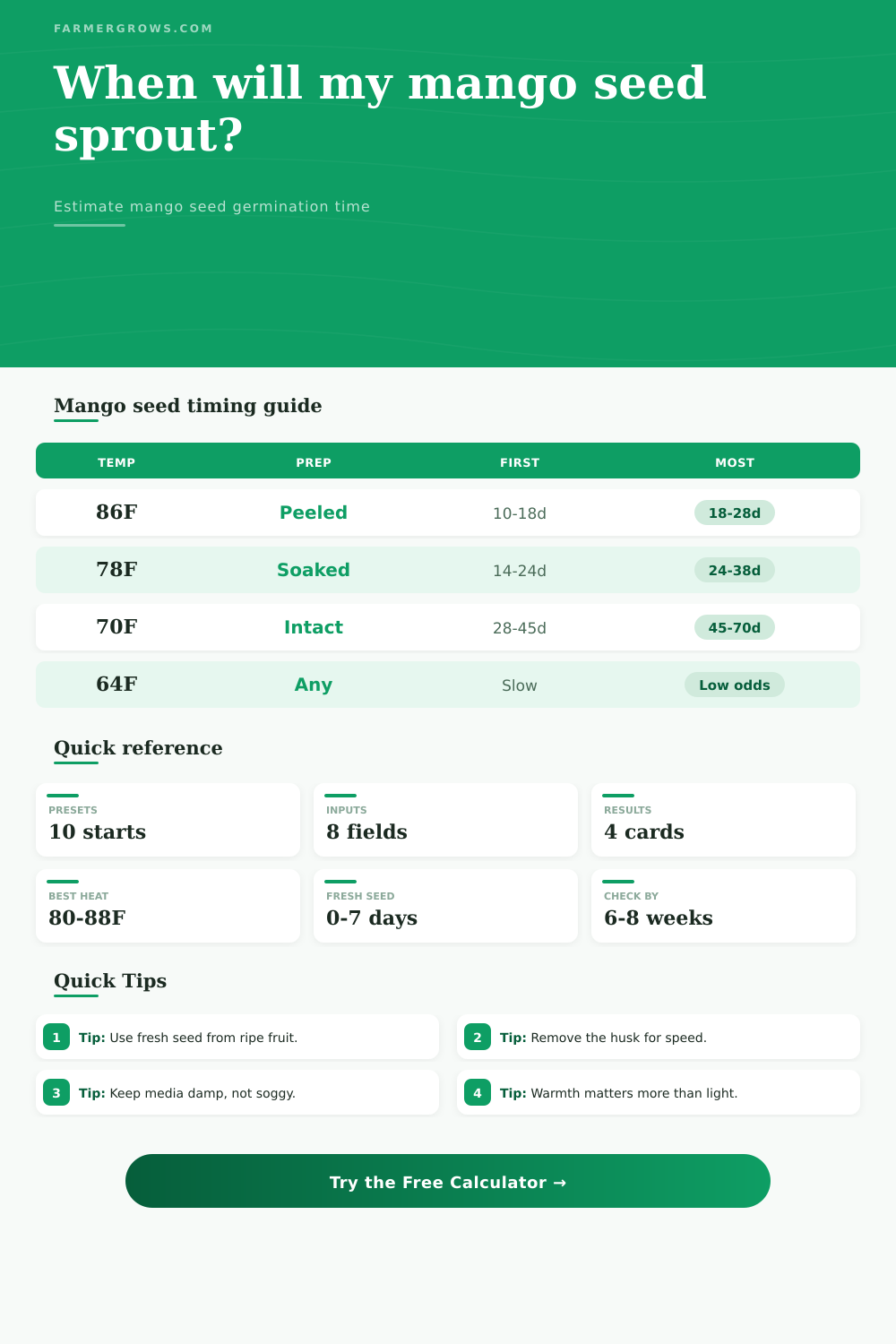
Mango Seed Germination Time Calculator
Estimate the first sprout date, main germination window, seed viability, and final check date from seed freshness, husk removal, warmth, moisture, depth, and starting method.
📋Mango germination presets
Choose a real seed-starting situation, then adjust the details for your mango variety, room temperature, and planting method.
🌱Seed and growing conditions
Mango seeds are tropical and recalcitrant, so they slow down quickly when old, cold, buried too deep, or kept waterlogged.
Mango germination estimate
Calculated from your mango seed type, preparation, freshness, temperature, medium, and moisture level.
Full germination breakdown
📊Condition signals
🔍Comparison grid
Compare your selected setup against cooler, warmer, and fully optimized mango seed starts.
📘Mango seed reference tables
| Medium temp | Seed activity | First signs | Most likely window |
|---|---|---|---|
| 60-64°F / 16-18°C | Very slow | 35-60 days | Low odds unless warmed |
| 65-69°F / 18-21°C | Slow | 28-45 days | 45-75 days |
| 70-79°F / 21-26°C | Steady | 18-32 days | 30-50 days |
| 80-88°F / 27-31°C | Fast | 10-20 days | 18-35 days |
| 89-95°F / 32-35°C | Fast but watch rot | 9-18 days | 16-32 days |
| Preparation | Typical effect | Risk | Best use |
|---|---|---|---|
| Husk removed | 5-10 days faster | Bruising embryo | Careful indoor starts |
| Soaked peeled seed | 2-5 days faster | Over-soaking | Dry-looking embryos |
| Damp towel baggie | Easy inspection | Mold if too wet | Early root checks |
| Husk intact | 10-18 days slower | Hidden rot | Rough handling avoidance |
| Water suspension | Unreliable timing | Low oxygen | Short demonstrations |
| Seed age | Condition cue | Timing effect | Viability cue |
|---|---|---|---|
| 0-2 days | Plump, pale, firm | Fastest | High |
| 3-7 days | Slight surface drying | Small delay | Good |
| 8-14 days | Wrinkling starts | Noticeable delay | Moderate |
| 15-30 days | Light, dry edges | Long delay | Low |
| 31+ days | Shriveled or brittle | Unreliable | Very low |
| Condition | Good range | Watch for | Adjustment |
|---|---|---|---|
| Planting depth | 0.5-1.5 in | Deep, cold media | Cover lightly |
| Moisture | Damp, airy | Standing water | Vent or drain |
| Seed mix | Fine and clean | Compaction | Add perlite |
| Coco coir | Moist, springy | Salt or sogginess | Rinse and drain |
| Garden soil | Loose sandy loam | Heavy clay | Use a pot mix |
Start counting from the day the cleaned seed is placed in damp medium. A peeled mango embryo may show a root before the green shoot appears above the soil.
If no root appears by the final check date, inspect for firmness. A firm pale seed can be rewrapped warm, but a soft, sour, or blackened seed should be discarded.
This calculator estimates timing for home mango seed starting. Local seed maturity, fruit storage, fungal pressure, and exact embryo condition can shift results.
And then there’s that juicy Ataulfo, pulled off the counter and cracked open to reveal sweet, creamy flesh that’s a fine dessert. It is also a seed in a fibrous husk that holds the promise of a tree. After enjoying the fruit, most people discard the pit, missing the gradual spectacle of a tropical plant starting its life from seed on their kitchen table.
Tapping a mango seed into a tree is more a test of patience different than gardening know-how; you’re essentially working to tease a living thing from a state in which it would prefer to remain asleep. Usually, it isn’t a question of knowing how to do things as much as when. Once you know what conditions apply where you live, the calculator (above) do all the math for you and spares you the need to guess if your window sill will be warm enough for a tropical embryo.
How to Grow a Mango Tree from a Seed
The thing with mango seeds: They’re recalcitrant, meaning they don’t care for being dried out or left waiting around. They’re happy to go directly from fruit into the ground, because viability decreases rapidly. Leaving that pit to sit on the counter for a couple of weeks while you get up the nerve to plant it? You’ve already lost some ground. Freshness is the first thing spent in this game. A fresh-seed taken from a piece of fruit a week after picking will be highly vigorous. One that’s been in the drawer for a month are struggling against drying out and fighting an uphill battle.
Temperature is the other area where most home gardeners is challenged. A mango embryo is used to a place where there’s no such thing as “cold.” What seems comfy-cozy in your house may be winter to an embryo, which would find eighty degrees Fahrenheit chilly. Expect delays if your medium hovers around seventy. It won’t mean the seed has been fatally ruined, only that its metabolism slows when cool, and it waits for a summery day that ain’t comin’. That is why people uses heat mats and keep things near cozy appliances in home set-ups. At this point warmth trumps light (you could grow a root in complete darkness, but not cold.)
Preparation also matters. It’s safer because there is less chance of damaging the delicate inner embryo if you just plant the whole thing. However, it is slower because the seed must rot away its own husk before the embryo root can break free. Soaking softens the tissue, and peeling off the husk gently hastens the process by days. Safety vs. Speed (do you want the faster route? Peel it). Are you wary of harming the tender green kernel within? Leave it be. With the tool in hand, you get to make an educated guess on which way to go, based off how each form of prep alters your expected time frame.
It’s also moist; another trap: We tend to think wet = alive, which isn’t always so. Wet media will smothers roots. It will also invite rot. Good: air pockets; bad: standing water. Like a wrung-out sponge is what you’re aiming for, check the feel rather than the calendar, since a drowned seed will turn black and mushy. A firm one is good (you may have just been slow), or dead (but then, maybe not).
The depth also doesn’t matter as much as we think it does: Too deep and the shoot will expend energy to try to get up out of there. It must be shallow enough to get some light sooner or later, but still keep its moisture. This small detail make a big difference for the young plant.
And lastly, what kind of tree do you expect to grow? Are you trying to get a monoembryonic variety or a polyembryonic one? The first one might be completely different once it fruits in a few years, whereas the second one is a true clone of its parent. Grow now just for the love of growing, with the fruit still a far-off hope.
Be patient, but don’t let yourself forget: All you need to do is keep the seed moist, but not sodden, and keep it warm. When it’s time, it’ll push through that green shoot.