Malabar Spinach Growth Time Calculator
Estimate germination, transplant timing, first leaf harvest, repeat harvest rhythm, trellis fit, and vine length for warm-season Malabar spinach vines.
Malabar spinach is not cool-season spinach. It is a tropical, twining vine that speeds up in heat, stalls in cold soil, and needs vertical support for clean leaf harvests.
Growth Time Results
Dates adjust for seed prep, planting method, warm-season temperatures, trellis height, spacing, and harvest pressure.
| Malabar spinach type | Growth habit | First harvest | Vine length | Best use |
|---|---|---|---|---|
| Green Basella alba | Green stems, tender broad leaves | 45 to 60 days | 6 to 10 ft | Everyday summer greens and stir-fries |
| Red-stem Basella rubra | Red-purple stems, ornamental vines | 48 to 62 days | 6 to 10 ft | Edible fence, arbor, and warm bed harvests |
| Thick-leaf Asian selection | Fleshier leaves and strong heat tolerance | 50 to 65 days | 7 to 12 ft | Long hot-season harvests |
| Container-trained vine | Pruned shorter for pots and balconies | 50 to 68 days | 4 to 7 ft | Patio pots with frequent tip pruning |
| Market tip-harvest strain | Managed for branching and tender shoots | 42 to 56 days | 5 to 9 ft | Repeated bunching tips and small leaves |
| Start method | Seed treatment | Typical germination | Timing effect | Use when |
|---|---|---|---|---|
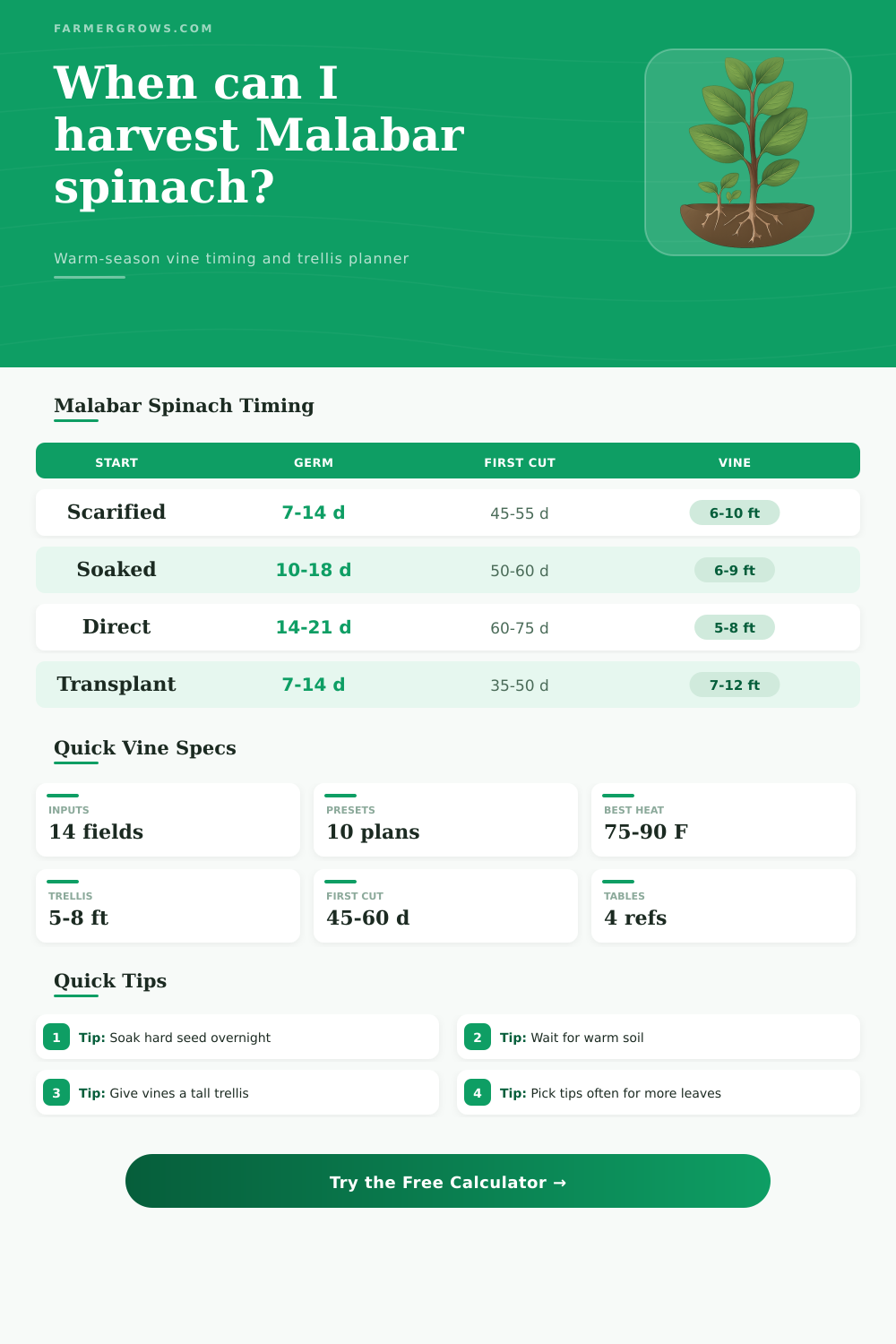
| Indoor transplant | Scarify plus soak | 7 to 14 days | Fastest reliable start | Short seasons or early trellis crops |
| Indoor transplant | Soak only | 10 to 18 days | Slightly slower but simple | Seed coat is hard but fresh |
| Cell flat | Scarify only | 9 to 16 days | Good if trays stay warm | You want clean transplant spacing |
| Direct sow | No treatment | 14 to 24 days | Slowest and most temperature-sensitive | Soil is already warm and settled |
| Container direct | Soak or scarify | 10 to 20 days | Needs warm potting mix | Balcony or patio vines |
| Support setup | Useful height | Expected vine length | Training note | Harvest effect |
|---|---|---|---|---|
| Tomato cage or short teepee | 3 to 4 ft | 4 to 6 ft | Pinch early and wrap often | More side shoots, less vertical length |
| Panel trellis | 5 to 6 ft | 6 to 9 ft | Best all-purpose backyard support | Clean leaves and steady tip harvest |
| Fence line | 5 to 7 ft | 7 to 10 ft | Guide vines before they tangle | Good for repeated side picking |
| Arbor or pergola | 7 to 10 ft | 9 to 14 ft | Use long season and high heat | Large canopy with shade and leaves |
| Container stake | 3 to 5 ft | 4 to 7 ft | Water and feed consistently | Earlier stress if roots dry out |
| Condition | Malabar spinach response | Timing adjustment | Harvest rhythm | Field note |
|---|---|---|---|---|
| Soil below 65°F | Slow or uneven germination | Add 7 to 14 days | Wait before first cut | Unlike true spinach, cold is not helpful |
| Soil 70 to 85°F | Strong germination and rooting | No delay | Pick tips every 4 to 7 days | Ideal warm-season start |
| Days 80 to 95°F | Fast vine growth if watered | May shorten by 2 to 5 days | Frequent tender harvest | Heat-loving summer green |
| Nights below 55°F | Growth pauses after planting | Add 5 to 12 days | Harvest later | Hold transplants until nights warm |
| Dry roots in heat | Leaves toughen and vine slows | Add 4 to 10 days | Longer interval between cuts | Mulch and steady moisture matter |
Seed tip: Nick or lightly scarify the hard seed coat, then soak overnight in warm water. That usually tightens the germination window, especially before direct sowing.
Harvest tip: Start with tender vine tips once plants are climbing strongly. Frequent small cuts make Malabar spinach branch instead of becoming one long tangled vine.
Unlike most leafy greens, Malabar spinach want special treatment, meaning special conditions. Most people buy seed, sow in early spring, then is frustrated when nothing happens. Nothing grows…yet. What happened? Nothing went wrong with the seed; it’s just that this vine like warmth. If you want a healthy crop on a trellis, get the how-to part correct: soil must be warm (or at least starting to be), and there must be enough water to encourage climbing.
After you input your local weather and start date, page’s calculator figures out for you when things are ready to go; without any guesswork as to whether frost might damage tender young plants, or cool soil prevent germination. Why? Those inputs are actualy physical limitations. The key one is soil temperature. Below seventy degrees Fahrenheit, the thing remain dormant, waiting. It is not rotting; it is just waiting. This postpones all the other stages of its life. You cannot harvest what has not yet decided to grow.
How to Grow Malabar Spinach
Soaking seeds does matter. A lot. Seed coats are smooth and tough. Without soaking (or scarifying), water can’t get in, so things sprout unevenly. Soaking or scarifying or both make for more reliable germination, and often save several day early on. The tool shifts the timing depending on whether you soak only, scarify only, or soak then scarify. It’s a little thing you do in the kitchen that results in saving weeks out in the garden. You spend fifteen minutes now to get a faster start later in the season.
After the vines set up, vertical support is key. A trellis or other structure isn’t optional: If the plants has no place to go but down, they’ll all tumble, making a messy tangle that’s harder to harvest and prone to getting moldy. Usually a six- to eight-foot-high structure work well in the home garden. Higher structures gives you more leaf surface in a given area of ground. You can see from reference table on the page just what the expected vine lengths will be before fall comes. That way you know what kind of coverage you’re going to have.
The pace is determined by heat. When the plant has hot days in the eighties and nights that don’t dip below sixty-five, it grows quickly. Under such conditions, you can harvest again after just a couple of days… Over and over. Pick the tips, and the plant branches out some more… Giving you more tips to pick. And then more. This continues. This means that repeated picking equals repeated production. It happens again and again, it is a perpetual-motion machine of growth.
But when the weather cool or the soil dries out, the vine shuts down. It is not dead, but it has stalled. It produces no more new leaves. This is why steady watering is important. Water consistently, and the plant will grow through the hottest spells. Both green and red cultivars of Basella perform similarly when stressed, so your choice will depend largly on appearance. Green *Basella alba* have tender leaves that you can use daily in cooking. Red *Basella rubra* colors edible fences. Neither is meaningfully faster growing.
The difference is in the transplant timing: starting seeds indoors before moving them outside beats direct sowing by several weeks. It also avoids that fragile period of germination in changing soil. Remember that what we call “planting time” is actually an extended series of dependencies, not one moment in time at all. There’s sowing, then there’s warmth and water and some vertical space, too. Without each of those things happening in order, the timing get extended. You should of planned better.
You don’t need perfect conditions, but you do need consistent ones. Use the calculator to lay out the links, and identify potential issues with empty trellis ahead of time. Sometimes gardening is about not just managing plants, but also about managing expectations. Nature follows its own schedule, while you want a lot. The trick is to work with that timetable, rather than against it, by matching up when you sow to when the vine needs to be warm. Align the two, and what was once a fussy tropical import becomes a dependable summer staple that keeps feeding you even as other greens bolt in the heat.