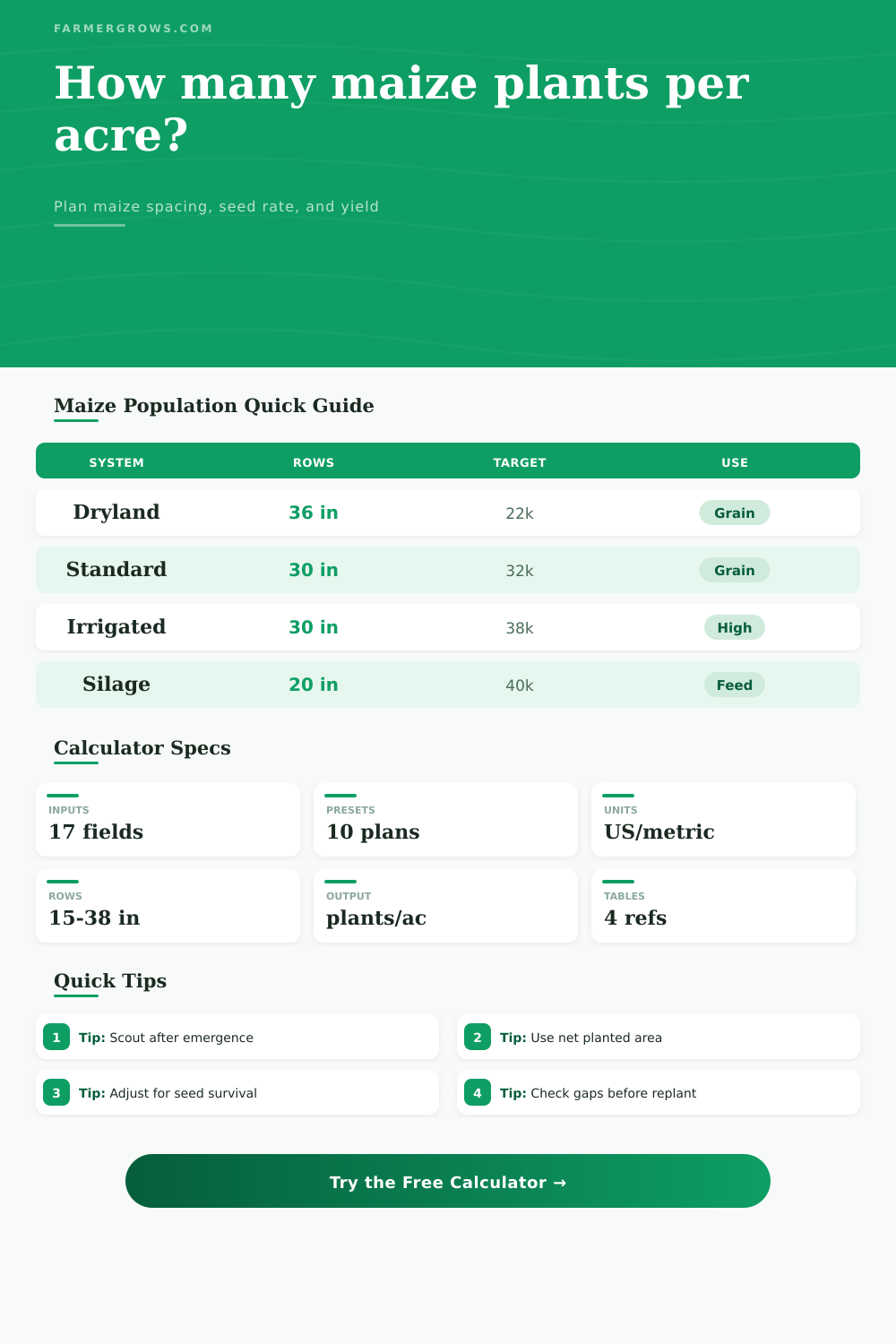
Maize Plants Per Acre Calculator
Estimate maize population from spacing or field stand counts, then plan seed rate, seed units, row feet, harvestable ears, and grain or silage yield for each planted block.
Use net planted acres whenever possible. The calculator keeps spacing population, observed stand, seed establishment, seed unit order, and harvest yield checks separate so a maize plan can be reviewed before and after emergence.
Maize Population Results
Enter spacing and stand inputs to calculate maize plants per acre.
| Row spacing | Row feet per acre | Plants/ft at 30k | Plants/ft at 36k | In-row spacing at 36k |
|---|---|---|---|---|
| 15 inches | 34,848 ft | 0.86 | 1.03 | 11.6 inches |
| 20 inches | 26,136 ft | 1.15 | 1.38 | 8.7 inches |
| 22 inches | 23,760 ft | 1.26 | 1.52 | 7.9 inches |
| 30 inches | 17,424 ft | 1.72 | 2.07 | 5.8 inches |
| 36 inches | 14,520 ft | 2.07 | 2.48 | 4.8 inches |
| 38 inches | 13,755 ft | 2.18 | 2.62 | 4.6 inches |
| Row spacing | 1/1000 acre row length | Target 28k count | Target 34k count | Target 40k count |
|---|---|---|---|---|
| 20 inches | 26.14 ft | 28 plants | 34 plants | 40 plants |
| 22 inches | 23.76 ft | 28 plants | 34 plants | 40 plants |
| 30 inches | 17.42 ft | 28 plants | 34 plants | 40 plants |
| 36 inches | 14.52 ft | 28 plants | 34 plants | 40 plants |
| 75 cm | 5.81 m | 28 plants | 34 plants | 40 plants |
| Target final stand | Kernels/ac at 86% establishment | 80k units for 100 ac | Spacing at 30 in rows | Common fit |
|---|---|---|---|---|
| 22,000 plants/ac | 25,581 kernels/ac | 32.0 units | 8.2 inches | Dryland or low rainfall |
| 28,000 plants/ac | 32,558 kernels/ac | 40.7 units | 6.4 inches | Moderate grain field |
| 32,000 plants/ac | 37,209 kernels/ac | 46.5 units | 5.6 inches | Standard grain maize |
| 38,000 plants/ac | 44,186 kernels/ac | 55.2 units | 4.8 inches | Irrigated high-yield field |
| 42,000 plants/ac | 48,837 kernels/ac | 61.0 units | 4.3 inches | Silage or forage block |
| Plan | Typical target | Usual rows | Management note |
|---|---|---|---|
| Rainfed grain maize | 20k-26k plants/ac | 30-38 inches | Protect soil moisture and avoid overpopulation. |
| Standard grain maize | 30k-34k plants/ac | 30 inches | Match hybrid strength and fertility plan. |
| Irrigated maize | 36k-40k plants/ac | 20-30 inches | Dense stands need water and nitrogen support. |
| Silage maize | 38k-44k plants/ac | 15-30 inches | Target biomass while watching lodging risk. |
| Sweet maize patch | 18k-24k plants/ac | 30-36 inches | Leave room for ears, picking, and airflow. |
| Popcorn maize | 32k-38k plants/ac | 20-30 inches | Small kernels can support closer stands. |
For stand counts: Count live, competitive maize plants after emergence is mostly complete. Sample good, average, and weak areas instead of relying on one clean row.
For seed orders: Use net planted acres and realistic establishment. Germination on the tag is not the same as final field survival after cold soil, pests, skips, crusting, or planter issues.
When you start growing corn, it’s a matter of making your seed selection: the hybrid decision. Then after you prepare your soil and test for water-holding capacity, then you plant, then worry about planting too many seeds or not enough; about whether 70 percent emerged, as advertised on the packet label. That is: How many plants actualy made it to harvest? It comes down to this single number.
The calculator (above) do the math once you punch in how many emerged in each row and how far apart those rows is spaced. Just figure out what goes into the box, and what should of come out. The most common mistake are with stand and space. Space population is theoretical (the planter was set up for). Stand population is real, representing what grew after weather and pest damage. If all you consider is what you planted then you’re planning on a non-existent field.
How to Count Corn Plants and Plan Your Crop
To determine how many plants actualy emerged, scout after emergence and count the plant within defined segments. The calculator will convert these numbers into plants per acre. This provides a comparison of what you planned versus what actualy happened. How long does that row need to be? How do you get that conversion? One-thousandth of an acre on 30-inch wide rows equals about 17 feet of row. That’s not far; but it becomes the starting place for all your yield estimates for the growing season ahead. If there are ten plants in that stretch, then you’ve got ten thousand plants per acre. Multiply that number by three to get 30, which puts you at three-tenths of an acre. Alternatively, you can measure neighbors instead than gaps.
There’s yet another twist: Seed rate calculations. Not all seeds tagged “germinates well” in the lab survives in cold, wet soil. To close that gap, the tool asks for both germination and expected field survival. If establishment isn’t great, you’ll have to buy more seed to reach your goal. It sounds like simple math, and you risk forgetting it at bag-filling time. The calculator display how many kernels are needed in total, which prevents you from running dry.
Numbers can get tricky when estimating yields. With the grain factor method, you use the number of kernels in an ear times the number of ears per plant. That’s fine for ballparking. But nothing is ever uniform, not even a cornfield. You’ve got one plant with big ears; another with tiny ones. In fact, that’s why the calculator gives you a yield range; the more truthful picture of what to expect. A fourteen percent swing is about right (accounting for uneven pollination).
Tight spacings (rows) and tight populations (plants/row) is popular these days, but it takes more than changing the planter setting to achieve them. Consistent water levels from an irrigation system allow higher stands on irrigated field. On dryland fields, competition for precious soil moisture also makes it harder for crops to grow when rows are narrow. The number of row feet per acre depends off row spacing (see table of references). Narrower rows (tight spacing) mean more row feet and different canopy geometry that impacts light availability.
There’s no magic number of plants for maize population planning; it’s all about mitigating risk. It’s a trade-off between the risk of lodging on one hand and seed cost and potential yield on the other. The calculator provides a structure in which to deliberately make that trade-off. It begins with a theory, followed by a count as a test, then an adjustment before the season close. That’s a way to convert a guess into a strategy.