🌸 Magnolia Sun Calculator
Find out if your planting site gets the right sunlight for your magnolia type
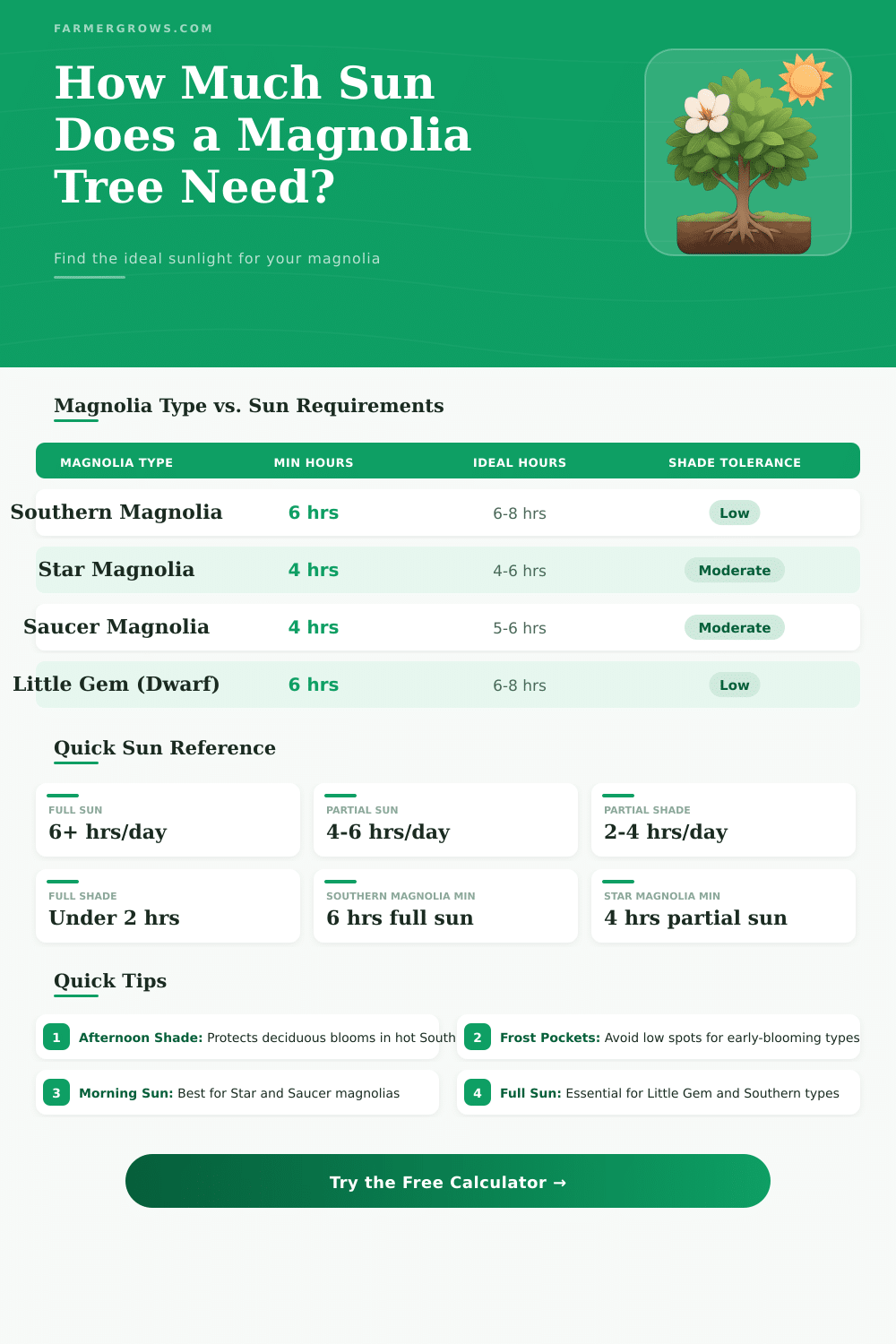
| Magnolia Type | Min Hours | Ideal Hours | Shade Tolerance | Notes |
|---|---|---|---|---|
| Southern Magnolia | 6 hrs | 6-8 hrs | Low | Needs full sun; evergreen |
| Star Magnolia | 4 hrs | 4-6 hrs | Moderate | Morning sun best; protect from late frost |
| Saucer Magnolia | 4 hrs | 5-6 hrs | Moderate | Afternoon shade helps in warm zones |
| Little Gem (Dwarf) | 6 hrs | 6-8 hrs | Low | Compact; great for containers in full sun |
| Jane / Tulip Magnolia | 4 hrs | 5-6 hrs | Moderate | Later bloomer; reduced frost risk |
| Climate Zone | USDA Zones | Best Exposure | Special Advice |
|---|---|---|---|
| Cool Northern | Z4-6 | Full sun, south-facing | Maximize warmth; avoid frost pockets |
| Temperate | Z6-8 | Full sun to partial sun | Good drainage; protect early bloomers |
| Warm / Southern | Z8-10 | Full sun or dappled afternoon shade | Afternoon shade prevents deciduous scorch |
| Magnolia Type | Bloom Season | Frost Risk | Mitigation |
|---|---|---|---|
| Star Magnolia | Early spring (Mar) | High | Avoid frost pockets; north-facing delays bloom |
| Saucer Magnolia | Early-mid spring (Apr) | High | Sheltered site; avoid open low ground |
| Jane / Tulip Magnolia | Mid-late spring (Apr-May) | Moderate | Later bloom reduces frost damage risk |
| Southern Magnolia | Summer (Jun-Aug) | Low | Evergreen; frost less likely at bloom time |
| Little Gem | Summer (Jun-Sep) | Low | Long blooming season; full sun needed |
Sunshine is the main benefit for Magnolia Tree. Before you think to plant one, first set that in mind. The most many types of Magnolia Tree do best in full Sun escaping shade, and getting this Sun decides the strength of your tree and whether it truly will give those wonderful flowers.
Full Sun usually means at least six hours of direct sunshine daily. Many Magnolia Tree truly flower well when they get between six and eight hours of direct light. More than that?
How Much Sun Do Magnolia Trees Need
They do not need it for everything. Flowering and growth of seeds needs much energy, so sunshine matters that much for those trees.
Partial shade also works, if the tree gets at least four hours of direct, clear Sun daily. Southern Magnolia Tree and their relatives both like a lot of light, and that four-hour amount truly helps them reach their best state. But here the main point (if you want the most flowers), plant it in full Sun.
A tree that soaks up all that sunshine will produce more spring flowres than one in another place.
Escape strongly shaded places that face north. Those areas reduce both the number of flowers and the general form of the tree. Magnolia Tree flower much better in sunny spots, simply and clearly.
Now, in truly warm climates things are something different. When you struggle with big heats or lack of rain, Magnolia Tree could like a bit of afternoon shade to ease the weight. Open stripped places are not good, because strong winds can brake those big tender flowers and branches.
Young Magnolia Tree needs patience before it starts to produce flowers. Standard southern Magnolia Tree grown from seed can take five to ten years before you see the first flower. Once mature, Magnolia Tree still need good Sun to truly shine.
Even so, hybrids commonly flower sooner, so choosing one of them or buying a plant with buds already you spare years of waiting.
The Jane Magnolia shows between the most popular choices. Magnolia Tree come in many forms, from little bushes to medium accent trees, with leafy and evergreen versions. They are a bit picky about soil and light, so finding the right place is worth the effort.
Good drainage is also important. Magnolia Tree grow best in full Sun with soil that drains well instead of holding water.
Not all Magnolia Tree give dense, thick shade under them. Other plants can live together under Magnolia Tree without problem. The hard part?
Pruning of Magnolia Tree does not always go easily. They do not handle big heavy cuts. Start them in open spaces with enough airflow works more well, especially because somehybrids reach great sizes.