Lye Soap Calculator
Estimate NaOH lye, water, fragrance, mold fit, oil SAP blend, lye concentration, water ratio, superfat, and cured batch shrink for cold process soap.
This calculator uses common NaOH SAP values in grams of NaOH per gram of oil. Always verify SAP numbers from your oil supplier, weigh lye carefully, and follow your normal lye safety procedure.
Soap Batch Results
Calculated NaOH, water, oil weight, fragrance, mold fit, and cured batch weight.
oil lye = oil weight x NaOH SAPNaOH = sum oil lye x (1 - superfat / 100)water = NaOH x (100 - concentration) / concentrationwater = NaOH x water:lye ratiofragrance = total oils x fragrance percent / 100fill = batter volume / mold volume; cured = batch x (1 - shrink / 100)| Oil or fat | NaOH SAP used | Typical recipe role | Calculator note |
|---|---|---|---|
| Olive oil | 0.134 g/g | Mild, conditioning base | Slow to harden, common in high-olive recipes. |
| Coconut oil, 76 degree | 0.183 g/g | Cleansing, bubbly lather | High SAP; adjust superfat and usage level thoughtfully. |
| Palm oil | 0.142 g/g | Hardness and structure | Midrange SAP for balanced bar formulas. |
| Shea butter | 0.128 g/g | Creaminess and conditioning | Lower SAP; often used as part of the solid fat blend. |
| Castor oil | 0.128 g/g | Lather support | Small amounts can improve lather texture. |
| Lard | 0.138 g/g | Mild, firm traditional bars | Useful in farmhouse style recipes. |
| Beef tallow | 0.140 g/g | Firmness and creamy lather | SAP can vary by rendering source. |
| Avocado oil | 0.133 g/g | Conditioning oil | Close to olive oil in NaOH demand. |
| Canola oil | 0.133 g/g | Soft, conditioning oil | Keep recipe balance in mind for bar hardness. |
| Rice bran oil | 0.128 g/g | Conditioning and silky feel | Lower SAP than many common liquid oils. |
| Setting | Conservative range | Common value | Use in the calculator |
|---|---|---|---|
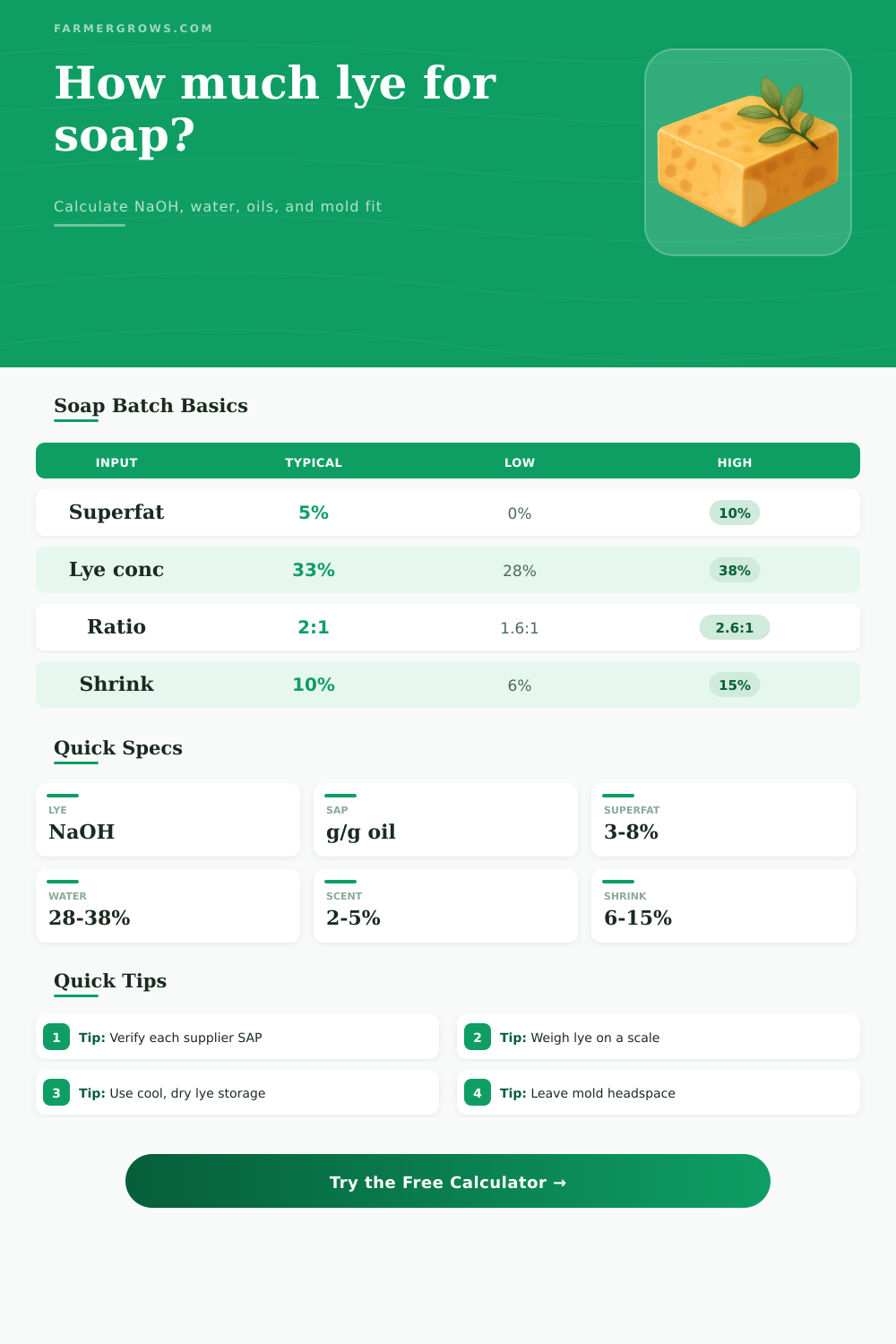
| Superfat | 3% to 8% | 5% | Reduces calculated NaOH after oil SAP values are summed. |
| Lye concentration | 28% to 38% | 33% | Higher concentration means less water and usually faster trace. |
| Water:lye ratio | 1.6:1 to 2.6:1 | 2.0:1 | Alternative way to enter water when you do not use concentration. |
| Cured shrink | 6% to 15% | 10% | Estimates finished batch weight after cure moisture loss. |
| Mold example | Inside volume | Approx batter weight | Planning note |
|---|---|---|---|
| Small test loaf, 20 x 7 x 6 cm | 840 mL | 800 g batter | Good for new oil blends and color tests. |
| Standard loaf, 25 x 8 x 7 cm | 1,400 mL | 1,330 g batter | Often fits about 900 to 1,000 g oils with moderate water. |
| Tall loaf, 30 x 9 x 8 cm | 2,160 mL | 2,050 g batter | Leave headspace for textured tops and insulation. |
| Slab mold, 35 x 25 x 5 cm | 4,375 mL | 4,155 g batter | Use even fill height for consistent bar thickness. |
| Total oil weight | 2% fragrance | 3% fragrance | 5% fragrance |
|---|---|---|---|
| 500 g oils | 10 g | 15 g | 25 g |
| 750 g oils | 15 g | 22.5 g | 37.5 g |
| 1,000 g oils | 20 g | 30 g | 50 g |
| 1,500 g oils | 30 g | 45 g | 75 g |
| 2,500 g oils | 50 g | 75 g | 125 g |
Check SAP values before weighing lye. Published SAP numbers are averages, so supplier data should be used when it is available for a specific oil or fat.
Compare batch volume with mold volume. A batter that calculates near 100% fill may still need headspace for texture, insulation, or movement to the curing area.
Making soap at home requires you to determine the correct amount of lye that you need to add to the oils that you have chosen to use. The amount of lye that you will need are dependent upon the chemistry of each of the fats that you intend to use, the amount of extra oil that you would like to leave behind, and the amount of water that you would like to add to the mix. Once you have determined the amount of lye, the amount of extra oil, and the amount of water that you will use in your recipe, you can determine such things as the amount of fragrance that you would like to use in your recipe and the amount of space that the soap will need to fit within your mold.
For these last three factors, many individuals will find themselves in a situation where they have either prepared soap that contains too much lye, or their soap ended up being too softly. Thus, it is with the use of mathematics that these variables can be balanced to create a bar of soap that is correct in each of these categories. One of the most important number in creating a bar of soap at home is the SAP value for each oil that is to be used within that batch of soap.
How to Calculate Soap Ingredients
The SAP value for each oil represents the amount of sodium hydroxide that would be required to turn one gram of that specific fat into soap. For instance, olive oil has an SAP value of near 0.134, coconut oil has an SAP value of 0.183, and shea butter has an SAP value of 0.128. As a result of these different values, oils that contain a higher SAP value will require more lye to perform the reaction than oils with lower SAP values.
A calculator allow for these values to be determined, as it can perform the mathematical calculations necessary to determine the amount of lye that is required for a batch of soap, based off the type of oils that are to be utilized. Another of the factors to consider in the creation of soap at home is the concept of superfat. Superfat is the percentage of oil that is left unreacted within the soap, which allow for the soap to be somewhat mild upon the skin.
Most recipes that are published use a superfat percentage that ranges from three to eight percent, with five percent being the most common middle ground for these percentages. Recipes that use a lower percentage of superfat will result in a firm bar of soap that can last longer, but any such recipes contain a lower margin for error in the event that the SAP values for each oil are not the same as the values that are published within the recipe. The calculator that is used in the creation of these recipes can calculate the superfat percentage after the sodium hydroxide values for each oil have been summed.
The amount of water that is to be used in the soap can be entered into the calculator in one of two ways. One way is to select a percentage of lye concentration that will be used, thirty-three percent of lye concentration being one of the most common percentages that is selected for these recipes. The other way is to use a ratio of water to lye that can be entered into the recipe.
Each of these two methods will result in the same outcome for the batch of soap that is prepared, but one or the other may be more common depending upon the individual that is learning to create soap at home. A higher percentage of lye concentration will indicate that there will be less water that is used in the recipe for the soap, and a higher percentage of lye concentration results in a shorter curing time. A lower percentage of lye concentration will indicate that there will be more water that will be used in the preparation of the soap, which will allow for more working time prior to the addition of fragrance and other ingredient.
The amount of fragrance that can be loaded into the soap is calculated by dividing the amount of fragrance by the total weight of the oils. Most fragrance oils are published to work best within a range between two and five percent of the weight of the oils. Five percent of one thousand grams of oil, for instance, would contain fifty grams of fragrance oil.
Such an amount is enough to fill a standard mold. Because fragrance oil can play a role in the trace of the soap, many individuals will first test their soap with the oils without the use of fragrance oil, and then add the calculated amount of fragrance oil once they are satisfied in the trace of their soap free of fragrance oil. While the factor of mold fit may seem to be an easily-overlooked variable in the preparation of soap, if the size and shape of the mold that is used is not appropriate for the batch of soap that will be prepared, the batch may overflow within the mold or be too thin.
A calculator will provide an estimate for the volume of the batch of soap that will be prepared, based upon the total weight of the batch and the density of the batch. Based upon the size of the mold that is to be used, the calculator will indicate whether or not there is enough headspace within the mold for the batch of soap that will be prepared, or if adjustments must be made to the batch size that is to be prepared. A batch of soap that is prepared will shrink in size during the curing process, which lasts between four and six weeks.
During that process, the moisture from the soap will evaporate, and the percentage of shrinkage for most batches of soap is around ten percent. The amount of shrinkage is important to consider if the soap is to be sold by weight, or if the number of bars of soap that will emerge from a given mold is important. Any calculator that determines the ingredients for soap will calculate the amount of shrinkage and apply it to the total weight of the batch.
Thus, the output of the calculator will be the weight of the batch of soap once it has cured. In addition to the factors that are covered by the calculator, individual factors of the oils that are to be used in the soap can also have an impact upon the properties of the completed soap bar. For instance, coconut oil will create an abundant lather with the soap, but can dry the skin if used in amounts above thirty percent of the recipe without also using an amount of superfat to compensate for the drying properties of the oil.
Olive oil will provide a mild soap bar that cures in longer periods of time, as will shea and cocoa butter. Castor oil will increase the stability of the lather that is created with the soap, and will work best in small percentages of that oil. The properties of each of these oils can be viewed in reference tables that exist for each of these oils, which allow for those curious in making soap to understand the role that each oil will play within their batch of soap.
Many of the mistakes that occur in the making of soap at home can be explained by three major causes. The first of these major causes is the use of published SAP values for the oils rather than the data that is published by the manufacturer of that specific oil. The second of these causes is the omission of the application of superfat after the total amount of lye that is required by the oils has been calculated.
The third of these causes is the lack of knowledge of the fact that the mold will not contain the same amount of the soap that is listed on the label for that mold; adjustments must be made in the recipe for the amount of soap that will be prepared. Each of these mistakes will result in soap bars that are too soft, too harsh, or of the incorrect size for the mold. In addition to the factors that are accounted for in the calculator, other factors can impact the properties of the soap that is prepared.
For instance, if the temperatures of both the lye and the oils are cooler than room temperature, the trace will take longer to occur. The opposite is true for warmer temperatures. The density of the batch will also impact the amount of space that will be required within the mold for the batch of soap.
Batches that utilize a great deal of hard fats will be denser than batches with a great deal of liquid oils. While these factors may seem to ruin the batch of soap that is prepared, they are rarely an issue when using soap baking techniques at home. However, they are an explanation for why some individuals may have issues with fullness in the molds of others.
The value of calculating each of these factors prior to the preparation of soap at home is that individuals can test their ideas for recipes without losing their ingredients. Each of these recipes can be compared to others, adjustments to the superfat can be made, and the batch sizes can be adjusted to ensure that the molds will be appropriate for the batch of soap that will be prepared. Once the numbers have been calculated, the creation of soap can be prepared with care and precision.
Thus, running the numbers prior to the preparation of soap allows for the process to become a craft that can be repeated at will.