Solar Panel Row Spacing Calculator
Estimate shade-free row pitch, rear-edge shadow clearance, array footprint, and ground coverage ratio for farm fields, greenhouse margins, livestock yards, and rural ground mounts.
Use this spacing calculator for preliminary layout. Final plans should still account for local terrain, tracker limits, code setbacks, wind zones, snow movement, electrical clearances, and the shade tolerance of the crop or work zone below the array.
Solar Row Spacing Result
Results use solar geometry for the selected date and shade-free window, then compare the required shadow gap with your service aisle requirement.
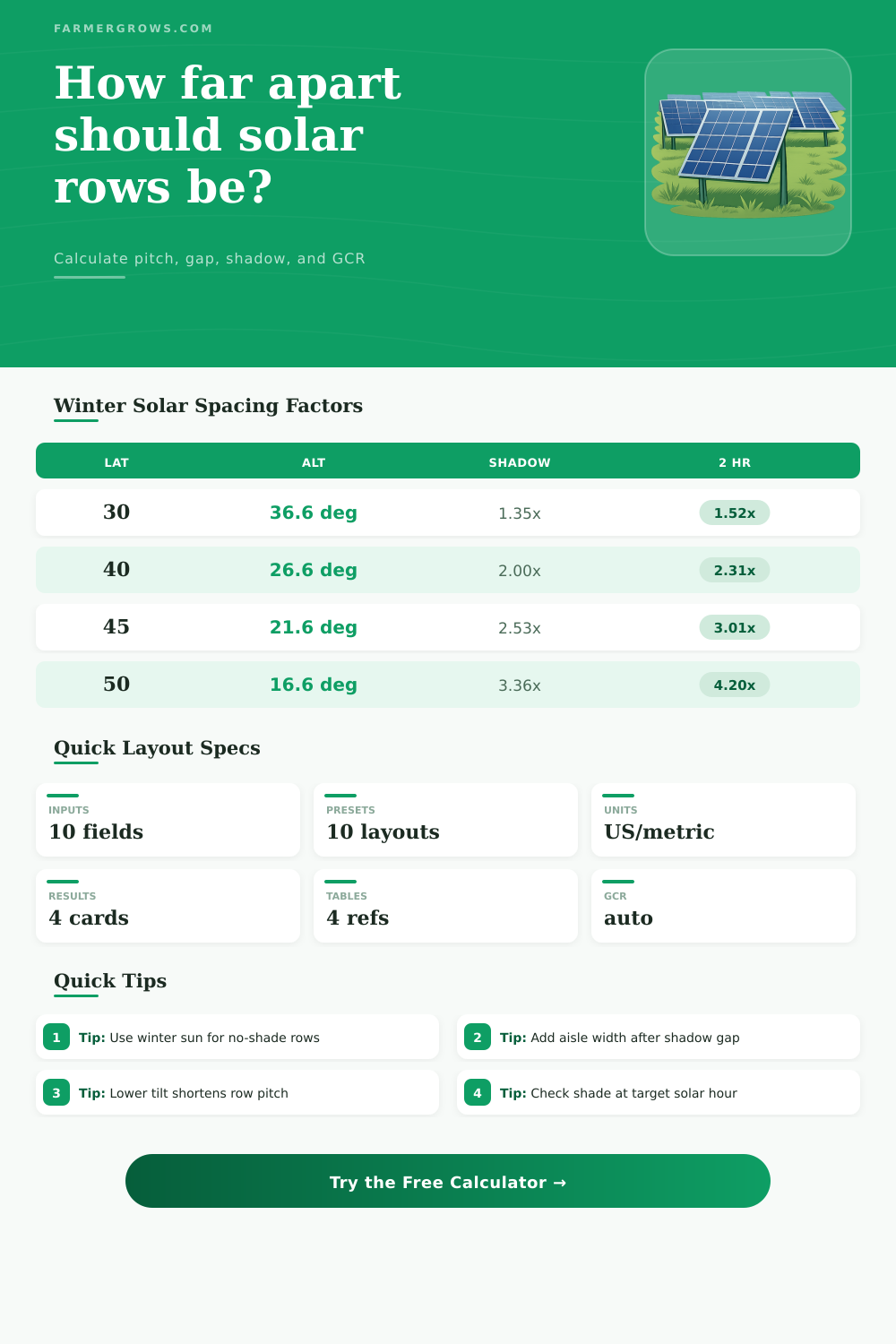
| Latitude north | December noon altitude | Shadow per 1 ft height | 2-hour winter projection | Spacing meaning |
|---|---|---|---|---|
| 25° | 41.6° | 1.13 ft | 1.26 ft | Warm-climate rows can usually hold a tighter pitch. |
| 30° | 36.6° | 1.35 ft | 1.52 ft | Good for many southern yard and pump-station arrays. |
| 35° | 31.6° | 1.63 ft | 1.85 ft | Winter spacing begins to widen noticeably. |
| 40° | 26.6° | 2.00 ft | 2.31 ft | Common design point for no-shade fixed ground mounts. |
| 45° | 21.6° | 2.53 ft | 3.01 ft | Use more buffer near barns, trees, or tall crop residue. |
| 50° | 16.6° | 3.36 ft | 4.20 ft | Northern winter rows need large gaps or lower tilt. |
| 55° | 11.6° | 4.89 ft | 6.77 ft | December no-shade layouts become land intensive. |
| Panel tilt | Vertical rise factor | Horizontal footprint factor | 6.5 ft panel rise | Layout note |
|---|---|---|---|---|
| 15° | 0.259 x length | 0.966 x length | 1.68 ft | Compact rows, weaker winter angle and slower wash-off. |
| 20° | 0.342 x length | 0.940 x length | 2.22 ft | Useful for tight yards and low-profile pasture arrays. |
| 25° | 0.423 x length | 0.906 x length | 2.75 ft | Balanced tilt for many mid-latitude farm layouts. |
| 30° | 0.500 x length | 0.866 x length | 3.25 ft | Common fixed tilt with moderate winter pitch. |
| 35° | 0.574 x length | 0.819 x length | 3.73 ft | More winter gain and more rear-edge shadow. |
| 40° | 0.643 x length | 0.766 x length | 4.18 ft | Often needs wider rows for no-shade December design. |
| 45° | 0.707 x length | 0.707 x length | 4.60 ft | High tilt, strong snow shed, large spacing requirement. |
| Latitude and tilt example | Panel footprint | Clear gap | Row pitch | GCR |
|---|---|---|---|---|
| 35° lat, 20° tilt | 6.11 ft | 4.52 ft | 10.63 ft | 0.57 |
| 35° lat, 30° tilt | 5.63 ft | 6.61 ft | 12.24 ft | 0.46 |
| 40° lat, 25° tilt | 5.89 ft | 6.98 ft | 12.87 ft | 0.46 |
| 40° lat, 35° tilt | 5.32 ft | 9.47 ft | 14.80 ft | 0.36 |
| 45° lat, 30° tilt | 5.63 ft | 10.74 ft | 16.37 ft | 0.34 |
| 50° lat, 30° tilt | 5.63 ft | 15.00 ft | 20.63 ft | 0.27 |
| Design season | Solar declination used | Latitude 40 noon altitude | Shadow per 1 ft height | Best use |
|---|---|---|---|---|
| December solstice | -23.44° | 26.6° | 2.00 ft | Conservative no-shade winter production rows. |
| November or late January | -17.0° | 33.0° | 1.54 ft | Useful when some solstice clipping is acceptable. |
| March or September equinox | 0.0° | 50.0° | 0.84 ft | Greenhouse and crop shade studies outside winter. |
| June solstice | 23.44° | 73.4° | 0.30 ft | Summer crop shade, grazing comfort, and aisle checks. |
For no-shade winter rows: Use the December solstice and a plus or minus 2-hour window when production during short days matters. Solar noon alone can make rows look tighter than they will perform.
For working farms: Compare the calculated shade gap with the service aisle. The larger value should set the clear gap so mowers, carts, animals, or crop workers can still move between rows.
Space out your solar panels correctly to make most of a solar array. Too narrow and one row block the sun all afternoon (in winter). Too wide and you’re wasting land, room for panels and for things like equipment. The trick is how much space you have, then it’s deciding whether you want some wider clearance for crops or service vehicles.
Latitude establishes baseline; the sun is lower on the horizon for those of us north of 30 degrees then it is at lower latitudes. A steeper angle lift the top of the array higher above ground, which stretches shadow farther north. The tilt also matters. The greater the tilt, the more upper edge of array is lifted, which increases its northerly extension and stretches the shadow longer into day’s northern arc. With each additional 15-degree increase in tilt (e.g., 20 degrees vs. 35), you need a correspondingly broader pitch of same-length panel.
How to Space Your Solar Panels
The calculator run both these variables through your specified time frame and selected date. You don’t have to pull out the trigonometry table to understand the give-and-take.
Then there’s the service aisle. That tends to be overlooked as well, but on many farms it’s wider than minimum space needed to avoid shadows from sun. So the aisle gets the win and the array has some extra room which reduces shading on marginal days. On tight lots where the shadow math demand more space, it’s the other way: You push your rows further apart even if it feels like you’re walking a narrow aisle between them.
Ground coverage ratio tell you what fraction of total footprint is actualy occupied by the panels themselves. The higher the ratio, the closer together the collectors are packed on a given acreage, which is nice if land cost is high. Lower ratios buy you better winter performance and easier access at price of spreading the array over more ground. It is hard to tell without knowing where you live or seeing the actual numbers calculated for your particular tilt and latitude side-by-side.
Fewer people realizes that the answer varies with season. To protect output on the shortest days, December-solstice design produce conservative spacing. An equinox date moves sun up and tightens needed gap. If you have grazing land or certain greenhouse, you can tolerate a little winter shading to allow for narrower rows the rest of the year. You could of try this trade-off yourself: Use tool, changing its design date instead of making a guess at one-size-fits-all.
Math doesn’t include real-world complications like a site’s orientation. A south-facing slope will lengthen shadows. A north-running one shorten them. Already there might be other shade from trees or perhaps a neighbor’s barn at some hours of the day. Snow drifts along row can accumulate against bottom of adjacent array and limit headroom over time. On open sites, wind uplift can forces a shallower array tilt. This also alters shadow length yet again.
To get practical results, run the numbers based off your latitude, the tilt angle you want, and the size of the system you need. Then, walk the layout with real things, either the crop or the equipment (in mind). Stand between the stakes and if the spacing feels tight once you stand there make it wider.
It’s an array that will serve you for decades. Wasting a bit of extra aisle width, a few feet, is not like wasting money by realizing, after pouring the concrete, that you realy need to shift the rows.