🐮 Livestock Judging Cuts Calculator
Score class gaps, compare spreads, and read tight or wide livestock classes fast.
How it helps: enter the cuts between placings, pick a class size, and the calculator turns those gaps into total separation, average cut, and a projected scorecard read.
Calculation breakdown
| Metric | Value |
|---|
Two judging tips
| Cut size | What it usually means | Judge's read | Study cue |
|---|---|---|---|
| 0.0-0.5 | Nearly tied | Very close class | Hard to separate |
| 0.5-1.5 | Tight pair | Top animals close | Quality decides |
| 1.5-3.0 | Clear split | Clean separation | Common contest card |
| 3.0+ | Wide gap | Obvious order | Lower quality group |
| Mixed cuts | Uneven class | One pair dominates | Check why it changed |
| All small | Very level set | Harder ranking | Look for finer detail |
| Species | Main clues | Common spread | Study focus |
|---|---|---|---|
| Beef cattle | Muscle, structure, balance | Moderate to tight | Feet, width, and design |
| Sheep | Finish, balance, correctness | Usually tight | Symmetry and handle |
| Swine | Muscle, lean, product | Moderate | Blade, ham, and base width |
| Goats | Skeletal correctness | Tight to moderate | Feet, pasterns, and balance |
| Dairy cattle | Frame, dairy strength | Moderate to wide | Angularity and openness |
| Horses | Balance, movement, structure | Moderate | Topline, set, and motion |
| Cut pattern | Class type | Score feel | Best study use |
|---|---|---|---|
| 0.5 / 0.5 / 1.0 | Very close class | Extremely tight | Elite pair study |
| 1.0 / 1.0 / 2.0 | Balanced class | Common card | Top pair matters |
| 2.0 / 1.5 / 2.5 | Moderate spread | Mixed merits | Watch middle split |
| 3.0 / 2.0 / 1.5 | Front-heavy card | Early separation | Check top end first |
| 4.0 / 3.0 / 2.0 | Wide class | Obvious order | Practice quick calls |
| 0.5 / 2.0 / 0.5 | Uneven class | One gap dominates | Explain the shift |
Livestock judging cuts form key part of the whole process about rating of contests. Well understand, as you attribute cuts can a lot help for reach better score for the participants These contests happen in United States for face students and control that knowledge and communication skills they got.
Judging livestock, you must always observe and estimate the positive and negative attributes of every animal in the main facets. Between them are frame size, scope, provision, muscle, proportion, structural correctness, motion and breed attributes. True judge stay systematic and never act haphazardly.
How Cuts Work in Livestock Judging
It is neccesary learn to carefully research the creatures. Especially matter fix attention in parts of the animal that gives the most precious cuts.
When judges bind the big cuts to the alive creature, they learn to estimate the value of alive physical parts for the meat. It is inherent learn this relation during judging of breeding either slaughter animals. Since folks domesticated creatures for meat product, livestock judging stayed important resource.
Butchers and later commercial meat packers necessarily must know how many meat you can exhaust from animal.
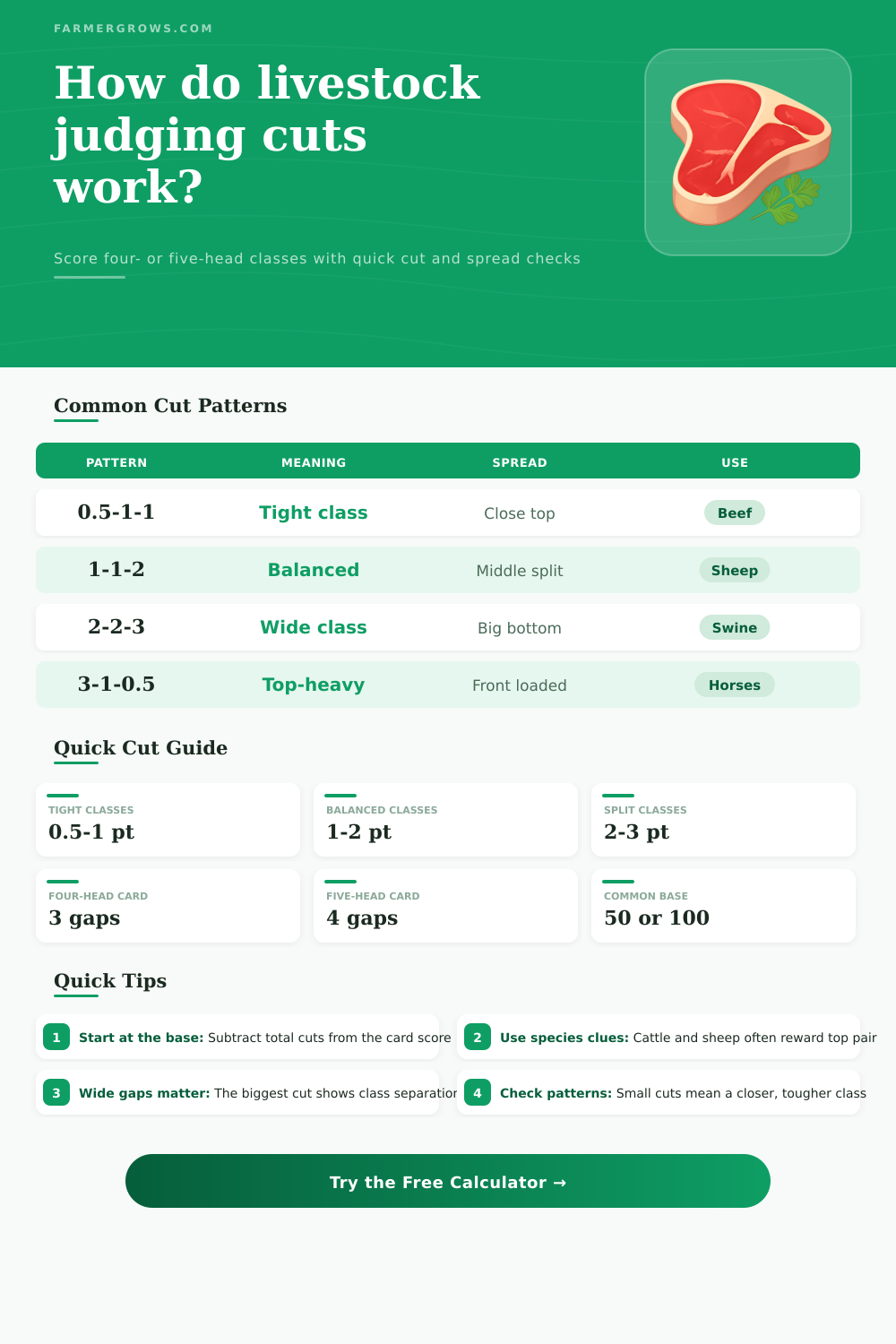
As so indeed estimate slices in contest? Officials give cut to every pair in the official certification according to the grade of trouble of its position. Big cuts show ease of the place, during little cuts point approximation.
The amount of the three cuts never surpasses 15 each class. For count lost spots, officials attributed cuts to each from the three pairs, top, centre and bottom, in the class. If the competing certification differs the official, you lose spots according to those cuts.
Competitions identify also 30 until 40 meat slices during the contest. Neither importa, how many muscles you mention, good retail meat cut have high proportion of muscle, especially comparatively to thick fat and bones. Judging classes of retail meat cuts, you favour those with bigger muscular percentage.
Utilities help for reach accuracy. You can download free calculator for scoring to phone for fast usage anywhere. Suffice to enter the official certification, the competing place and cuts, and the score appears.
In Canada you occasionally call cuts splits. The CUTS Livestock Judging Contest in Cherokee, Oklahoma, is sample of state-broad contest that bids such skills.