Liquid Fertilizer Per Plant Calculator
Estimate feed solution per plant, total batch volume, concentrate or soluble fertilizer amount, N-P-K delivered per plant, and weekly nutrient load from label-rate or target-ppm mixing.
Load a realistic starting point, then adjust plant count, feed volume, fertilizer analysis, label rate, target nitrogen ppm, dilution strength, and feeding interval.
Liquid Fertilizer Plan
Your liquid fertilizer plan will appear here.
| Plant stage | Typical solution per plant | Common N ppm range | Feed interval | Planning note |
|---|---|---|---|---|
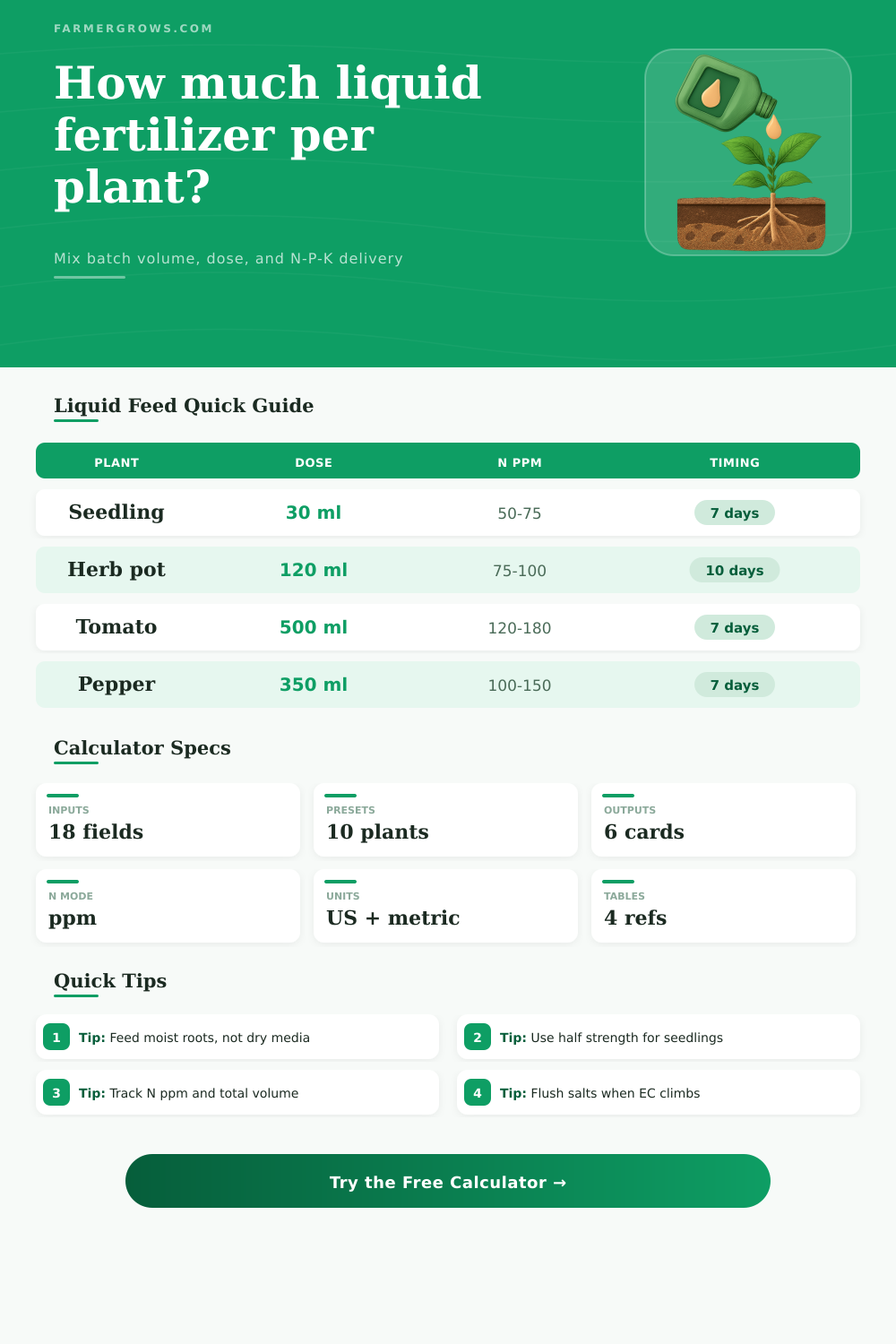
| Seedlings after first true leaves | 20 to 50 mL | 50 to 75 ppm N | 7 to 10 days | Start weak; avoid feeding dry plugs. |
| Small herb or leafy pot | 100 to 250 mL | 75 to 125 ppm N | 7 to 14 days | Keep growth steady without pushing soft leaves. |
| Fruiting container vegetable | 350 to 750 mL | 120 to 180 ppm N | 5 to 10 days | Match volume to root zone and irrigation frequency. |
| Hydroponic top-up or refill | System based | 120 to 200 ppm N | As reservoir drops | Monitor EC and pH when recirculating. |
| Field transplant starter | 150 to 300 mL | 75 to 150 ppm N | At transplant | Place solution near root ball, not on foliage. |
| Label rate unit | Metric equivalent | Per gallon equivalent | Best used for | Calculator handling |
|---|---|---|---|---|
| 1 teaspoon per gallon | 4.93 mL per 3.785 L | 4.93 mL/gal | Liquid concentrates in small batches | Converted to mL product. |
| 1 tablespoon per gallon | 14.79 mL per 3.785 L | 14.79 mL/gal | Common fish or organic liquids | Converted to mL product. |
| 1 fluid ounce per gallon | 29.57 mL per 3.785 L | 29.57 mL/gal | Large liquid batches | Converted to mL product. |
| 1 gram per gallon | 1 g per 3.785 L | 1.00 g/gal | Dry soluble fertilizers | Converted to grams product. |
| 1 gram per liter | 1 g/L | 3.79 g/gal | Metric soluble recipes | Converted to grams product. |
| Fertilizer analysis | N at 1 g/L | P2O5 at 1 g/L | K2O at 1 g/L | Use caution |
|---|---|---|---|---|
| 5-1-1 liquid or dry-equivalent | 50 ppm N | 10 ppm P2O5 | 10 ppm K2O | Mild, but odor and salts still matter. |
| 3-4-6 tomato feed | 30 ppm N | 40 ppm P2O5 | 60 ppm K2O | Good fruiting balance, watch repeated K load. |
| 20-20-20 soluble | 200 ppm N | 200 ppm P2O5 | 200 ppm K2O | Full-strength rates can be strong quickly. |
| 46-0-0 urea | 460 ppm N | 0 ppm P2O5 | 0 ppm K2O | Use precise scales and low rates. |
| Batch size | Plants at 120 mL | Plants at 250 mL | Plants at 500 mL | Mixing note |
|---|---|---|---|---|
| 1 liter | 8 plants | 4 plants | 2 plants | Useful for seedlings or houseplants. |
| 1 gallon | 31 plants | 15 plants | 7 plants | Common watering can batch size. |
| 2 gallons | 63 plants | 30 plants | 15 plants | Good for patio vegetables. |
| 5 gallons | 157 plants | 75 plants | 37 plants | Stir thoroughly before filling cups. |
Before feeding: Water-stressed plants can take up fertilizer unevenly. Apply liquid feed to evenly moist media, then adjust strength if leaf tips brown or EC rises.
Before scaling up: Mix a small test batch, check that dry fertilizer fully dissolves, and keep product records so ppm, dose volume, and interval stay consistent.
We hope we’re not harming our plants’ roots when we guess at the volume of liquid fertilizer we apply (but most gardeners do). Many people wrongly think of it as medicine where more is better. Too often, it is actualy an overdose that creates salt build-up. This can stops your desired growth. Often it’s not just a matter of if you’re feeding but of how much of what you’re delivering to each individual plant.
This is where you must reads past the generic label directions to see what the actual nutrient load for that root zone will deliver and get it right. Instead of focusing only on neediness (how hungry are they?) consider also capacity (what’s their size?). It makes sense, right: You wouldn’t give the same strength solution to a tiny cell-pack seedling that you’d offer a full-blown 5-gallon-bag mature tomato, but lots of people does, simply because it’s easier.
Stop Guessing: Measure Your Fertilizer Correctly
Enter your numbers; number of plants, target dose, and the calculator up top will do the figuring for you to turn the otherwise-confusing rate on labels into real-world amounts. Why should you bother shifting from guesswork to measurement? Tender baby roots are more easy shocked than tough older ones. High electrical conductivity can harms them, even when an established plant barely notices.
Most people get tripped up because they do not understand what happens when the concentrate is diluted down to the solution you apply. You can’t just look at a bottle of soluble powder or even a fish emulsion and think that it contains the amount of nitrogen that’s going to end up in soil. Unless you factor in how much you’re watering (batch size) and how much water you’re using (dilution ratio), there’s no way to tell.
For example, if you’re making a gallon of solution for use with a dozen herbs, do you know how many milliliters of product should of go into the gallon to reach your desired parts per million? Here’s how: The key concept is that bigger containers with more roots can holds greater amounts and strength of nutrient mix, buffering its impact more effective than small ones.
The other thing to keep in mind here: When do you apply these? Monthly full-strength drenching can cause osmotic stress; applying nutrients at a level equivalent to half-strength but feeding once weekly can be preferable to drenching with full strength every month (which tends to mimic more naturally availability of nutrients). The breakdown of weekly load of nitrogen gives you a visual cue on how much you’ve applied and whether your cumulative dose is heading into dangerous territory.
Some crops require greater amounts of potassium… For instance, peppers demands more K during their bloom phase. That’s where tweaking the N-P-K balance becomes as critical as managing total amount you put on. What you may discover is that there’s a shift in how your plants work that requires a change from a generic balanced feed to something slightly more tailored.
The one subtle variable that makes all the difference: How much runoff do you account for? What’s in the bucket isn’t necessarily what’s delivered (especially if you have a drip system where some is lost on the way out to the plants, or if you are using water containers without drainage holes). A little buffer added into the mix guarantees that last plant receives as strong a dose as the first. Sounds insignificant, until you see the row has one-sided growth and realize it was probably due to uneven delivery (not uneven biology).
And lastly: The efficiency of nutrient uptake depends on soil moisture. If the growing medium is dry when applying liquid fertilizer, it will quickly become concentrated in spots (which harms root hair). Feeding when the medium is moist help spread out the nutrients better. A little bit of pre-watering with plain water helps too; again, just a tweak in procedure but avoids the bitter flavor of salt burn on leaf tips.
Precision trumps intensity every time. Knowing exactly how much water each plant gets lets you stop guessing and start gardening with purpose. This transforms an irregular watering schedule into a reliable system that ensures your crops thrive and aren’t set back by surprises.