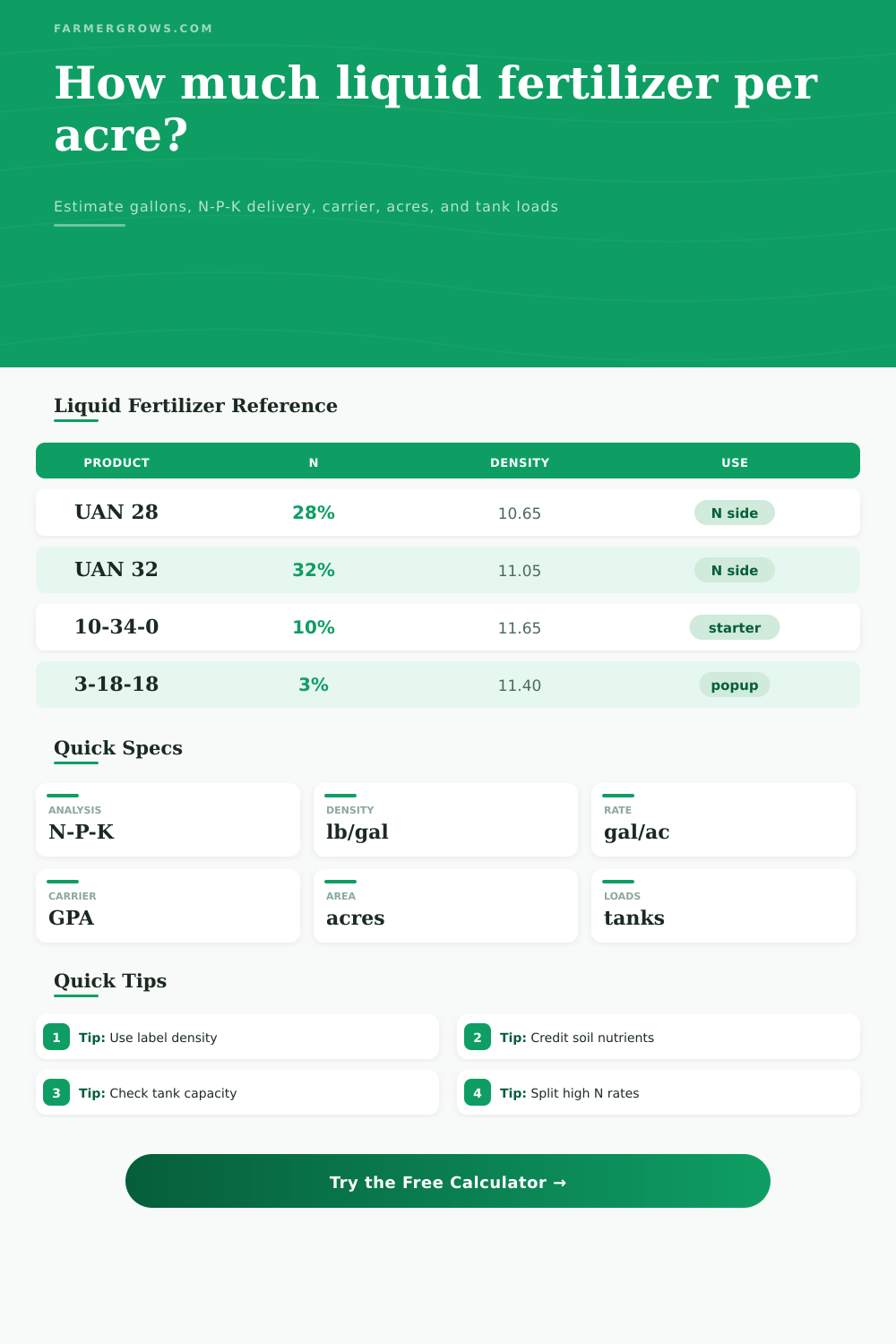
Liquid Fertilizer per Acre Calculator
Plan liquid fertilizer gallons per acre from label N-P-K analysis, product density, target nutrients, soil credits, application efficiency, carrier volume, acreage, and tank size.
Choose a common liquid program, then adjust acres, target nutrients, soil credits, density, carrier volume, tank capacity, and efficiency for the actual field plan.
Label analysis by weight
Target nutrients per acre
Soil, manure, or residual credits
Liquid Fertilizer Plan
Your application plan will appear here.
Calculation Breakdown
| Liquid product | Typical analysis | Typical density | Nutrient supplied per gallon |
|---|---|---|---|
| UAN 28 solution | 28-0-0 | 10.6 to 10.7 lb/gal | About 3.0 lb N per gallon before efficiency. |
| UAN 32 solution | 32-0-0 | 11.0 to 11.1 lb/gal | About 3.5 lb N per gallon before efficiency. |
| Ammonium polyphosphate | 10-34-0 | 11.6 to 11.7 lb/gal | About 1.2 lb N and 4.0 lb P2O5 per gallon. |
| Low-salt starter blend | 3-18-18 | 11.3 to 11.5 lb/gal | About 0.34 lb N, 2.05 lb P2O5, and 2.05 lb K2O per gallon. |
| Balanced liquid blend | 8-8-8 | 10.3 to 10.8 lb/gal | About 0.8 to 0.9 lb of each labeled nutrient per gallon. |
| Final volume target | Fertilizer rate example | Carrier added | Planning note |
|---|---|---|---|
| 10 GPA banded starter | 5 gal/ac product | 5 gal/ac carrier | Good for lower-volume planter or strip-till delivery systems. |
| 15 GPA sidedress | 10 gal/ac product | 5 gal/ac carrier | Enough carrier to improve flow while keeping nurse tank gallons moderate. |
| 20 GPA broadcast | 12 gal/ac product | 8 gal/ac carrier | Common planning point for liquid nitrogen or complete blend application. |
| 30 GPA fertigation fill | 8 gal/ac product | 22 gal/ac carrier | Higher water volume can help distribution in irrigation-driven applications. |
The calculator finds the gallons per acre required by N, P2O5, and K2O, then uses the largest required gallon rate so at least one target is met.
Enter a chosen liquid fertilizer rate and the calculator checks delivered nutrients, shortages, excesses, carrier gallons, total volume, and tank loads.
Final GPA must be at least the fertilizer GPA. If it is lower, the calculator flags that no water carrier remains at that setting.
Delivered nutrients are multiplied by the selected efficiency. Lower efficiency raises the target-sized fertilizer rate or creates a manual-rate shortage.
Total spray mix is divided by tank capacity to estimate full loads, a partial final load, fertilizer gallons per load, and acres per tank.
A product chosen for one nutrient may overapply another. Use the shortage or excess table before committing to the blend.
| Goal | Product | Approximate rate | What to verify |
|---|---|---|---|
| 60 lb available N/ac | UAN 28 at 85% efficiency | 23.7 gal/ac | Label density, nozzle suitability, and crop stage. |
| 80 lb available N/ac | UAN 32 at 85% efficiency | 26.6 gal/ac | Salt risk, placement distance, and weather window. |
| 30 lb available P2O5/ac | 10-34-0 at 90% efficiency | 8.4 gal/ac | Starter safety, seed contact rules, and row placement. |
| 20 lb available K2O/ac | 3-18-18 at 90% efficiency | 10.8 gal/ac | Blend compatibility and total salt near seed. |
| Tank size | Final volume | Acres per tank | Useful for |
|---|---|---|---|
| 300 gal | 15 GPA | 20 acres | Small fields, plot sprayers, and vegetable blocks. |
| 500 gal | 20 GPA | 25 acres | Pasture, hay, and moderate-volume broadcast work. |
| 1000 gal | 20 GPA | 50 acres | Row crop sidedress or preplant field operations. |
| 1600 gal | 30 GPA | 53.3 acres | High-volume spray, fertigation staging, or wide booms. |
Use the liquid label, not a dry analysis shortcut. Liquid fertilizer N-P-K is still percent by weight, so the density converts analysis into pounds of nutrient per gallon.
Check carrier and compatibility before loading. A nutrient-perfect rate can still be hard to apply if final GPA, salt safety, agitation, or tank mix order does not fit the equipment.
Sometimes it’s easy to get caught up in a few clicks of your mental calculator. You look out at field ready for spraying with your sprayer full and think, “I think I have the right rate of N…” Does that sound familiar? It does to a lot of farmers.
Applying liquid fertilizer seems naturaly, until you do some math about the economics; every time you turn that sprayer on, you’re literally dumping cash in the ground. Exact nutrient delivery are often more important than total quantity, getting it right means the difference between a profitable year and a break-even year. A lot of farmers goes by their rule-of-thumb guesses for years, until the price of crops changes, or the weather changes, or soil conditions change.
Why You Should Use the Fertilizer Calculator
If you want to know exactly what’s going into the ground (and what plant is really going to get), then you need to know exactly what you’re putting out. But there’s the catch with liquid nutrients: What does the label say? And what does field say?
The catch is this: You get an analysis, but it’s reported as X percent by weight, so you need to convert to density to know how many pounds of N (or P or K) are in a gallon. Just because gallonage on your plan sheet is close doesn’t mean a tank of UAN 32 is equivalent to one of UAN 28. Once you enter your density and label analysis into the calculator above, it figure it out for you. It converts those percentages into real-world numbers, showing exactly how many pounds of a nutrient you are applying per acre.
Because if you add twice as much of a concentrated product, you’ll add two times as much salt to that area near seed, risking damaging early plant growth. Most people mess this up with soil credits. Maybe you had manure applied in the fall or you grew cover crop last year that left some nitrogen in the ground. Unless you take these credits into account, you’ll apply a whole target rate and over fertilize field, risking runoff. But by using the tool, you can figure out what already exists in the soil so that you’re only replacing what’s not there.
That’s the part people don’t get right. They think about how much fertilizer they’re purchasing but not about overall nutrient balance of the soil. You should also adjust for efficiency. Not all the pounds of nitrogen you put down makes their way into the plant. Some is lost through volatilization, leaching and denitrification. Eighty-five percent efficiency are a reasonable estimate that helps buffer for this loss without going overboard on application.
The other logistics problem is carrier volume. Pouring forty gallons of concentrate on an acre doesn’t get the job done (evenly). To achieve uniform coverage, you must dilute the mixture with water and get it through your nozzles. The calculator tells you the amount of carrier water required based off your target number of gallons per acre, and therefore the number of tank loads that’ll do the trick for your particular field size.
It is a small detail, yet it are important to your time-management plans. Knowing that you’ll require three, rather than four, full loads lets you plan accordingly in terms of both labor hours and fuel stops. A reference table on the page shows you at a glance how tank capacity relates to the volume applied, providing a quick double-check prior to heading to field.
So in the end, it’s all about risk management: “I want just enough nutrient to produce a high-yield result, without applying so much as to cause environmental damage and/or waste my money.” And that’s where liquid has an advantage over dry granular, the ability to fertigate with drip lines or even side-dress at key growth periods. But there’s also a need for discipline that comes with such flexibility. You must adjust based off soil conditions, double-check your density, and keep track of what goes in and out.
In other words, when you go from guesswork to calculating the precise rate, you begin investing money into producing a crop instead of pouring cash down in the dirt. That mindset make all the difference on every acre you own.