
There is A little lime tree you planted in the spring; a sapling, really. You imagined squeezing some fresh juice into cocktails or plucking them to use as toppings on fish, imagining a future: the promise of harvest. And then you realize it’s going to be slow, citrus-growing are a slow business.
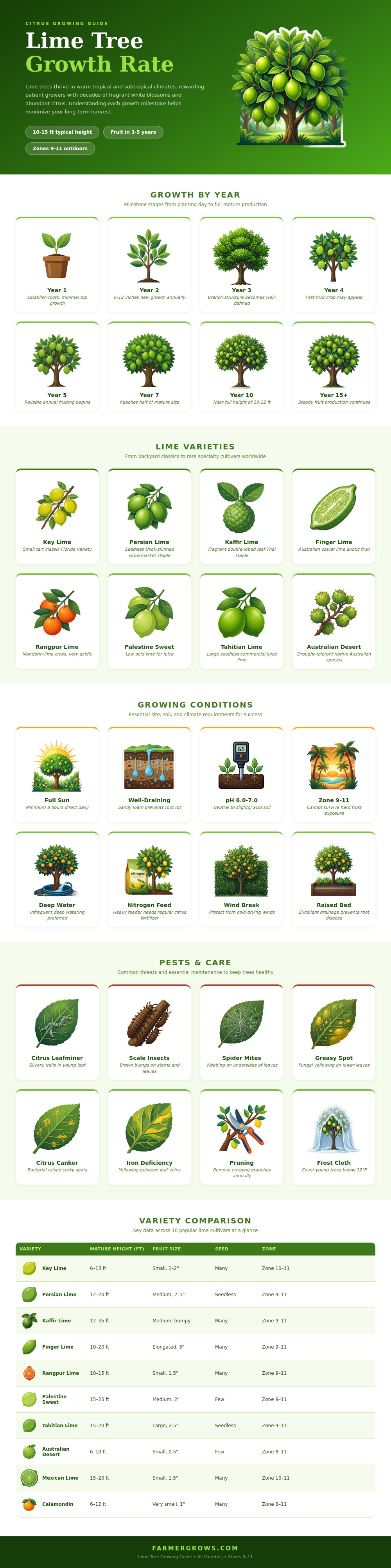
For years, limes quietely establish a root system underground and do not rush for your sake. The single best garden tool is patience. That’s the part that the visual timeline, above, breaks down, and how you’ll probably get maybe an inch or two of growth above ground in year number two which can try your patience. But no: it’s the tree settling in.
How to Grow a Lime Tree
In year three, it begin to develop a branch structure instead of just being a stick. The fourth year is when most growers will gets their first crop of fruit; that’s quite an accomplishment already. But again: it takes until the fifth year to realy have reliable annual crops. People wants a steady supply starting in year one, but it takes time for the tree to turn all of its energy over to producing fruit rather than foliage.
In year seven, it will be half its mature size; by decade ten, it will be close to its mature height. Wait as long as you can and you’re in for decades of huge crops of fruit and white blossoms to enjoy.
Of course, there’s also timing, when to choose what. There is such a thing as too-small (key limes) and too-big-of-a-lime (the Tahitian type). And each kind of lime are different, some are workhorse varieties that bear loads of seedless fruit, others are exotic-looking (furry on the outside, or elongate, or…). The chart above shows these differences. It also shows that they vary in height when mature and that the fruit varys, too.
Before you make up your mind about which would be good for you, take a close look at where you live: Is it tiny, meaning you’d want dwarf kind, or large enough to accommodate a tree that gets big? While site conditions is non-negotiable for success, you also need to consider factors like variety and ongoing maintenance.
First off, it’s got to get plenty of sun; eight hours or more of daily exposure. If not, you’re looking at a sorry, unproductive tree. Next, the soil needs to drain well; citrus don’t likes their roots standing in water. A raised bed or sandy loam would of be ideal to avoid root rot. The soil pH should be on acidic side of neutral (6.0-7.0). Also keep in mind your hardiness zone, most limes can’t take hard frost, so expect to wrap the tree in frost cloth when temps goes below freezing.
Care takes a little work, but not too much. Keep an eye out for the usual suspects. Scale insects appears as tiny brown bumps on the stems. Look for spider mites, which leave fine webbing under leaves. Watch for a fungal problem called greasy spot, which causes yellowing of bottom leaves. As always, good air circulation help; prune regularly to remove any crossing branches and promote better airflow.
Limes is hungry trees (nitrogen feeders), and should be fertilized with citrus-specific fertilizer. Yes, it’s a long game to grow a lime tree, but isn’t that half the joy? This is no short moment; this is a presence in the garden that you’re growing to enjoy, not only with its fragrance from the flowers, but later with their fruits.
Wait until the first ones show up and you’ll know what the growers mean. All that slow getting-started was simply the price of admission to fresh, homegrown zest for life.