Lime Requirement Calculator
Estimate lime tons per acre, total material, effective neutralizing material, and split applications from soil pH, buffer pH, texture, CEC, incorporation depth, and lime quality.
Load a common field situation, then adjust the soil test, crop target, product quality, depth, acreage, and maximum application rate.
Lime Recommendation
Results show 100% CaCO3-equivalent need, the corrected product rate, ENM requirement, and a practical split plan.
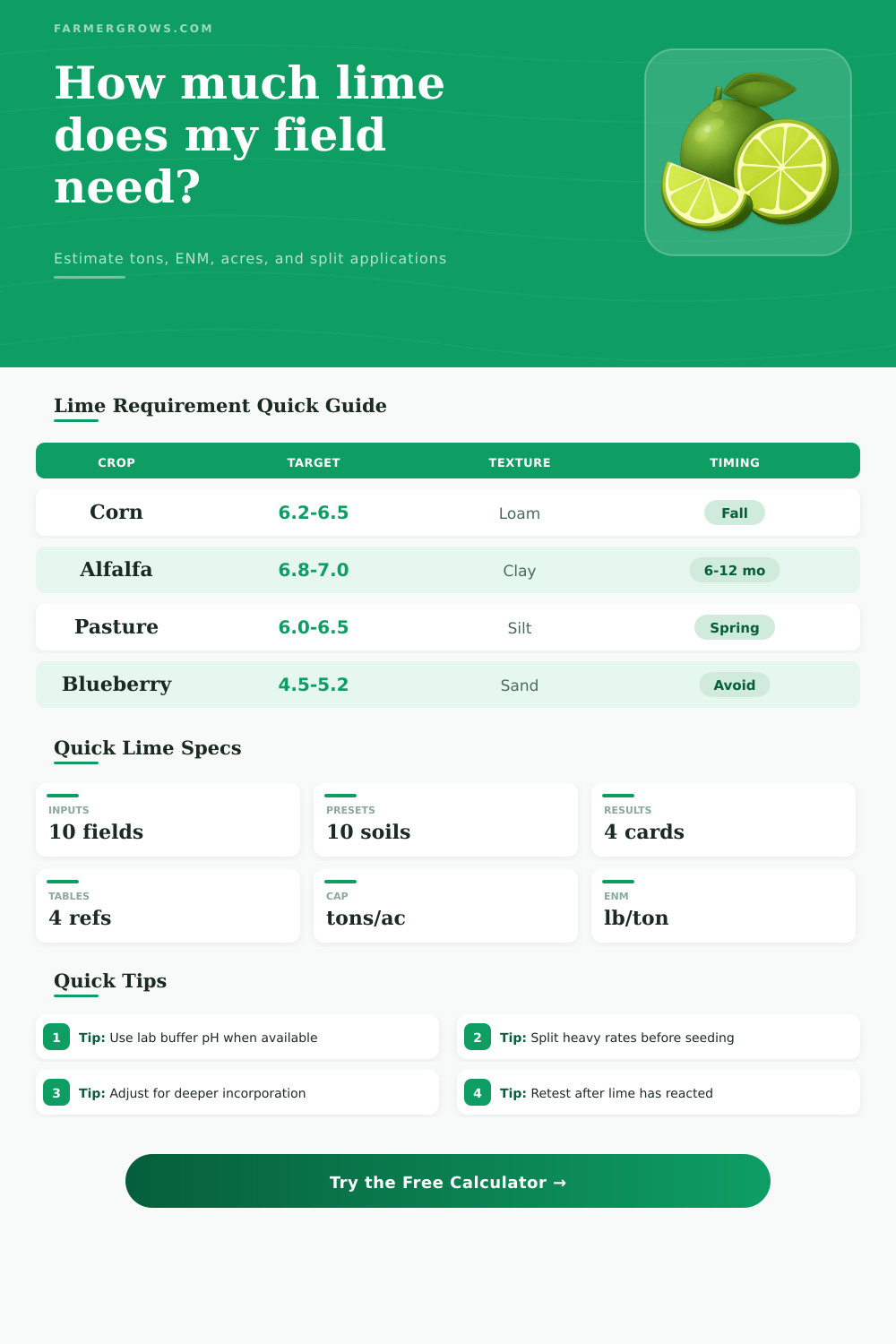
| Crop or use | Common target pH | Lime priority | Field note |
|---|---|---|---|
| Corn and soybean rotation | 6.2 to 6.5 | Medium | Works well for most mineral soils and broad nutrient availability. |
| Alfalfa and clover | 6.8 to 7.0 | High | Lime well before seeding because nodulation and stand life depend on pH. |
| Grass pasture or hay | 6.0 to 6.5 | Medium | Surface applications can help, but reaction is slower without incorporation. |
| Vegetable garden | 6.2 to 6.8 | Medium | Check crop exceptions before liming a mixed vegetable bed. |
| Blueberry and acid crops | 4.5 to 5.2 | Avoid | Do not lime unless the soil test target is above the current pH. |
| Soil condition | Buffer or CEC clue | Rate behavior | Planning note |
|---|---|---|---|
| Sandy soil | CEC 3 to 8 | Lower tons per pH unit | React quickly but avoid overliming low-buffer soil. |
| Loam soil | CEC 8 to 18 | Moderate tons per pH unit | Often matches standard extension lime tables. |
| Clay loam or clay | CEC 18 to 35 | Higher tons per pH unit | Reserve acidity can make split applications sensible. |
| Organic or muck soil | CEC 25+ | Highest buffer capacity | Use crop-specific targets and local soil test guidance. |
| Low buffer pH | 5.8 to 6.2 | More lime needed | Indicates greater stored acidity than water pH alone shows. |
| Material | Typical CCE or ECCE | Best use | Calculator setting |
|---|---|---|---|
| Calcitic ag lime | 85% to 100% CCE | Bulk field correction where magnesium is adequate | Use lab ECCE or enter ENM if listed. |
| Dolomitic ag lime | 80% to 100% CCE | Fields that need both pH correction and magnesium | Use the same ENM or ECCE correction. |
| Pelletized lime | High fineness, varied ECCE | Small acreage, hay topdress, or starter correction | Use a lower cap and actual label analysis. |
| High-calcium lime | 90% to 105% CCE | Calcium supply without extra magnesium | Use custom CCE/ECCE if quarry data differs. |
| Custom blend | Analysis required | Any material with a current lab sheet | Enter ENM first, otherwise ECCE and CCE. |
| Situation | Timing | Split trigger | Practical note |
|---|---|---|---|
| Before alfalfa seeding | 6 to 12 months before | More than 2 tons/ac | Incorporate the first pass before final seedbed work. |
| Row crop rotation | Fall or post-harvest | More than 3 tons/ac | Fall spreading gives more time for reaction before planting. |
| No-till surface lime | Any firm traffic window | More than 1.5 tons/ac | Surface pH changes first; subsoil response is slow. |
| Pelletized lime topdress | Near active growth | More than 0.75 tons/ac | Use repeated light rates rather than one heavy application. |
| Emergency low pH field | As soon as traffic allows | Always if very heavy | Retest after reaction before chasing the last pH point. |
Compare pH and buffer pH from the same lab method when possible. Switching labs can make small pH changes look larger than they are.
Moisture, fineness, incorporation, and time control pH response. Retest after the material has had a full reaction window in the soil.
Lime is used to change the acidity of an soil. However, lime isnt a fertilizer or a crop. Lime is used to control the pH of the soil.
The pH of the soil determine if the crop develops a normal root system. Many people just add lime to the soil according to a schedule that they know is correct. However, a correct application of lime to the soil should be based off the acidity reserve of the soil.
How to Use Lime to Control Soil pH
By using a calculator, you can find out how many ton of lime you should apply to each acre of your field. To use this calculator, you just have to enter the soil test results and the type of lime product you will use in your fields. Soil pH will tell you the acidity levels of your soil right now.
However, soil pH will not tell you how much lime you need to add to change the acidity of your soil. To find out how much lime you need to add to your field, you must perform a buffer pH test on your soil. If your buffer pH test comes up with a low reading, it means your soil contains a lot of hydrogen and aluminum ion.
These ions will replace the lime ions that you neutralize in your soil. Soils that contain clay or organic matter will require less lime than sandy soils. This is because clay soil and organic soil have a more higher cation exchange capacity.
Sandy soil has a lower cation exchange capacity. Therefore, sandy soil will require less lime to raise the pH of the soil as much as clay soil. The depth at which you incorporate the lime also matters.
If you incorporate the lime into the soil to a depth of six inches, you will incorporate more soil than if you applied the lime to the soils surface to a depth of two inches. The effective calcium carbonate equivalent, or ECCE, is a number that is used to ensure that your lime recommendation is accurate. The quarry that you buy your lime from may list the lime at 95 percent CCE.
However, when you add the lime to the soil, it may only neutralize 80 percent of the acidity in your soil. The lime calculator that is used to determine how much lime to apply to your fields takes this into account so that you do not apply too little lime to your fields. If your soil test results include an ENM rating instead of the ECCE, that ENM rating will also be used in the calculations to determine how many tons of lime will be required for your fields.
In some cases, you may need to apply the lime in split application. If the rate of lime that your soil requires is higher than the amount that you can spread in one pass with your lime applicator, you will have to split the application of lime to your fields. If the rate of lime that your soil requires is above two tons of lime per acre, it is possible to split the application of lime into two or three passes with your lime applicator.
For example, pelletized lime can be applied to hay fields. Surface lime can be applied to fields that are managed in no-till operations. By splitting the application of lime to your fields, the first pass of applying lime will react with your soil.
After the first pass, you can measure the pH of the soil, and then you can apply the remaining lime. Splitting the application of lime to your fields will ensure that you do not under-lime your fields. Furthermore, by splitting the application of lime, you will not apply too much lime to your fields at once.
The soil test results that the calculator uses may not reflect your field when you apply the lime to them. Variables like rainfall, manure applications, and tillage changes can change the pH of your fields between the time that you test the soil and when you apply lime to it. Therefore, it is best to use the lime calculator to size the job that you will have to perform.
Then, adjust the amount of lime that you apply according to the scales that your lime truck use to measure the amount of lime to be delivered. Applying lime to the fields may seem like a one-time process. However, you will have to apply lime to the fields again and again.
The pH of the soil will drift over time. The pH of your soil will drift if you remove large amounts of soil’s calcium and magnesium element by planting crops in the soil. Furthermore, the soil will drift in its pH if you regularly use nitrogen fertilizers.
Therefore, you should periodically test your fields to determine whether the pH of your soil drifted over time. The three-year retest cycle will allow you to detect any drift in the soil’s pH. Furthermore, by testing your soil, you can also determine whether the levels of magnesium in the soil have decreased over time.
If the levels of magnesium in the soil have decreased over time, you will need to use dolomitic lime rather than calcitic lime to replenish the soils element. In some cases, you will have to incorporate the lime into the soil. In other cases, the lime will remain on the soil’s surface.
By applying lime to the surface of the soil, you will change the pH of the top two inches of soil. However, to change the pH of the soil’s full rooting zone will take longer. If your crop requires that the pH of the soil is even throughout a six-inch layer of soil, you should apply lime to your fields in the season prior to planting your crops.
The number that the calculator produces are only as useful as the lime that you buy from the quarry. The numbers will only be accurate if the soil test results of your fields match the lime in the quarry. For this reason, you should always ask for the current ECCE or ENM sheet for the lime product that you are planning to use in your fields.
You should never rely upon the average ECCE or ENM of the lime product from the previous year. The change in the effective rating of the lime will change how many ton of lime you have to deliver to your fields. This will ultimately change the cost of the lime and the pH of the soil that your crops will experience.
Your lime application decision will have to take into account the soil test results of your fields and the lime calculator that will help to turn the soil test results into the number of tons of lime that your spreaders will spread across your field. Actually, you could of used more lime if you didnt check the ECCE first.