Lime Per Acre for Hay Calculator
Estimate hayfield ag lime from hay crop type, current soil pH, target pH, buffer pH or CEC, lime ECCE, correction depth, acreage, split timing, yield level, and total tons.
Choose a realistic hayfield situation, then tune the pH, buffer pH or CEC, ECCE, depth, acreage, and split plan to match your soil report.
Hay Lime Plan
Your lime recommendation will appear here.
Moderate lime need. Correcting pH helps nitrogen, phosphorus, and root growth pay back.
Highest pH target. Lime should be corrected before seeding whenever possible.
Legume persistence drops in acidic soils, so split lime early if the rate is high.
Surface-applied lime reacts slower, especially without incorporation and in dry seasons.
| Hay crop | Common target pH | Why it matters | Calculator behavior |
|---|---|---|---|
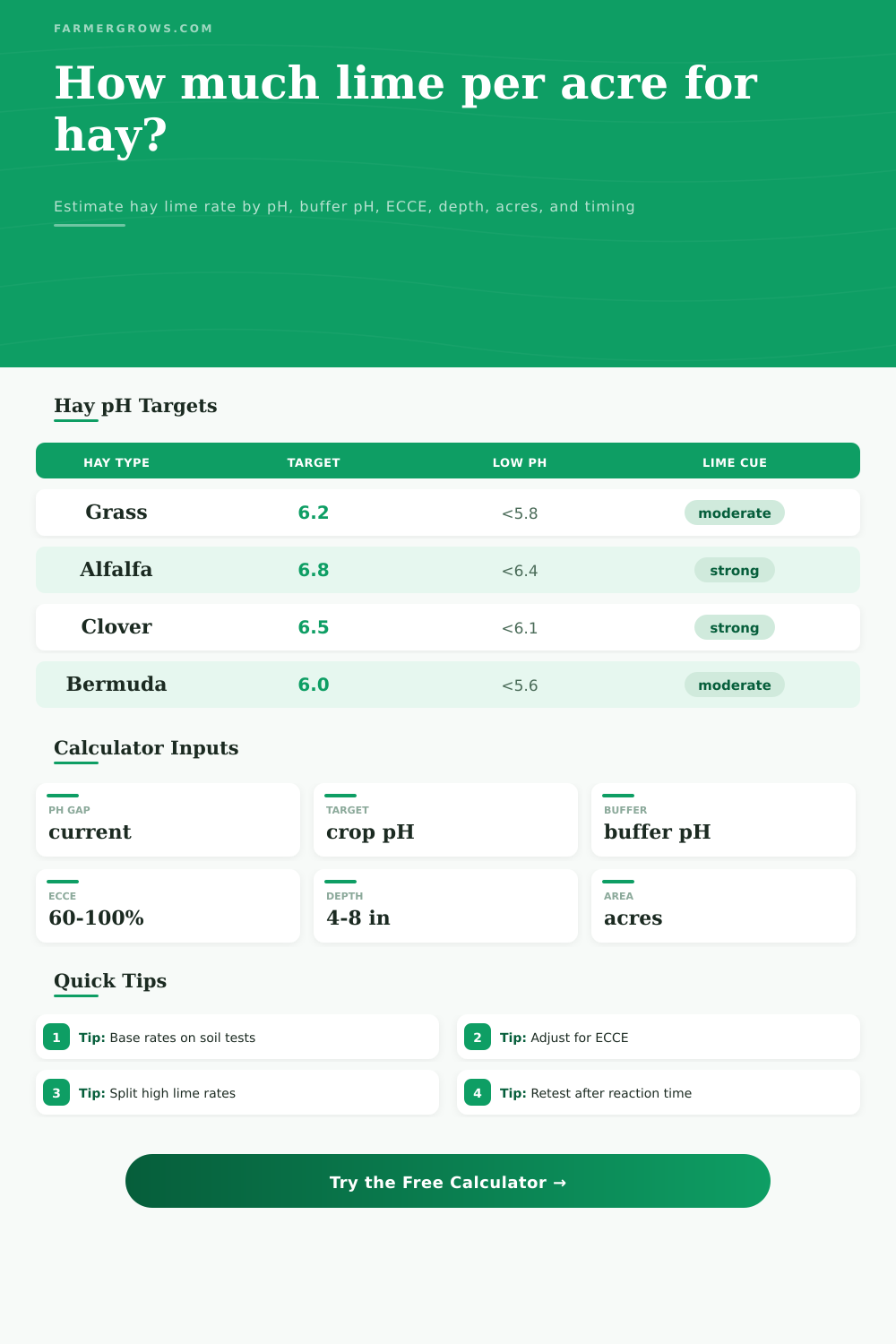
| Cool-season grass hay | 6.0 to 6.3 | Supports N response, tillering, and phosphorus availability. | Uses 6.2 unless custom target is entered. |
| Alfalfa hay | 6.7 to 7.0 | Rhizobia activity and stand life are sensitive to acidity. | Uses higher target and high-priority alerts. |
| Bermudagrass hay | 5.8 to 6.2 | Warm-season grass tolerates slightly lower pH than alfalfa. | Uses 6.0 and moderate lime priority. |
| Grass-clover hay | 6.3 to 6.7 | Clovers need better pH than grass-only fields. | Uses 6.5 and legume-sensitive notes. |
| Native meadow hay | 5.8 to 6.2 | Lower-input stands often need slower correction. | Uses 6.0 with conservative timing. |
| Soil buffering signal | Typical texture | Effect on lime need | Planning note |
|---|---|---|---|
| Buffer pH 6.8+ or CEC below 6 | Sandy or low organic matter | Lower reserve acidity | Smaller rates can move pH faster; avoid overshoot. |
| Buffer pH 6.5 to 6.7 or CEC 6 to 12 | Loam to silt loam | Moderate reserve acidity | Common hayfield correction range. |
| Buffer pH 6.2 to 6.4 or CEC 12 to 20 | Clay loam or high organic matter | High reserve acidity | More lime is needed for the same pH rise. |
| Buffer pH below 6.2 or CEC above 20 | Heavy clay or muck influence | Very high reserve acidity | Use soil-lab recommendations and split high rates. |
| Lime ECCE | Rate multiplier | Example for 2 tons/ac pure lime | Use case |
|---|---|---|---|
| 100% | 1.00x | 2.00 tons/ac | High-quality fine ag lime or pelletized lime. |
| 90% | 1.11x | 2.22 tons/ac | Common bulk ag lime planning value. |
| 75% | 1.33x | 2.67 tons/ac | Coarser or lower-neutralizing source. |
| 60% | 1.67x | 3.33 tons/ac | Low ECCE lime where more tons are needed. |
| Calculated rate | Suggested split | Timing window | Reason |
|---|---|---|---|
| 0 to 1.0 tons/ac | One pass | Any good spreading window | Light maintenance correction. |
| 1.1 to 2.5 tons/ac | One or two passes | Fall or after a cutting | Moderate acidity; fit around hay traffic. |
| 2.6 to 4.0 tons/ac | Two passes | Fall plus next off-season | Limits surface overload on established sod. |
| Above 4.0 tons/ac | Two to three passes | Over 12 to 24 months | Large correction should be verified by retesting. |
Use the lab recommendation first. This calculator estimates lime from pH, buffer pH, CEC, depth, and ECCE, but local soil-test calibration should override a generic planning number when your lab provides one.
Time lime around hay traffic. Fall, dormant-season, or post-cutting applications reduce wheel damage and give lime more months to react before peak spring growth or legume seeding.
Applying lime isn’t a quick fix. It’s a slow chemical process. Lime need to be applied precisely (at the right rate) and reacts slowly in the soil. Apply too little (and your alfalfa will start to fade), but apply too much (and you’ll see it sitting on the ground). Applying the wrong amount without a plan can cost you money, and your alfalfa.
When you input details of your soil test, the lime calculator do the math for you, so there’s no guesswork involved with conversion factors or coefficients. Target pH varies depending on what you are growing. The best pH depends on what you are growing. Cool-season grasses likes a slightly acidic pH (about 6.2), but they also needs it to be somewhat neutral so their nitrogen cycles correctly. Perfect isn’t necessary.
Why You Need a Lime Calculator
Not so with alfalfa; this one’s finicky about acid. Legumes like alfalfa prefer a pH nearer to 6.8 or above, which allow the nitrogen-fixing bacteria to work well in the root system. That means those guys can’t get it done if your soil is acidic, and no matter how much fertilizer you throw at it, you’ll have lower yields. Picking the right crop from tool’s list will help you meet your forage goal.
Another factor is that soil texture determine the level of acidity in your soil. A sandy soil has low buffering capacity; not much reserve acidity… And a little bit of lime will rapidly alter pH. In such circumstances, use light rates.
Conversely, clay soils/high-organic-matter fields has high buffering capacity; they suck up lime without raising pH. To make an equivalent adjustment, you must apply a heckuva lot more stuff. This is where the tool help. If it knows your soil’s cation exchange capacity (or its buffer pH), it adjusts rate to match, taking into account the soil’s resistance to change.
Quality also varies among limes, which is why effective calcium carbonate equivalent (ECCE) is important. A high quality pelletized lime with an ECCE close to 100% means that every pound count. Coarse bulk lime, soft marl, etc., can cost less but have an ECCE in the 60-70% range. That means you’re paying for filler if you don’t correct the rate based off a lower-quality product.
Fortunately, the calculator does this automatically; it calculates that a 2-ton requirement may require as much as 3.3 tons of lower-grade product, achieving the same level of neutralization. It saves money…and avoids under-correction.
With established stands, timing is everything. Lime spread over growing hay in spring sits on ground. It doesn’t react until rain comes along or tillage mixes it in. Applying half in the fall, after the last cut, means those winter rains will wash the lime down into the soil profile where they can do their work during rest. Apply the other half in next late summer, and you’ll have gradual improvement of soil chemistry but protect your crop stand.
You should of used more careful planning. If we’re thinking long term, liming is one of those investments in the future. Unlike nitrogen fertilizer that gives us an immediate shot in the arm, liming lays the groundwork for other nutrients to be effective. With proper soil testing and adjustments based off crop requirements and type/quality of materials used, slow chemistry becomes the solid base. Make your soil environment conducive to growing hay. That’s what converts costly rocks into money-making feed.