Lime per Acre for Clover Calculator
Estimate clover lime tons per acre and total tons from clover type, current pH, target pH, buffer pH, soil texture, ECCE percent, acreage, incorporation depth, and establishment timing.
Pick a clover field situation, then adjust pH, buffer pH, soil texture, ECCE, acreage, depth, and establishment timing to match the soil report.
Clover Lime Estimate
Adjust the soil inputs to calculate tons per acre and total tons.
Correct pH before final seedbed work so lime can mix into the root zone and support nodulation.
Surface lime helps, but reaction is gradual. Lime the season before if the current pH is far below target.
Keep surface acidity from creeping down, especially where nitrogen fertilizer or rainfall acidifies the topsoil.
Red clover responds well to corrected pH, better phosphorus availability, and active rhizobia.
| Clover type | Common pH target | Acidity concern | Calculator behavior |
|---|---|---|---|
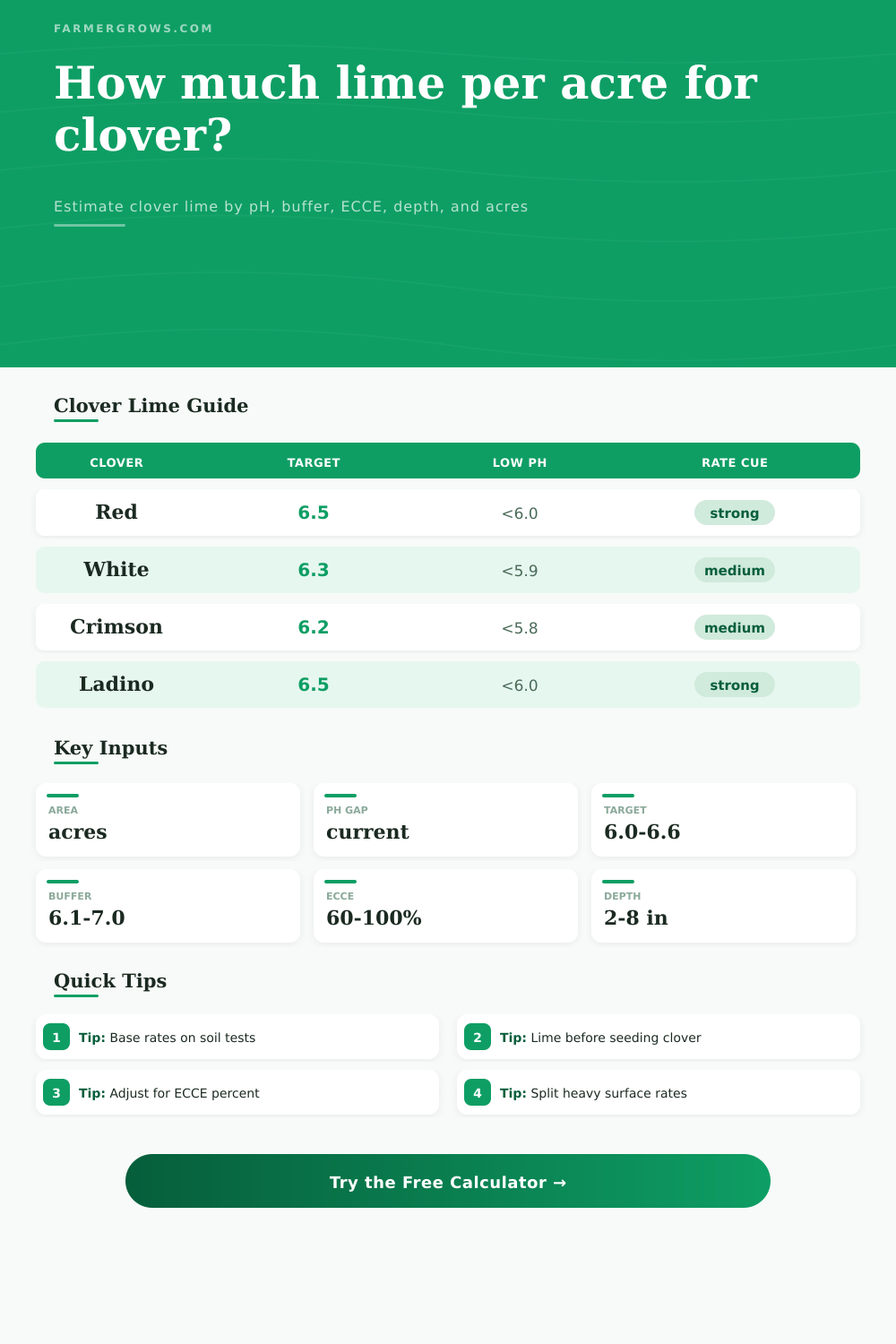
| Red clover | 6.3 to 6.7 | Low pH reduces nodulation and stand life. | Uses pH 6.5 unless edited. |
| White or ladino clover | 6.2 to 6.5 | Small seedlings struggle in acidic surface soil. | Uses pH 6.3 to 6.5 by type. |
| Crimson clover | 6.0 to 6.3 | Annual stands still need good early root growth. | Uses pH 6.2 for cover crop plans. |
| Alsike or berseem clover | 6.2 to 6.5 | Wet or annual fields need pH checked before seeding. | Uses moderate legume sensitivity. |
| Clover grass blend | 6.2 to 6.5 | Grass tolerates acidity better than clover. | Uses pH 6.4 as a balanced target. |
| Soil signal | Typical texture | Lime effect | Planning note |
|---|---|---|---|
| Buffer pH 6.9 or higher | Sand or low CEC soil | Lower reserve acidity | Small lime rates can move pH quickly, so avoid overliming clover. |
| Buffer pH 6.6 to 6.8 | Loam or sandy loam | Moderate reserve acidity | Common maintenance and preplant correction range. |
| Buffer pH 6.3 to 6.5 | Silt loam or clay loam | Higher reserve acidity | More lime is needed for the same pH gap. |
| Buffer pH below 6.3 | Clay, muck, or high organic matter | Highest reserve acidity | Use lab calibration and split large surface applications. |
| Lime ECCE | Rate multiplier | 2 ton/ac pure equivalent | Field note |
|---|---|---|---|
| 100% | 1.00 x | 2.00 tons/ac | High quality fine lime or pelletized lime. |
| 90% | 1.11 x | 2.22 tons/ac | Common planning value for bulk ag lime. |
| 75% | 1.33 x | 2.67 tons/ac | Lower neutralizing value or coarser grind. |
| 60% | 1.67 x | 3.33 tons/ac | Verify label quality before ordering extra tons. |
| Timing | Best use | Reaction expectation | Split cue |
|---|---|---|---|
| Fall before seeding | Spring frost seed or drilled clover | Gives rainfall and time for surface reaction. | Use one pass for light rates. |
| Preplant renovation | Tilled or harrowed seedbed | Fastest because lime is mixed into soil. | Can handle higher one-pass rates. |
| No-till into grass | Existing sod or pasture mix | Reaction is slower below the surface. | Split when above pass cap. |
| Established maintenance | Keeping clover in a stand | Steady surface correction over months. | Retest before repeating heavy rates. |
Use the buffer pH when you have it. Current pH shows acidity now, while buffer pH helps estimate how many tons of lime are needed to change the soil.
Lime early for new clover. If the rate is high and the stand is already seeded, split surface applications and retest before pushing pH past the target.
Order top-quality seed for red clover (and plant it properly!), but even then…you could end up with no crop at all because the soil chemistry isnt right. It’s not the fault of the seed, which does what it must do; its simply not the right chemical environment for it.
To be able to fix atmospheric nitrogen into its roots, red clover need a very particular pH range, one narrower than most grasses tolerate. Whether you have a mat of healthy red clover or a field full of weeds depends on getting the lime correct.
Why Lime Is Important for Red Clover
Once you know your soil test results, entering them in the calculator above makes the rest of the math happen for you. No more guesswork about conversions and coefficients that trip you up time after time.
First, start with the target pH; that’s what you’re trying to accomplish. For general use, red clover likes its soil at about pH 6.3-6.7 (meaning 6.3 is more acid than 6.7), while white clover will tolerate being somewhat more acid, maybe down to about 6.2. So if your starting pH was 5.6, you know you have some work to do.
How many bags of lime does it take to get there? That’s where the buffer pH comes into play. Regular old pH testing will tell you current acidity. Buffer pH tells you how much reserve acidity still exists in the soil to bring it back down. You want a higher buffer pH. Low numbers resist change and hold onto acidity tightly, so they requires additional lime.
The calculator takes all that resistance into account and adjusts accordingly, correcting below the surface instead of merely on top. The rate at which lime will work also depends greatly on soil texture. Clay holds everything in place, including acidity. It require much more lime to change the pH, but it holds that change longer. Sand doesn’t hold much. It has a poor ability to resist change, so the pH changes quickly and it releases nutrients fast.
In other words: If your soil is clay, don’t put down all the lime at one time. It won’t be as effective; lime needs a little time to work its way farther into the ground than the first inch, and splitting up application will help it get there. (That’s why the calculator has an option for split rates.) On heavy sod, putting three tons down all at once can just be wasting money, since it sits on the surface and doesn’t do anything. Spread the process out over a couple or even three passings, to get the stuff down to where it does good, to the roots, where the nodules of clover start forming.
Lime comes in different forms. Some of it doesn’t work well and some works better than others. Lime also has a calcium carbonate equivalent (ECCE) that ranges from 70-90% effectiveness in agricultural lime. To get the same chemical effect, a higher ECCE will require less material by weight. A low ECCE requires more weight. The lime calculator takes this into account and determines how many tons you should of order.
Because price-per-ton is often the lowest price feature, you may easily select the least costly product, but only the cost-per-unit-of-neutralizing-value will count! Pelletized lime is costly but is uniform and easy to spread, key when working on an uneven surface or small field.
The last variable that many of us forget is timing. Lime is slow. Adding lime to the soil doesn’t take effect immediately; it may take months to completely neutralize any soil acidity (unless you mix it with the soil). Liming in spring is too late for that season’s growth, even though frost seeding clover over an existing lawn is a great idea, so you really want your lime in the ground beforehand. Apply in fall so that winter rains and freeze-thaw cycles can work the material down into the soil profile.
Is it a good plan to ask clover to grow in bad soil and wait until planting day for it to adjust? Not such a great plan. Read your soil test results with care. Did it match the depths at which things was planted? For instance, a six-inch deep sample is typical in a seedbed, yet perhaps yours was not tilled and the active zone may not have been as deep. With the tool, you can change the acreage and even the sample depth to calculate total tonnage required for your whole field. No more panic of being partway into the spreading process and finding yourself out of lime!
Also: how will you do the job, logistically, and how much will it cost? Know before ordering; know where to go.
“The point of all this was to provide a stable environment in which the clover could live and work and not constantly get corrected. Clover also has the ability to fix nitrogen, which will benefit the overall farm system. However, if the soil isn’t within range (too acidic), it can’t do its thing. So getting the pH correct is the foundation. When we have the foundation then it’s easier to do the other things. Instead of fighting the soil, you’re working WITH the soil. When you have the correct inputs, it’s simple mathematics. Look at the numbers, make adjustments based off your own conditions and go with it. Turns out, growing clover ain’t so much about the seed but rather the space provided for the clover to live.”