Lettuce Seeds Per Hole Calculator
Estimate how many lettuce seeds to sow in each station, row spot, or plug cell using germination, field emergence, seed age, spacing, target plants, and thinning tolerance.
Lettuce seed is small, shallow-sown, and quick to thin, so the right seeds-per-hole number depends on seed freshness and how much blank space you can tolerate. This calculator finds the smallest seed count that reaches your reliability target, then estimates total seed needs and thinning work.
Lettuce Seeding Plan
Your lettuce seed plan will appear here.
| Lettuce use | Common seed count | Final spacing | Thinning goal |
|---|---|---|---|
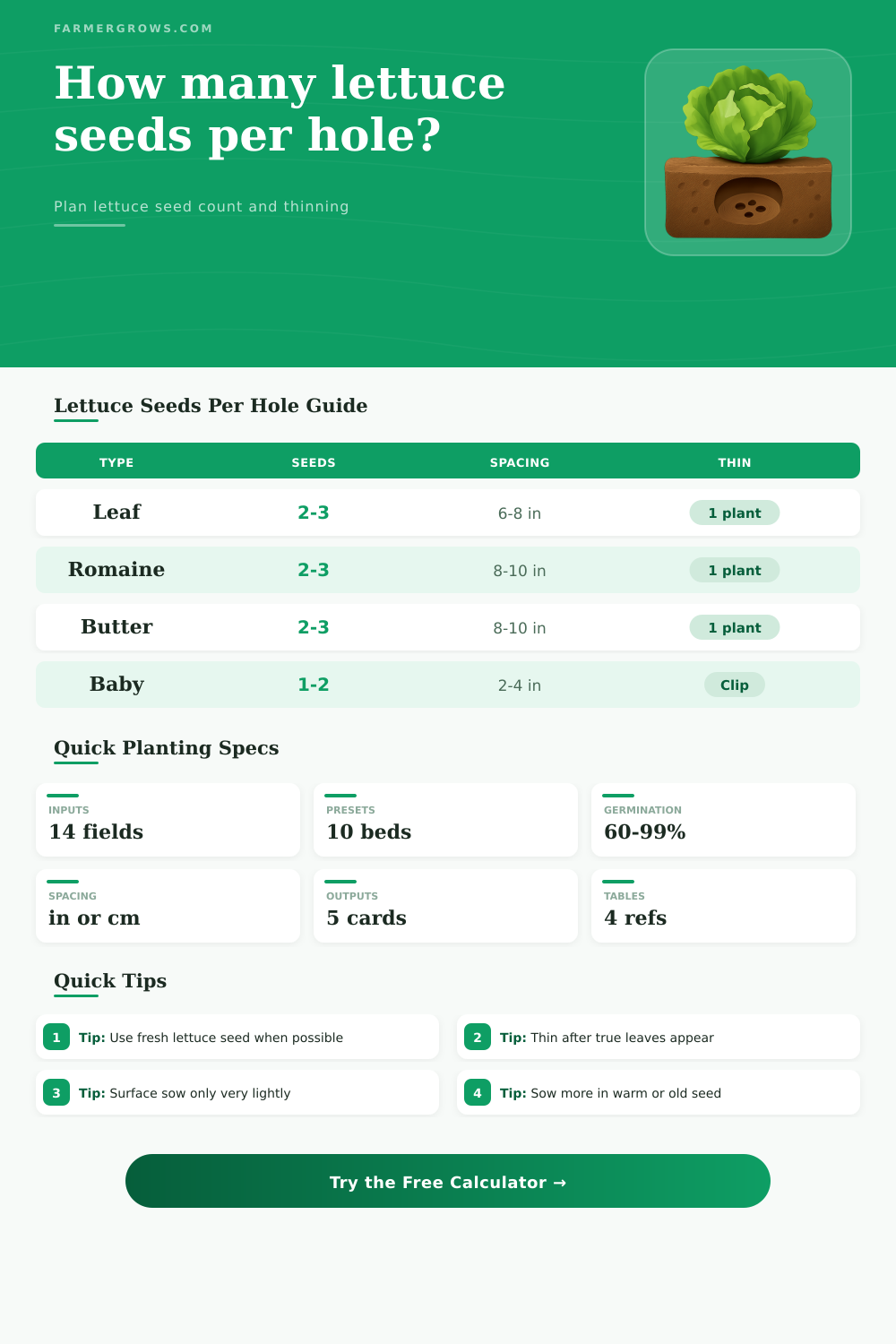
| Loose leaf heads | 2 to 3 seeds per station | 6 to 8 in apart | Thin to 1 sturdy plant or harvest extras young. |
| Romaine heads | 2 to 3 seeds per station | 8 to 10 in apart | Keep 1 upright plant with a strong central crown. |
| Butterhead heads | 2 to 3 seeds per station | 8 to 10 in apart | Keep 1 plant; crowded heads stay small and loose. |
| Crisphead lettuce | 3 seeds if direct seeded | 12 to 15 in apart | Thin carefully to 1 plant because heads need room. |
| Baby leaf cutting | 1 to 2 seeds per close spot | 2 to 4 in equivalent | Clip as greens; exact single-plant spacing matters less. |
| Plug trays | 1 to 2 seeds per cell | One cell per transplant | Snip extras, leaving the best seedling in each cell. |
| Seed success per seed | 1 seed reaches 1 plant | 2 seeds reach 1 plant | 3 seeds reach 1 plant |
|---|---|---|---|
| 90% effective success | 90% | 99% | 99.9% |
| 75% effective success | 75% | 93.8% | 98.4% |
| 60% effective success | 60% | 84% | 93.6% |
| 45% effective success | 45% | 69.8% | 83.4% |
| Bed example | Lettuce spacing | Estimated stations | Best use |
|---|---|---|---|
| 4 x 8 ft raised bed | 8 in rows by 8 in plants | 78 stations | Leaf lettuce or mini heads. |
| 4 x 8 ft raised bed | 10 in rows by 10 in plants | 50 stations | Romaine and butterhead heads. |
| 30 ft single row | 8 in between plants | 46 stations | Succession sowing along a path edge. |
| 72-cell tray | 1 cell per transplant | 72 cells | Indoor starts for transplanting. |
| Sowing condition | Emergence setting | Seeds per hole effect | Practical adjustment |
|---|---|---|---|
| Moist, mild, fresh mix | 85% to 95% | Often 1 to 2 seeds | Cover lightly and keep evenly damp. |
| Outdoor spring bed | 75% to 85% | Often 2 to 3 seeds | Use row cover if drying winds are likely. |
| Warm soil or old seed | 55% to 75% | Often 3 to 5 seeds | Sow extra and thin quickly after emergence. |
| Crusted or deeply covered | Under 60% | High blank risk | Improve seedbed before increasing seed too much. |
Thin by snipping: Pulling crowded lettuce seedlings can disturb the keeper plant. Snip extras at soil level when seedlings are easy to identify.
Watch heat: Lettuce seed loses vigor in hot storage and can germinate poorly in warm soil. Use the seed age and emergence fields when conditions are not ideal.
When you sow lettuce seed, it’s not arithmetic; it’s a matter of how much risk you’re willing to take in a small area. Don’t think “I’ll put in one seed and wait to see if it grows,” as with beans or corn. With those, you can drop in two in case one rots or gets eaten by slugs, or if the soil is too dry for that particular seed to sprout.
With lettuces, the issue is: How many to sow per hole? Too little, and you’ll end up with gaps here and there across your beds. Too many, and come spring you’ll be up to your elbows in plants, thinning the masses, a task nobody realy likes but everybody does eventually.
How Many Lettuce Seeds to Plant in Each Hole
With those conditions defined, the calculator above does the math, turning guessing into a probability model. It requires you to factor in germination rates, age of your seed, and the odds of emerging successfully on the ground. Many gardeners only learn about these factors when it’s already too late.
When the packet says “ninety percent,” it’s usually fresh seed sourced from a reputable company. Ninety percent sounds good, that is, if your conditions were lab-perfect. But outside, especially with cool-weather crops like lettuce, the soil temperature (warmth slows down their metabolism) can impede germination, causing seeds to give up long before breaking the surface. And crusty soil after a deluge? That’s a physical barrier beyond weak seedling power to penetrate.
The tool lowers the number of seeds you should plant, so you get not just hope, but a planting that matches what you’d hoped for achieve.
Before you’ve even opened the packet, choosing the appropriate lettuce variety determines your spacing strategy. For example, head types of lettuce (such as butterhead or romaine) require space to create their structure. Ideally, you’ll thin them down to just one strong plant per station eventually. Uniformity is the name of the game.
If you only sow one, odds are you’ll miss it completely if it doesn’t come up. If you sow three, you have a backup plan. You can still control the extra plants so they can be cut away easy.
Leaf lettuces play by different rules. Because you typically leave plants alone and just go out and pick outer leaves, rather than wait till the head forms fully, they can handle more density. This allows for somewhat lower per-spot dependability, since each plant doesn’t have to be perfect individually. In leaf-lettuce world, it’s more about total biomass, the more you have growing, the better your overall yield.
It’s laid out nicely on the page with their reference table; they match up desired spacings with the type of crop. As the table indicates, with baby leaf production, you’ll want to space things really closely, sometimes only two inches or even four between plants. That shifts the thinning discussion completely: Rather than eliminating competition, you’re managing it.
With a baby leaf situation, for example, you may decide to leave several plants together in a clump, then cut them all down as one when ready. It is a subtle but important detail when calculating your labor.
Head lettuce require precision thinning, with clean snips and a firm hand to get around each plant without disturbing its root system, the keeper plant. Snipping out seedlings at ground level rather than pulling them out by hand is faster and gentler. It means less jostling of their neighbors and less transplant shock. It also means less delay in getting going again, sometimes by a matter of days or weeks.
It’s more tempting to do now, while they’re still smallish and untangled, then later on.
Another level of complexity (that we can’t avoid) involves seed age. Unlike beans or tomatoes, lettuce seeds go stale pretty fast. Seeds that are two seasons old may not germinate as well as the packet originaly said they would. You can factor this into the equation: Just drop the expected emergence percentage to take this into account, which will then often suggest that you should increase the number of seeds per hole being sown.
That makes it feel counterintuitive… Why throw away more seed when I’m concerned about my quality? But sowing too few with older seed is the quickest route to empty holes. Those empty spots look awful and spoil the look of an otherwise-perfect bed.
Another key variable in how successful you will be is how deeply you sow. It matters, because lettuce seeds are light sensitive, which is why they need to be just under the surface (not buried) to really get going and pop up well. For most varieties, about a quarter inch or so is about right, the sweet spot.
Too deep, and the seedling has to expend more energy getting above ground level, using up its reserves before even starting to make food via sunlight; too deep also means blocking out light signal that tells it to grow. In addition to considering your soil conditions, the tool takes into account the preference for sowing depth to help you have a realistic expectation of when things may come up.
With careful management of moisture combined with shallow sowing, the odds favors you.
In short: How many seeds to sow per hole ultimately comes down to the intersection of making do with what space you have while also attempting to account for the unpredictable biology of growing thing. Your goal is to establish a complete stand. But not at the cost of a thinning hell-storm.
So even though the tool spits out numbers, they’re not hard-and-fast dictates so much as educated guesses rooted in probabilities. Use those numbers as a starting point for your sowing strategy, but adjust them up or down based off how well you know your local garden microclimate.
Getting lettuce right goes beyond any single green shoot emerging; it starts long before that. Before the first bolt, it’s all about crunching the numbers and preparing for the variables that will inevitably be tossed into the mix by nature. Get the number of seeds correct early on and you save yourself a race to perfection later, when the heat arrives and the bolts begin to show themself.