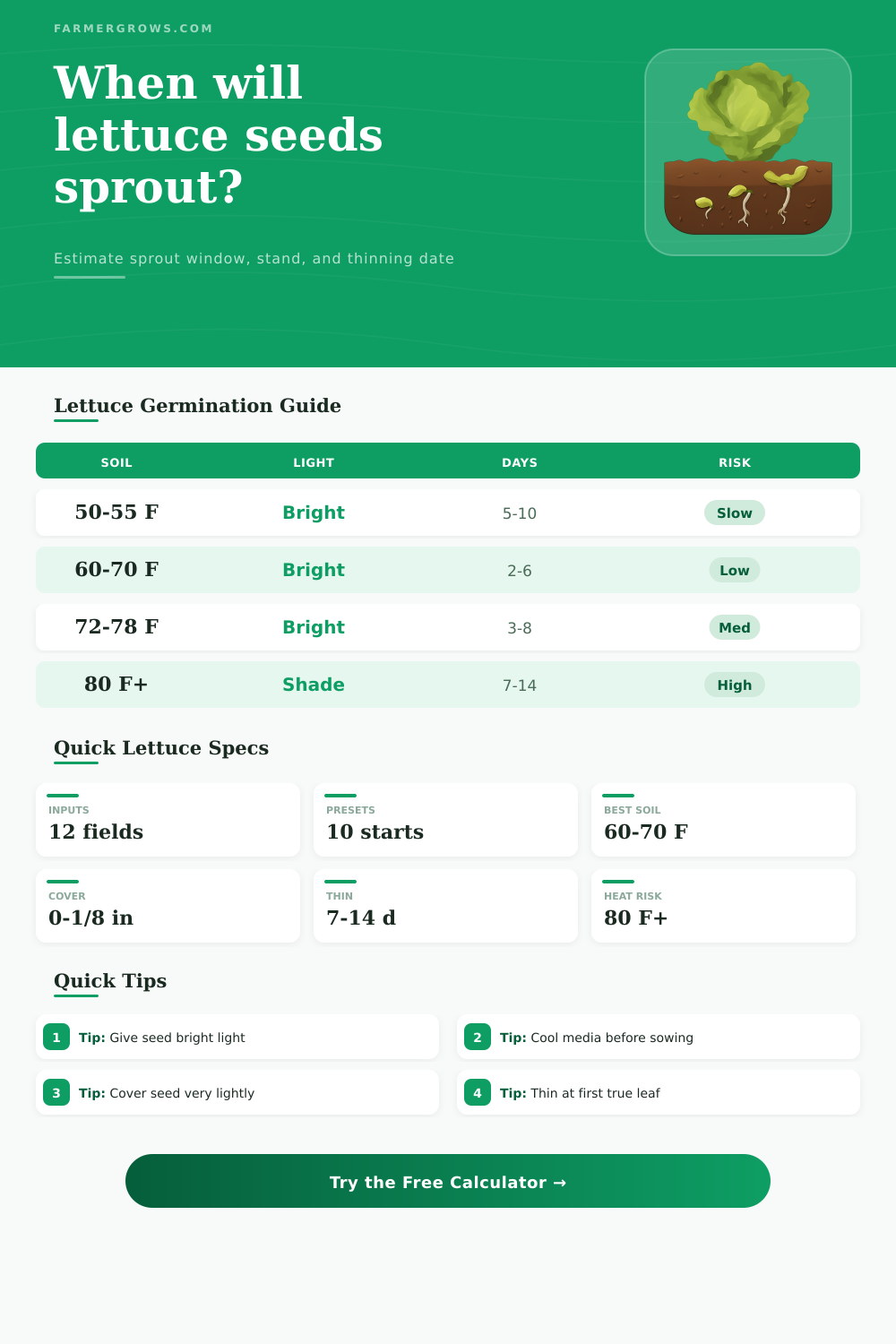
Lettuce Seed Germination Time Calculator
Estimate lettuce sprout dates, heat dormancy risk, expected stand count, and thinning date from seed-zone temperature, light exposure, cover depth, seed age, and sowing density.
Lettuce seed is small, often benefits from light, and can stall when the seed zone gets hot. This calculator is for germination and early thinning, not romaine head maturity, iceberg heading, or hydroponic grow-out schedules.
Lettuce Germination Estimate
Adjust the seed-zone temperature and light exposure to estimate lettuce emergence.
| Seed-zone temperature | Typical sprout window | Expected stand | What to watch |
|---|---|---|---|
| 40 to 45°F / 4 to 7°C | 7 to 14 days | Uneven but possible | Cold soil delays the first hooks and extends thinning. |
| 50 to 55°F / 10 to 13°C | 5 to 10 days | Moderate to good | Good for direct rows if the surface stays moist. |
| 60 to 70°F / 16 to 21°C | 2 to 6 days | Best stand | Usually the fastest reliable lettuce germination band. |
| 72 to 78°F / 22 to 26°C | 3 to 8 days | Fair to good | Use light, shade, and cool water to avoid hot pockets. |
| 80°F+ / 27°C+ | 7 to 14+ days | Unreliable | Heat dormancy can prevent or delay lettuce seed sprouting. |
| Light setup | Cover depth | Germination effect | Best use |
|---|---|---|---|
| Surface sow in bright indirect light | 0 to 1/16 in | Fastest for many lettuce lots | Trays, flats, and carefully misted beds. |
| Thin vermiculite or sifted mix | 1/16 to 1/8 in | Good moisture hold with some light | Plug trays and outdoor rows. |
| Covered dark until check | 1/8 in or more | Can slow light-sensitive seed | Only when drying is the bigger risk. |
| Direct hot sun on tray | Any depth | Raises heat dormancy risk | Avoid; move to bright shade during germination. |
| Cool pre-moistened media | 0 to 1/8 in | Improves warm-weather starts | Late spring, summer crisp, and fall starts. |
| Starting style | Common sowing density | Thin when | Keep spacing target |
|---|---|---|---|
| 128-cell plug tray | 1 to 2 seeds per cell | 7 to 12 days after emergence | One seedling per cell. |
| 72-cell plug tray | 2 to 3 seeds per cell | First true leaf begins | One strong seedling per cell. |
| Open flat | Light broadcast or small rows | When cotyledons expand | Prick out before roots tangle. |
| Direct garden row | 4 to 10 seeds per foot | Seedlings are easy to grasp | Thin according to final lettuce type. |
| Baby leaf bed | Dense broadcast | Usually no single-plant thinning | Thin by early cutting if crowded. |
| Condition | Timing effect | Stand effect | Correction |
|---|---|---|---|
| Seed zone over 80°F | Adds days or stalls sprouting | Lower final stand | Cool media, sow evening, or refrigerate moist seed briefly. |
| Surface dries after sowing | Uneven second flush | Patchy stand | Mist gently and use a thin moisture-holding cover. |
| Seed buried too deep | Delayed emergence | Weak seedlings | Use only a dusting of fine mix or vermiculite. |
| Old seed lot | Slower and wider window | Lower stand percent | Sow extra seed and test a small sample first. |
| Wet heavy media | Slower oxygen exchange | Damping-off pressure | Use airy mix and vent covers after sprouting. |
Cool first, then sow: For warm-season lettuce starts, moisten the mix with cool water and keep trays in bright shade until the first hooks appear.
Thin early and gently: Lettuce seedlings stretch fast when crowded. Clip extras at soil level once the first true leaf is visible.
Seedlings do best if kept cool and moist; lettuce require special care for germination (it’s a small seed and fussy). Keep the soil cool, keep it moist and don’t let summer come to soon.
Above: With this tool, you enter your own location variables into the equation, specifically, those about light and soil conditions, and it will tell you if you’re likely to have had seeds destroyed by hot weather, or simply slowed down. Instead of taking actual soil temperatures with a thermometer, most of us just record air temperature. Which can be misleading in springtime, since the soil warm and cools at different rates. Soils in the range of 60-70 degrees F are ideal for fast germination. Below fifty, things slow way down. This is not so bad if you can wait a bit. However, it can be potentialy dangerous, since the seed may die before popping up if medium dries out while waiting for them to arrive. Above eighty degrees, seeds goes dormant until cooler times; which looks like death, but isn’t. They won’t start.
How to Grow Lettuce Seeds
Since proper seed germination requires light (especially for lettuce), it’s good that the calculator asks whether you are starting seeds in covered or uncovered containers. It also ask how deeply they are buried beneath a covering. If the seed is to far buried to get any light, the process doesn’t happen. I use sifted potting mix or some vermiculite to cover the seeds, not enough to bury but just enough to hold in moisture while letting the light shine through. Seeds left exposed can bake if there isn’t even a bit of mulch to help retain moisture. An inch-deep covering would make it hard for them to work their way upward, and besides: too much soil above a seed weigh it down. There has to be a balance between anchoring it into place and not smothering it.
The reference table in the tool offers guidance for different starting techniques, ranging from direct seeding to using plug trays. You also need to know how old your seed is: It’s one of those things that people forget about until something goes wrong, but seed age does affect both the rate of germination as well as uniformity. Fresh seed from this year will be quick to sprout, and equally quick to emerge. Old seed (say, stored in your garage for four years) might emerge eventualy, but not all at once, nor as fast. To reflect that variable, the calculator factors the age of your seed lot into its prediction of when each might sprout. With older seeds it predicts fewer stands and a broader emergence time frame. In other words, plan on sowing heavier to account for reduced vigor in older seed. This is not a penalty, but just biology. Older seeds simply requires more time to get their shells off.
How much moisture will the germinating seeds get once they are planted? If it’s a bone-dry situation, forget it, lettuce babies aren’t going to go hunting around for hydration. You need to keep soil gently and consistently moist from the time you sow the seeds until first real leaves grow. How do you plan to water, under a humidity dome, perhaps? Or maybe just with mist sprays? This factor affects the calculator. Will a vented dome provide adequate humidity without causing dampness that invites damping-off disease?
It’s hard to resist keeping them all if you’re a beginning grower, but it’s important to thin. Crowded plants will not grows well; instead, they’ll reach for light by growing long, straggly stems. The tool finds the thinning day based off how many days you estimate it takes for plants to emerge (typically one week to two weeks from sowing, when first true leaves appear). If you clip off extras right down at ground level, you won’t damage any roots in the selected survivors.
No need to rush; seeds will emerge when they’re ready, if you give them the correct conditions: cool and moist, not hot and dry. The chart can help by giving a time frame, and also helps with thinning and planning steps. Monitor the soil temperature, not the sky, to know when things are right. Keep it cool and moist all along, and have faith that it would of worked.