Lettuce Plants Per Square Foot Calculator
Plan square-foot lettuce density by type, spacing, bed geometry, planting pattern, thinning, germination, survival, and succession schedule.
Choose a real lettuce bed scenario, then adjust spacing, row layout, bed count, seed buffer, and successions to match your crop plan.
Your Lettuce Planting Plan
Results update as you change the lettuce spacing and succession inputs.
Highest density for small leaves, quick cuts, and salad mix beds. Usually direct seeded and thinned lightly.
Flexible spacing for home gardens. Harvest whole plants young or pick outer leaves as plants expand.
Soft heads need more air and crown space than leaf lettuce, especially in humid weather.
Upright plants fit tighter than crisphead but still need enough shoulder room for full heads.
These tables use common extension-style spacing ranges. Seed packets and local trial results should override any generic planning value.
| Lettuce type | Common final spacing | Plants per sq ft at square spacing | Best use |
|---|---|---|---|
| Baby leaf salad mix | 2 to 4 inches after thinning | 9.0 to 36.0 | Quick baby greens, broadcast or close rows |
| Looseleaf lettuce | 3 to 6 inches | 4.0 to 16.0 | Leaf harvests, home beds, cut young |
| Butterhead or bibb | 6 to 8 inches | 2.25 to 4.0 | Soft heads with moderate airflow |
| Romaine or cos | 8 to 10 inches | 1.44 to 2.25 | Upright full heads or mini heads |
| Crisphead or iceberg | 10 to 12 inches | 1.0 to 1.44 | Largest heads, widest spacing, cooler season |
| Spacing pattern | Density formula | When it fits | Planning note |
|---|---|---|---|
| Square grid | 144 / spacing / spacing | Square-foot beds and intensive beds | Use equal plant and row spacing |
| Straight rows | 144 / plant spacing / row spacing | Market beds with row seeders or transplants | Wider rows reduce plants per square foot |
| Staggered rows | Straight row density x 1.15 | Offset transplants in wide beds | Useful for romaine and butterhead air flow |
| Broadcast then thin | Final plants by desired spacing | Baby leaf, salad mix, direct seeded leaf | Extra seedlings are expected and removed |
| Bed width | Row spacing | Approx rows with 3 in edge | Common lettuce fit |
|---|---|---|---|
| 24 inch bed | 6 inches | 4 rows | Leaf lettuce or mini heads |
| 30 inch bed | 8 inches | 4 rows | Butterhead or compact romaine |
| 36 inch bed | 9 inches | 4 rows | Romaine, bibb, or mixed heads |
| 48 inch bed | 12 inches | 4 rows | Large romaine or crisphead spacing |
| 48 inch bed | 8 inches | 6 rows | Looseleaf or mini romaine successions |
| Succession goal | Typical interval | Good lettuce types | Density adjustment |
|---|---|---|---|
| Home salads | Every 2 to 3 weeks | Leaf, butterhead, mini romaine | Plant smaller blocks more often |
| Market heads | Every 1 to 2 weeks | Romaine, butterhead, crisphead | Use realistic survival and harvest loss |
| Baby leaf | Every 1 week | Baby leaf and salad mix | High seed rate, lower final plant count |
| Fall heads | Every 2 weeks | Romaine, butterhead, crisphead | Spacing can be slightly wider as plants size up |
Thin early for head quality. Lettuce left too crowded may stay small, trap humidity, and bolt sooner. Clip extra seedlings instead of pulling when roots are close.
Use successions instead of one large planting. A small bed planted every 1 to 3 weeks usually gives steadier lettuce than one dense block maturing all at once.
Treating lettuce like it appears magically in the soil is one way to wind up with bitter, bolted leaves. You might start out with high hopes for a great salad harvest, but then you stop there. In truth: It’s all about the mechanics of lettuce. Lettuce is a crowd creature. Crowded, and it’ll be rowdy; spread out, and it will get leggy.
Enter the geometry of it all into the calculator above, and you provide common sense. Know this: An iceberg-type crisphead is a structure-building thing, so it needs some serious shoulder room. So what’s next? That’s where decisions begin: What kind of lettuce will it be? And how much space will it require?
How to Space Your Lettuce Plants
For a baby leaf salad mix, the thing you’re making when you want salad greens packed with freshness, you’ll choose density. Because you’re going after the youth, you won’t wait until they develops a head. Instead, you’ll harvest them young, nine to sixteen plants per square foot.
But switch to butterhead or romaine, and numbers flip. Now each plant need a bit of elbow room (six to eight inches). With these pre-sets toggled on your tool, it spares you having to do any math in the dirt.
It also factors in survival rate (not all seeds survive). In gardening, germination rates don’t work out very well. The packet says it’s guaranteed to sprout nine times out of ten; your garden may come back with seven. It wants to know how many thing will grow (that’s what germinates), and how many will survives (your survival rate). This is the one people tend to skim over.
How can you know? Because life isn’t tidy; you enter a margin for error. What if you plant right to the math, and suddenly three of those seedlings are gobbled up by slug? Now you’re behind. Then there’s extra seedlings you thinned, or a few that didn’t make it through transplant shock: Your last figure is how many actualy made it to harvest, not all the ones who poked up their first little green nub.
Spacing patterns also makes a difference, and not in ways you might imagine. For instance, straight rows are easy to imagine. However, staggered rows pack roughly fifteen percent more plants into a given width of bed space, while still leaving them enough room not to crowd each other. It’s a little geometric trick; feeding-the-family math, as I call it, that adds up when there’s a lot of family to feed.
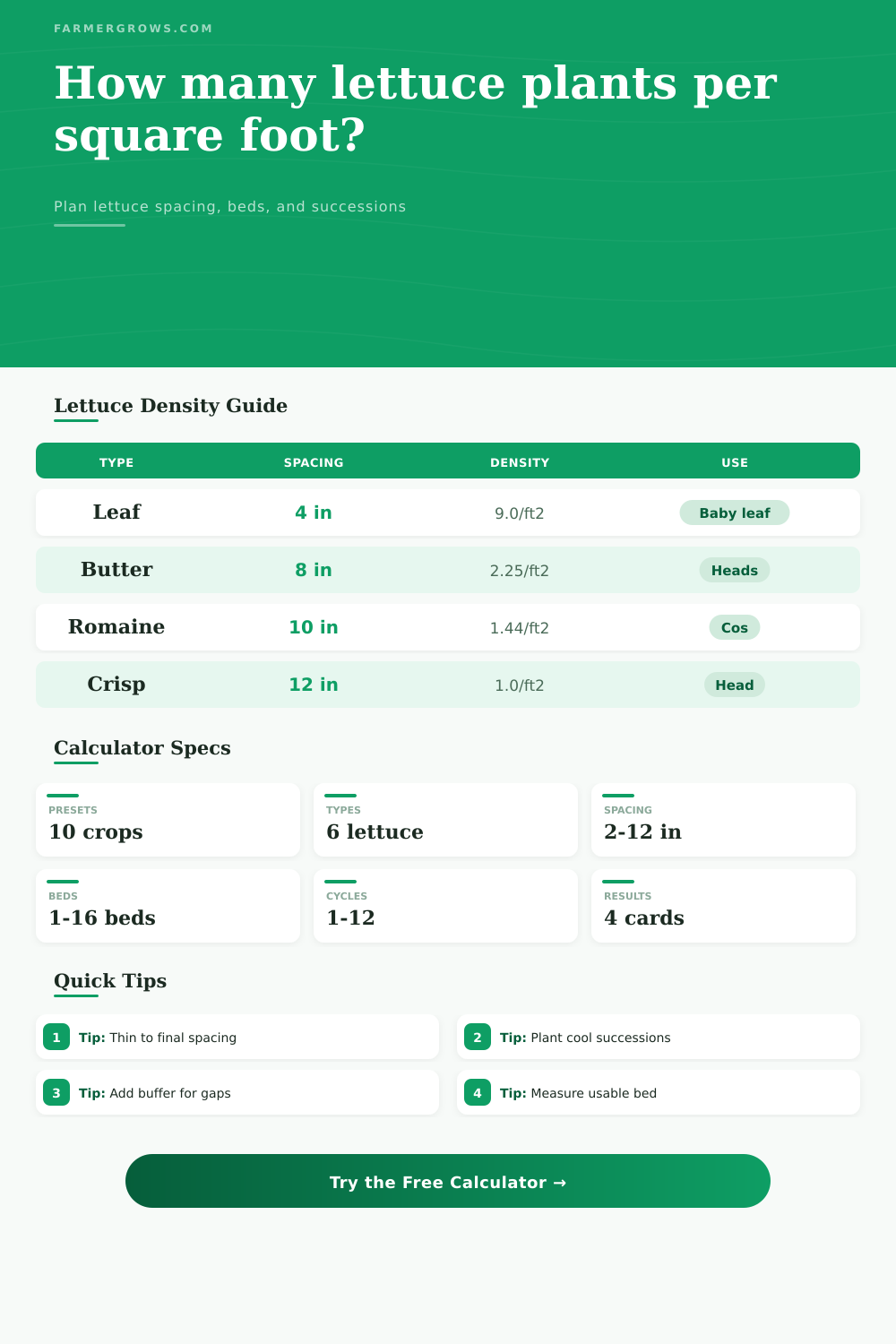
That chart on the page makes it clear: If you space crisphead lettuce, say, every 12 inches apart, you’re going to get just one plant per square foot. Sounds low? Those icebergs will grow to be huge. You shouldn’t of try cramming two of them onto a square foot; it’s a recipe for disease.
The unseen ingredient here is airflow. Humidity invites fungus and rot; crowded lettuce traps humidity. You want your plants to ventilate; you don’t want them steaming.
That’s when things get serious: succession planting. No, you don’t go out and plant everything at once, or you’ll be looking at a big pile of lettuce and months of empty spots in your bed. Here’s how it works with the calculator: Set your desired interval (every two weeks?); set your harvest window. Now it’s all about building a schedule, not just scheduling one event. You’re making salad supply chain.
The output will tell you what the average is each week and also show you the grand total of harvestable plants. Not enough for you? Don’t plant another seed this instant. Plant earlier. Timing is everything.
And also consider actual useable space in the bed. Few are perfectly edged. There’s drip line space that takes up real estate. You have to be able to get your hands in there to grab the heads. The tool gives you a percentage reduction for those realities. Better to plan on using 85 percent of the bed, different than plan on every single square inch and find out otherwise. A mature gardener plans for loss.
Growing lettuce is really not about forcing anything to grow so much as it’s about making things fit. It’s about placing plants in a limited space. A room. Measure twice, plant once; make some wiggle room for what happens out there anyway. Your eyes will tell you, but the numbers leads you.