Lentil Seeding Rate Calculator
Estimate lentil seed rate from target plants per square foot, seed size, TKW, germination, purity, emergence loss, row spacing, inoculation or treatment choice, and acres.
Use the seed tag for germination and purity, then enter the actual thousand kernel weight for the lot. The calculator raises seed rate when emergence risk is high and shows how the same target stand changes by lentil class and row spacing.
Seeding Rate Results
Enter a lentil seed lot and field target to calculate rate.
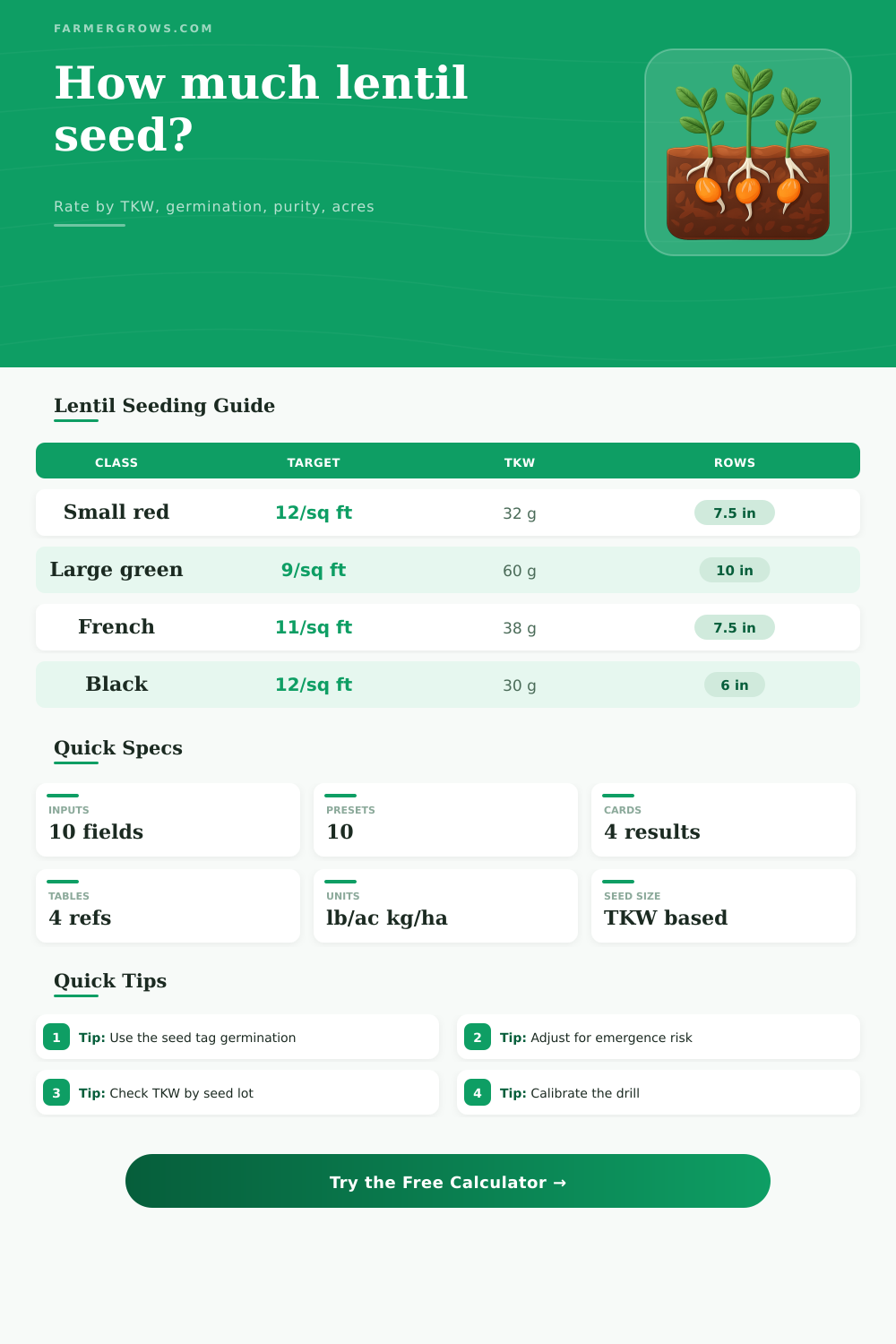
| Lentil class | Typical target plants/sq ft | Typical TKW | Planning note |
|---|---|---|---|
| Small red | 10 to 14 | 30 to 38 g | Often seeded dense enough to compete and canopy quickly. |
| Large green | 8 to 11 | 55 to 70 g | Large seed size can raise lb/ac even at moderate populations. |
| French green | 10 to 13 | 35 to 45 g | Good fit for tight rows and a balanced plant stand. |
| Black beluga | 11 to 14 | 25 to 35 g | Small seed requires careful drill metering and shallow placement. |
| Spanish brown | 9 to 12 | 40 to 55 g | Use local variety guidance when market class is specific. |
| TKW | Approx seeds/lb | Seed size reading | Rate effect at same stand |
|---|---|---|---|
| 28 g | 16,200 | Very small | Lower pounds per acre; watch metering precision. |
| 32 g | 14,175 | Small | Common small red planning value. |
| 40 g | 11,340 | Medium | Moderate seed weight for green or specialty lots. |
| 55 g | 8,247 | Large | Seeding pounds rise quickly. |
| 65 g | 6,978 | Very large | Confirm drill capacity and seed supply early. |
| Germination | Purity | Emergence loss | Net survival | Seed multiplier |
|---|---|---|---|---|
| 95% | 99% | 8% | 86.5% | 1.16 |
| 90% | 99% | 12% | 78.4% | 1.28 |
| 85% | 98% | 15% | 70.8% | 1.41 |
| 80% | 97% | 20% | 62.1% | 1.61 |
| 75% | 96% | 25% | 54.0% | 1.85 |
| Row spacing | Plants per row ft at 10/sq ft | At 12/sq ft | At 14/sq ft | Use note |
|---|---|---|---|---|
| 6 in | 5.0 | 6.0 | 7.0 | Fast canopy with narrow drills. |
| 7.5 in | 6.3 | 7.5 | 8.8 | Common cereal drill spacing. |
| 10 in | 8.3 | 10.0 | 11.7 | Moderate rows; watch weed pressure. |
| 12 in | 10.0 | 12.0 | 14.0 | Wider rows need stronger early weed control. |
| 15 in | 12.5 | 15.0 | 17.5 | Usually a special setup, not the default. |
Seed lot first: A small TKW change can move the rate by several pounds per acre. Use the seed tag or lab report before final ordering.
Calibrate in the field: Lentils are fragile, so verify drill output, seed depth, inoculant handling, and cracked seed before planting the full acreage.
To determine the correct seeding rate for lentil fields, farmer must account for several factors. The seeding rate will determine whether the lentil field can grow enough to close the canopy before the weed grow or whether the lentil field will remain thin throughout the growing season. Many people may know the target number of plants per square foot that lentil field should contain.
However, there may be a gap between that target and the number of pounds of seed that can go into the drill. When determining the number of pounds of lentil seeds to load into the drill, farmers must account for the size of the seeds, how many seed will grow from those seed quantities, and the conditions of the field in which they will be planted. The size of lentil seeds is a factor that many farmer may not think of when determining the seeding rate.
How to Choose the Right Seeding Rate for Lentils
However, the size of the seeds will require an adjustment in the seeding rate. For instance, if one batch of lentil seeds weigh thirty-two grams per thousand seeds and another weighs sixty grams per thousand seeds, then the pounds of seed required will be nearly double. While the two batches of lentil seeds may be the same variety, they may require different setting on the drill.
The calculator allows farmers to input the actual weight of the lot of lentil seeds that they are planning to use in their field so that they dont have to remember these conversion factor. The germination and purity rates of the lentil seeds will also factor into the seeding rate. While these rates provide a starting point for determining the seeding rate, they do not account for the condition of the seedbed.
Poor soil conditions can prevent the seeds from making firm contact with the soil. If the seeds do not make firm contact with the soil, the number of lentil plants that emerge from the ground will be less than those that should of emerged. An emergence-loss factor may be used to account for this.
Even if the seed appears favorably when viewing the germination and purity rates, the emergence-loss factor may require an adjustment in the seeding rate. Row spacing will also be a factor in the seeding rate. If the rows are narrow, then there will be more lentil plant per foot of row.
A benefit of planting lentil in narrower rows is that the plants will form a canopy over the seeds more quickly. If rows are spaced further apart, then there will be less cost in terms of the amount of seed that is required for each acre of planted lentil. However, there will be more time and more light for the weed to grow in the fields.
Thus, farmers can use the row spacing information in the calculator to determine whether the savings on seed cost will be worth the extra difficulty in managing the weeds that will grow in the fields. The treatment of the lentil seeds will factor into the determination of the seeding rate. Using fresh inoculant on clean lentil seeds usually requires no additional seeding rate.
However, if the field to be planted in contain significant amounts of residue or if a fungicide is to be added to the seeds, there will be an adjustment in the seeding rate. These adjustment to the seeding rate will seem small when considering the percentages of the changes. However, when planting hundreds of acres of lentil seeds, even a small percentage adjustment in the seeding rate can result in a noticeable difference in the amount of lentil seed that are planted into each field.
The drill calibration buffer cannot be ignored when calculating the seeding rate. The calibration buffer allows for three percent of the seeds that are counted into the calculation to remain in the seed box at the end of the field. If the buffer is not accounted for, there is the potential to either run out of lentil seeds or to plant too many seed in the last few pass of the drill through each field.
There are no perfect field drill, so this small buffer ensures that the farmer will follow the plan for the field and that there will be enough seed to plant the fields at the calculated rate. The total seed that will be required will tell the farmer how many bags of lentil seed will be required in the farm. Knowing how many pounds of lentil seed will be required per acre, how many acres will be planted, and the size of the bag of lentil seed will allow farmers to calculate the total number of bag of lentil seed required for the farm.
This calculation will prevent farmers from running out of lentil seeds during the planting season. Each class of lentil seed has different requirements for seeding rate. For instance, small red lentil seeds may require a higher seeding rate for the fields than other class of lentil seeds.
The reason for this is because small red lentil seeds require the fields to be covered with lentil plants quickly. Large green lentil seeds cost more per seed, so these seeds are usually planted at the lower end of the target seeding rate. French green and black lentil seeds have seeding rate requirement in the middle of the range for lentil planting rates for these two varieties.
The reference tables provide the targets for seeding rates for lentil field. For small red lentil seeds, the target is twelve plants per square foot. For large green lentil seeds, the target is nine and a half plants per square foot.
These table will allow farmers to quickly determine the number of plant per foot of row if they set the row spacing in the calculator. This information can be used to determine if the drill that is being used in the field is accurately setting the seed in the ground. These reference tables provide farmers with context for establishing proper seeding rates in their fields.
However, they are not instruction regarding how to establish those rates. While the seeding rate calculator can help farmers to determine the rate at which they should be seeding their lentil fields each season, the calculator does not account for the many judgment call that farmers must make each year. For example, there may be situations in which a farmer may decide to use a higher rate of seeding for a batch of lentil seeds that have a slightly lower germination rate if the price of the seed is low and the seedbed is of high quality.
Similarly, the farmer may opt to use extra inoculant on high-value lentil seeds rather than adding more pound of lentil seeds to the fields. These type of choice are beyond the scope of the calculator, but the farmer should be aware of its capability. By running the number in the calculator prior to utilizing the drill to plant lentil seeds in the fields, the farmer ensures that they will not be negotiating with themselves while they are in the fields setting up their lentil stands.
At the time that a farmer run the numbers, they will know the rate for each lot of lentil seed that they have, they will know the emergence rate for the fields in which they will plant those lentil seeds, and they will know the bag count of lentil seed that will be required to plant all of the acre of lentil seed that they manage. Although the actual emergence of lentil plants from the soil will still depend on the weather, the farmer will have their starting point for the season established in a deliberate manner.