Lemon Tree Growth Time Calculator
Estimate how long a lemon tree needs to reach a target canopy and first fruit using grafted versus seedling age, lemon variety, rootstock vigor, container or ground root room, heat, light, feeding, water, stress, and current tree size.
Load a realistic lemon tree profile, then adjust current size, target canopy, rootstock, pot size, citrus care, heat, light, feeding, and stress for your site.
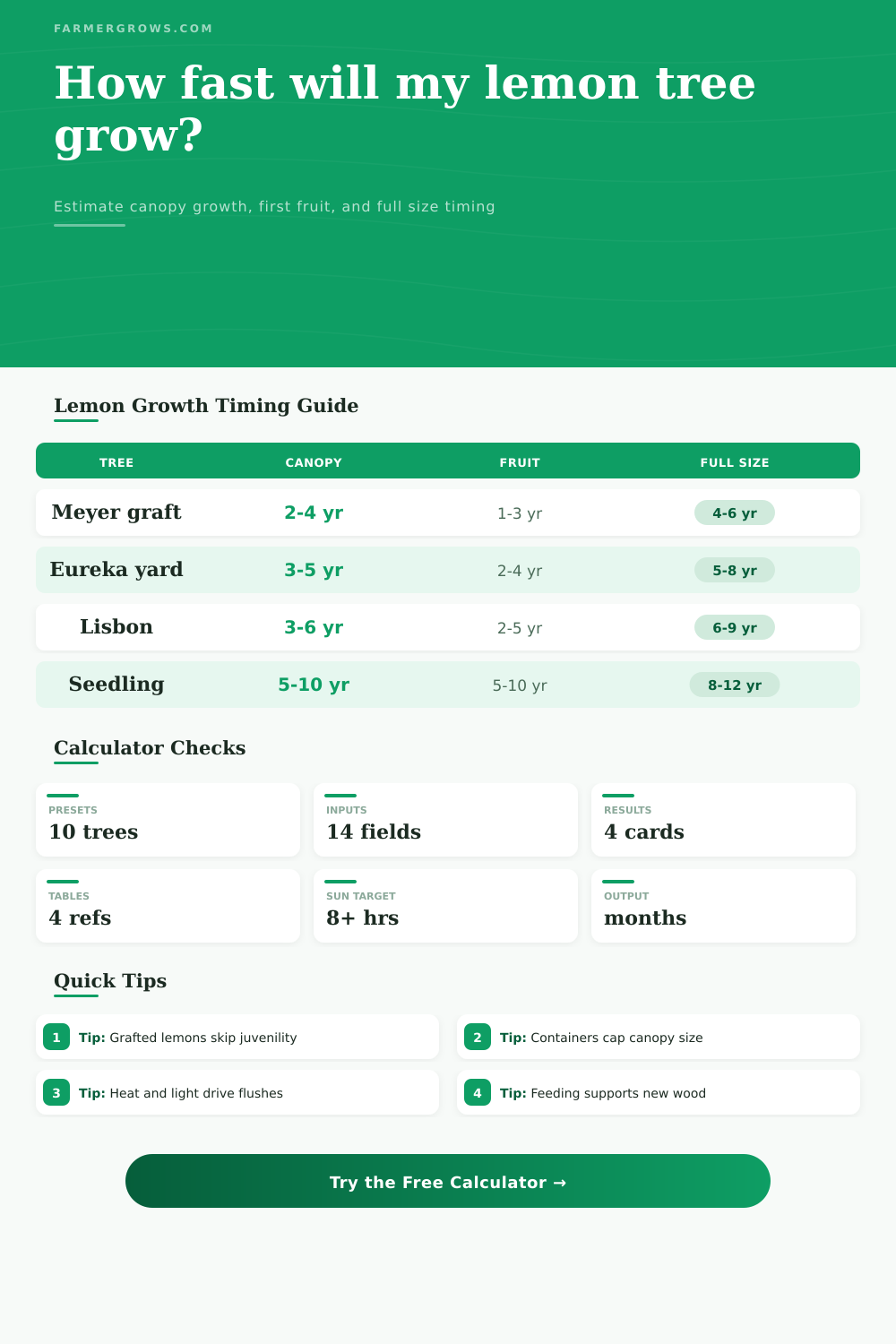
Grafted lemons carry mature scion wood and can fruit while small. Seedlings often grow thorns and leaves for years before reliable bloom.
Potted lemons may flower early but grow less canopy. In-ground trees usually take longer to fill, then build a larger permanent frame.
Dwarfing roots slow height and spread; vigorous rough lemon type roots can push fast growth where heat, drainage, and water are strong.
Lemons grow in flushes. Warm roots, 8 or more hours of direct sun, and steady citrus nutrition shorten the time to a target canopy.
Lemon Growth Estimate
Choose a lemon profile or enter your tree details.
Growth Breakdown
| Lemon type | Growth habit | First fruit timing | Canopy note |
|---|---|---|---|
| Improved Meyer | Compact, early flowering, often grown in pots | Often 1 to 3 years grafted | Good patio choice; target canopy is usually smaller than Eureka or Lisbon. |
| Eureka lemon | Medium vigor with repeated bloom in mild climates | Usually 2 to 4 years grafted | Needs strong light and steady feeding to build enough fruiting wood. |
| Lisbon lemon | Vigorous upright true lemon | Usually 2 to 5 years grafted | Can grow a larger canopy in heat, wind, and ground plantings. |
| Ponderosa lemon | Large-fruited specimen, often container managed | Often 2 to 4 years from graft or cutting | Heavy fruit can slow young branch growth unless thinned. |
| Seed-grown lemon | Variable, thorny juvenile growth possible | Often 5 to 10 years or longer | Canopy may grow before fruiting quality is known. |
| Root setup | Growth effect | Likely mature size | Timing watch-out |
|---|---|---|---|
| Dwarfing rootstock | Slower height gain, compact canopy | About 6 to 10 ft when well managed | Can fruit early but may take longer to reach a large target canopy. |
| Semi-dwarf citrus rootstock | Balanced home-orchard growth | About 10 to 16 ft in good ground | Strong enough for yard trees while still practical to prune. |
| Vigorous rootstock | Fast canopy push in warm soil | About 16 to 24 ft if not held smaller | Needs space, irrigation, and pruning before it becomes oversized. |
| Large container | Moderate, root-limited growth | About 5 to 9 ft depending on pot volume | Feeding and watering mistakes show quickly in pots. |
| Root-bound container | Stalled flushes and small leaves | Below normal for the variety | Repotting may pause growth first, then improve the following flushes. |
| Care factor | Strong growth range | Slow growth signal | Calculator effect |
|---|---|---|---|
| Direct light | 8 or more hours of strong sun | Thin canopy, long internodes, weak bloom | Less than 6 hours reduces annual canopy gain and fruit readiness. |
| Warm-season heat | Warm days with roots above cool-stress range | Leaves sit still for months in cool shade | Cool sites add time between growth flushes. |
| Citrus feeding | Seasonal nitrogen plus micronutrients | Pale leaves and short flushes | Low feeding reduces canopy growth and first fruit confidence. |
| Water and drainage | Even moisture with air in the root zone | Leaf drop after dry or soggy cycles | Wet feet and drought both add delay risk. |
| Stress recovery | No major freeze, pests, or hard prune | Defoliation or branch dieback | Setbacks add a recovery buffer before normal growth resumes. |
| Profile | Common annual canopy gain | First fruit expectation | Best target use |
|---|---|---|---|
| Grafted Meyer in 20 gallon pot | 0.8 to 1.8 ft per year | Often already flowering or within 1 to 2 years | Patio trees held around 5 to 7 ft tall. |
| Eureka in warm ground | 1.5 to 3 ft per year once established | About 2 to 4 years from grafted nursery start | Backyard trees trained to 8 to 14 ft. |
| Lisbon orchard row | 2 to 4 ft per year in strong sites | About 2 to 5 years from grafted start | Large productive canopy with regular pruning. |
| Indoor or balcony lemon | 0.3 to 1 ft per year | Varies with light, pot size, and winter warmth | Small ornamental crop and compact canopy. |
| Seed-grown lemon | 1 to 3 ft per year when young | Often 5 to 10 years or longer | Canopy experiment, rootstock, or novelty tree. |
These ranges are planning estimates for healthy trees. Local disease pressure, salinity, freeze damage, and root disorders can override normal citrus timing.
Size target: A target canopy larger than the likely mature size for the selected pot will be flagged because container root room can cap height and spread before the calendar does.
First fruit: The first fruit estimate uses both tree age and canopy strength. A grafted tree may flower early, but a very small canopy should carry only a light crop.
You bring a nursery lemon tree home with high hopes of zesting your dinner by summer. It is more likely to be a long wait, interrupted by occasional growth spurts and confusing times when leaves falls off. Yes, patience are required when you own a citrus tree, but that doesn’t mean doing nothing while you wait to see if the tree survives. Knowing what makes it grow more strong can help distinguish real issues from normal slowdowns.
First, plug your trees’ variety, container size, rootstock type, and local growing conditions into calculator above. The tricky math gets done for you, converting fuzzy wishes into precise timeframes for first bloom or a desired canopy size. That’s a shift from fretting over quietness to working on triggers for going places.
How to Help Your Lemon Tree Grow
The most important thing is how the tree got started. Was it a graft, or was it from seed? Grafts, which incorporate the woody part of an old tree (the scion) onto the rootstock of another hardy variety, bypass all that juvenile nonsense. As long as the new trunk have enough room for branches, it’ll start bearing right away. Lemons grown from seed don’t behave like this. For years, they builds up their structure…then maybe think about having offspring. By year 5 or 6, when a seedling’s looking mighty strong and leafy and thorny and everything… But no fruit, don’t panic; it’s just biology. What biology expects you to do: Be patient. And wait.
That is why buying a grafted young tree from the nursery is the one surefire way to get fruit fast. The tool takes that factor into account, pushing back the fruiting clock depending on your choice.
Genetics are important, but so is where the tree has lived. If it hasn’t had room to develop its roots, root restriction!; all bets are off. No matter how good its DNA, a potted lemon won’t be as tall as the same variety growing in the ground, in soil that’s deep and well-drained. The physical restriction of its container limits how far its roots can expand, and hence also limits the size of its canopy. This is a common misconception among many gardeners, who want their Meyer in a pot to become a full-sized shade tree, too. But the pot is no place for such biomass; it doesn’t provide enough root volume.
Planting in the ground (where the roots can spread down and outward) releases the genetic potential of the tree for size, both spread and height. The size-expectations charts on the page detail these size possibilities clearly, so you can have realistic goals in mind when you see slow progress.
All of that happens because off light and heat. Lemons don’t grow steadily, in one continuous line as they do, but in flushes. In warm weather when their roots is active and they get plenty of sun (eight hours or more), you’ll see rapid growth. In cool indoor air or even part-shaded outdoors, the flushes are few and weak. This is not a case where feeding makes up for it: Though fertilized citrus need nitrogen to make leaves, and a balanced citrus fertilizer supplies this… No amount of food can make up for not enough light or heat. A tree growing in less-than-full sun doesn’t push much wood at all, conserving itself instead. Too much fertilization of such a lightly lit tree result in spindly, weak growth prone to breakage from its own weight.
But also remember: Stress events put time back onto your clock. Whether it’s frost damage, pests, harsh pruning or repotting, the tree will go into recovery mode. It no longer spends energy creating a new canopy; now it spends energy on staying alive. These types of setbacks are built into the calculator as inputs; they help create a more honest timeline for you. They add buffer time for when the tree recovers, so if growth stalls out after a transplant you don’t panic. You know that a pause is normal; that it happens after a move, and you won’t intervene unnecessarily. Doing nothing (besides keeping the soil moist and protecting the tree) can be the best care of all, waiting for it to get back into its regular rhythm again.
Growing lemons, then, comes down to learning what to expect, and how to wait, not push. Nature will take its time, but you would of hurt the plant’s future health if you force things along. Follow the estimated dates above; mark on the calendar where “ideal” would be and see how far ahead or behind you are. When your tree gets off schedule, first look to the basics: Is there enough sun? Is it well-drained? If so, you should be able to get back on track faster than you would with a quick fix.
Your objective isn’t a fast growing sapling that exhausts itself in one year, but a sturdy, productive tree that will yield fruit for years, and decades… To come. Choose the best variety for your location, tend it consistantly, and let nature determine the timeline. It’s a lot more fun to watch that waiting, er, watching (as you go through another garden season).