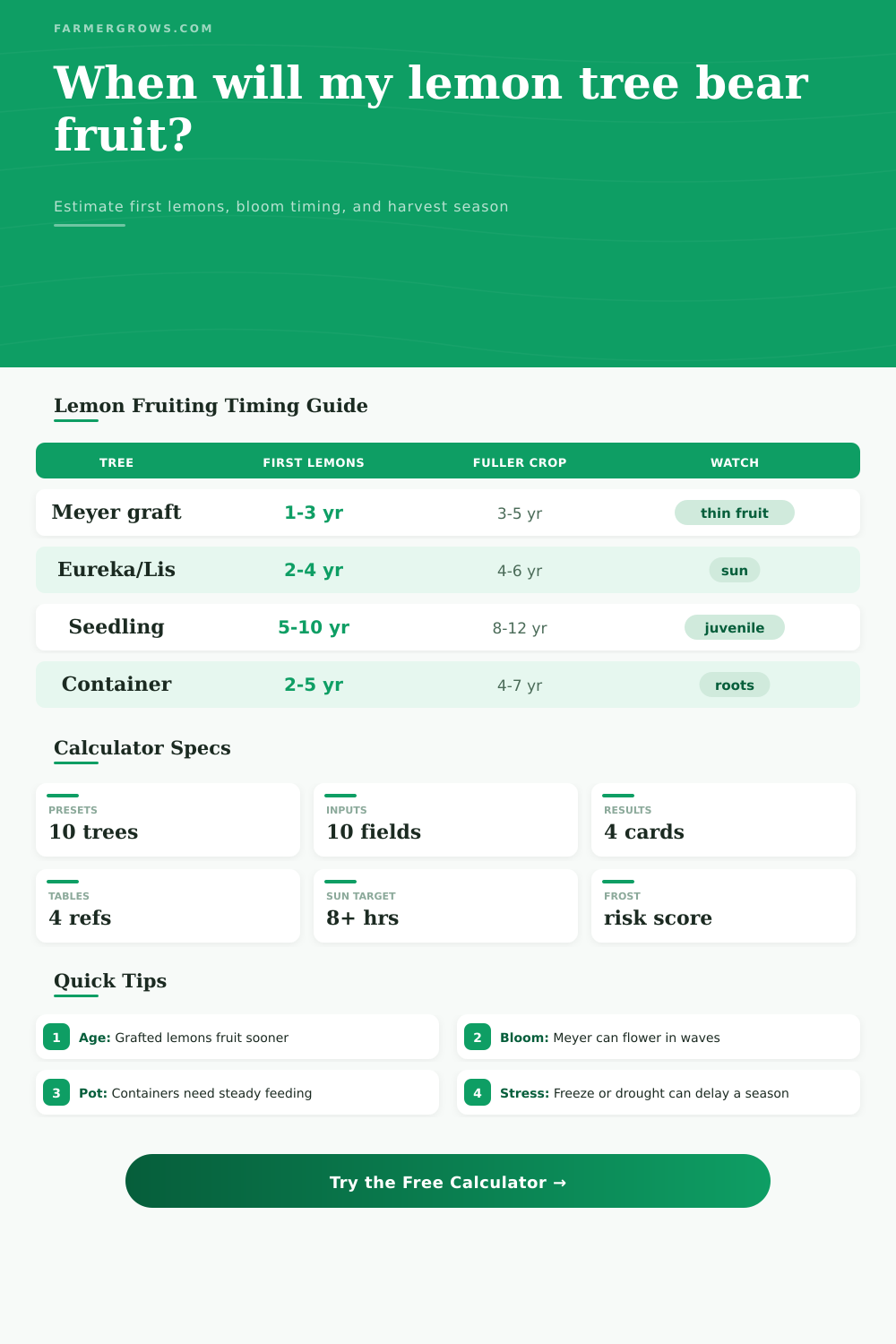
Lemon Tree Time to Bear Fruit Calculator
Estimate when Meyer, Eureka, Lisbon, Ponderosa, dwarf, container, grafted, or seed-grown lemon trees should flower, set their first useful lemons, and move into steadier harvests.
Pick the closest lemon tree situation, then adjust the 10 fields for your yard, greenhouse, or patio container.
Often blooms younger than true lemons, with multiple flower flushes in warm, protected conditions.
Usually crops heavily once the canopy is established and can flower through much of the year in mild climates.
Often needs a stronger framework before big crops, but tolerates heat and wind better than many patio lemons.
May stay thorny and juvenile for years, so the calculator treats it separately from grafted nursery trees.
Lemon fruiting estimate
Run the calculator to estimate first lemons, stronger cropping, bloom window, and delay risk.
| Lemon tree | First useful lemons | Stronger crop | Timing note |
|---|---|---|---|
| Grafted Meyer lemon | 1 to 3 years old | 3 to 5 years old | Can flower in several waves when warm and well fed. |
| Grafted Eureka or Lisbon | 2 to 4 years old | 4 to 6 years old | Needs healthy leaf area before carrying many lemons. |
| Dwarf container lemon | 2 to 5 years old | 4 to 7 years old | Root volume, watering swings, and feeding decide the pace. |
| Seed-grown lemon | 5 to 10 years old | 8 to 12 years old | Juvenile wood delays bloom even if the tree looks large. |
| Variety | Common bloom habit | Main harvest feel | Calculator adjustment |
|---|---|---|---|
| Improved Meyer | Spring plus repeat flushes | Fall through winter, often extended | Earlier baseline, lower delay when protected. |
| Eureka | Frequent bloom in mild zones | Nearly year-round in warm climates | Medium baseline with strong sun reward. |
| Lisbon | Heavy spring bloom | Winter through spring | Slightly later, better heat and wind tolerance. |
| Ponderosa | Ornamental repeat bloom | Large fruit, slower ripening | Moderate delay for oversize fruit load. |
| Factor | Best range | Delay signal | Why it matters |
|---|---|---|---|
| Direct sun | 8 or more hours | Under 6 hours | Flowering wood needs stored carbohydrates from healthy leaves. |
| Water | Even moisture, good drainage | Wilt, leaf drop, sour soil | Stress can drop blossoms and small fruit. |
| Nutrition | Citrus fertilizer during growth | Pale leaves, weak flush | Nitrogen and micronutrients support bloom and fruit fill. |
| Canopy size | Balanced leaf area | Hard pruning or defoliation | Small trees often abort fruit to keep growing. |
| Risk score | Likely delay | Common cause | Action |
|---|---|---|---|
| 0 to 2 | Little to none | Warm site, strong canopy | Keep care steady and thin heavy fruit on young trees. |
| 3 to 5 | 3 to 9 months | Small pot, partial shade, average care | Improve light, feeding, and watering consistency. |
| 6 to 8 | 9 to 18 months | Cool winter, root-bound pot, pest stress | Rebuild canopy before allowing a heavy crop. |
| 9 to 10 | 18 to 24 months | Freeze, defoliation, severe drought | Prioritize recovery wood and remove early fruitlets. |
This calculator gives planning estimates for home citrus care. Local cultivar behavior, rootstock, disease pressure, and nursery age can move real fruiting earlier or later.
A few flowers do not always mean a harvest. Young lemon trees often drop fruit until roots and leaves can support it.
Small pots may bloom early but crop lightly. Step up gradually and avoid wet, stale potting mix.
After a hard freeze, count timing from the recovered canopy rather than the original planting date.
A seed-grown lemon can be healthy and still take many years to flower because the wood is juvenile.
Wait for the fruit: Plant a lemon tree, and wait for lemons. Water the tree; feed the tree; watch for its leaves. But no lemons? No lemons…no fruit, and the silence can sound personal. That’s the common lament of citrus growers.
The page’s calculator does math once you input number of sun hours and your tree’s variety, so you don’t have to guess whether something’s amiss, or whether you’re just being patient in vain. When it comes to timing, things depends more on biology different than the calendar. Before the tree will reproduce, it has to learn to survive as a young tree. How much root mass should there be to hold that crop? And how big a canopy of foliage it should have to get by through making food? Those systems aren’t up and running yet… Hence quick appearance (and dissapears) of flowers until then. This is why there are no useful lemons right at the start.
Why Your Lemon Tree Has No Fruit
The tool takes into account age vs. The width of its canopy; the wider the canopy, the more vigorous the tree, but the smaller size on an old tree, the poorer light or other stress factor. Note that there is an important difference between seed-grown trees and grafted ones, like Improved Meyer or Eureka varieties grafted on dwarfing rootstock that most people purchase. The former are in its juvenile phase; the latter is mature already. That means it could of be another five to 10 years before your supermarket-bought seedling even reaches sexual maturity, a long time to wait for a nibble. Growing method makes all the difference in the timeline; see reference table on the page.
Biology can’t be rushed. Knowing this ahead of time will save you many years of wondering why you aren’t getting any fruit yet. Finally: no sunlight, no dice. To make bloom wood (the carbohydrate factory), lemons has to have a minimum of eight hours per day of direct sun. Reduced light results in both reduced flower production and increased leaf drop. If your tree lives in part shade, it adds months to your wait time. The tool uses your sun exposure data to tell you how much your tree will be delayed. It’s not a punishment; it’s physics, since you can’t make energy out of thin air. That’s why the calculator assumes a longer wait time for your tree if it’s situated in partial shade.
Why? Because roots are restricted, which creates a kind of pseudo-drought stress regardless of how much you water. This is a frequent issue with container plant, because containers restrict root growth and also dry out rapidly relative to soil in the ground. Because of this, the tool handles big in-ground trees different than tiny patio pots.
Finally, there is climate. And no, it is not in the sense of what everyone believes (that heat is bad). In fact, mild winters benefits the consistent crop cycle; hard frosts can knock back young wood, and set the tree back a year or two. How much exposure is there? That’s quantified in the results’ risk score. If yours are high, it’s time to worry about recovery, not harvest… So drop off any early fruitlets to conserve energy for fresh leaf growth. Even if it feels odd, your goal is saving structure, which promises more fruit down the road. You’re not making lemonade; you’re constructing a lemonade-making machine, and you want to be sure to build something strong enough to last. Don’t push it at top speed before it’s had its engine broken in.
By full-cropping age (four to six years for standard varieties), it will repay you with regular crops. Trust the process in the meantime, since those leaves is doing more work than they appear to be.