LED Grow Light Coverage Calculator
Estimate fixture count, coverage area, PPFD, and DLI from fixture PPF, beam angle, mounting height, canopy size, overlap, dimming, reflectance, and crop stage.
This calculator gives a planning estimate before you hang fixtures. Final layouts still need a PAR meter check because lenses, reflectors, aisle losses, plant height, and fixture-specific light maps all affect canopy readings.
Coverage Estimate
The estimate compares beam footprint and photon-limited area, then sizes fixtures for the full canopy at your target PPFD.
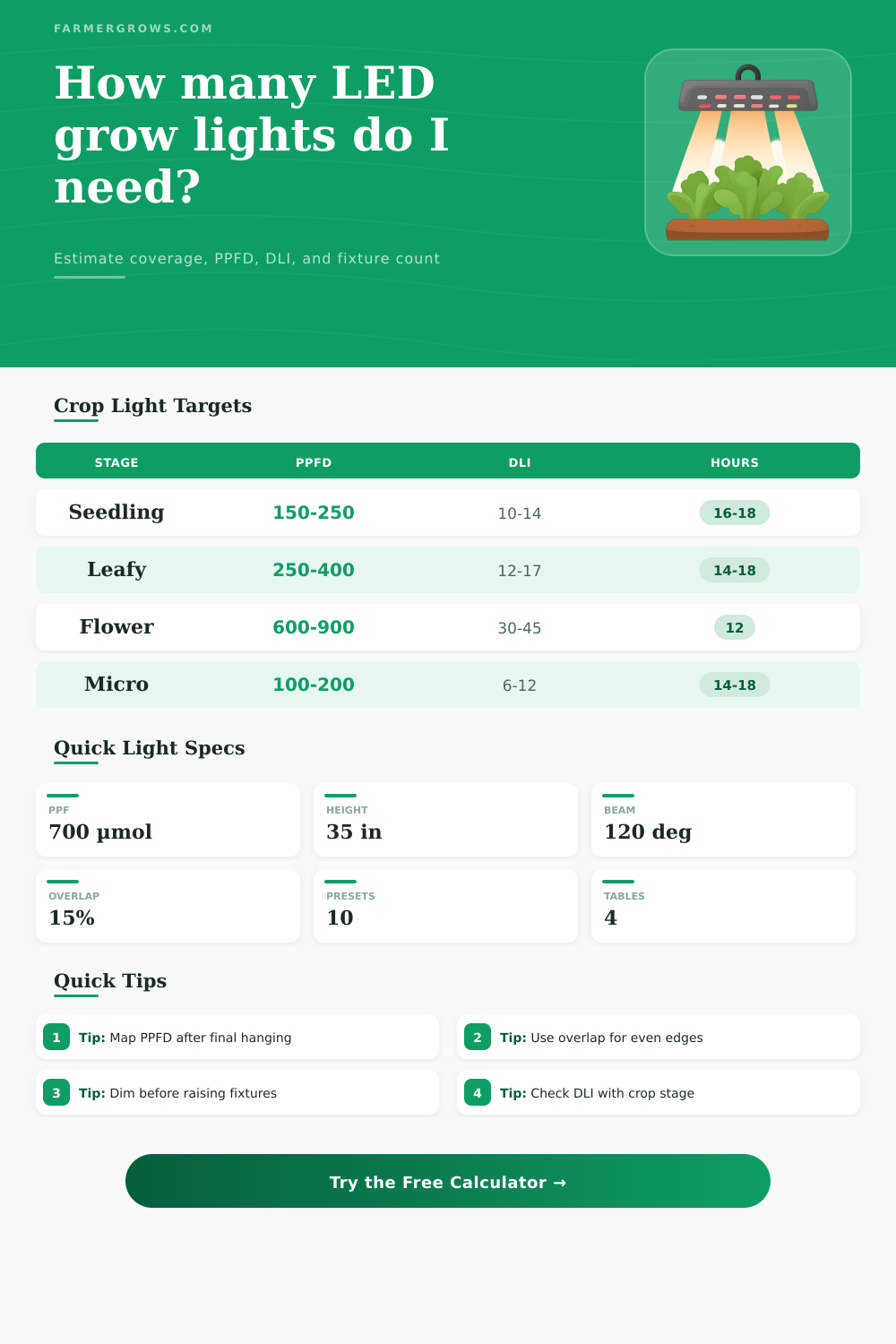
| Crop stage | Typical PPFD | Typical DLI | Common photoperiod |
|---|---|---|---|
| Seedling / propagation | 100-250 µmol/m²/s | 6-14 mol/m²/day | 16-18 hours |
| Microgreens | 100-250 µmol/m²/s | 6-14 mol/m²/day | 14-18 hours |
| Leafy greens and herbs | 250-400 µmol/m²/s | 12-20 mol/m²/day | 14-18 hours |
| Vegetative fruiting crops | 350-600 µmol/m²/s | 18-30 mol/m²/day | 14-18 hours |
| Flowering / fruiting crops | 600-900 µmol/m²/s | 30-45 mol/m²/day | 10-14 hours |
| Greenhouse supplement | 80-250 µmol/m²/s added | 4-12 mol/m²/day added | Based on daylight gap |
| Fixture class | Common PPF range | Best use | Coverage note |
|---|---|---|---|
| Shelf strip LED | 40-180 µmol/s | Seedlings, clones, microgreens | Short height and close spacing |
| Small board LED | 250-500 µmol/s | Herbs, lettuce, compact tents | Good for 2x2 to 3x3 areas |
| Mid bar or board | 600-1000 µmol/s | 4x4 tents and benches | Needs overlap for even edges |
| High-output bar LED | 1100-1800 µmol/s | Flowering or fruiting canopies | Hang higher for blend and cooling |
| Greenhouse top light | 1400-2500 µmol/s | Supplemental commercial bays | Designed from photometric layouts |
| Beam angle | 18 in height | 30 in height | Best planning use |
|---|---|---|---|
| 60 degrees | 1.7 ft diameter | 2.9 ft diameter | Narrow spot or aisle targeting |
| 90 degrees | 3.0 ft diameter | 5.0 ft diameter | Moderate boards and COBs |
| 110 degrees | 4.3 ft diameter | 7.1 ft diameter | Wide boards above tents |
| 120 degrees | 5.2 ft diameter | 8.7 ft diameter | Broad bar fixtures and shelves |
| 140 degrees | 7.4 ft diameter | 12.4 ft diameter | Very wide spread, more side spill |
| Average PPFD | 12 hours | 16 hours | 18 hours |
|---|---|---|---|
| 150 µmol/m²/s | 6.5 DLI | 8.6 DLI | 9.7 DLI |
| 250 µmol/m²/s | 10.8 DLI | 14.4 DLI | 16.2 DLI |
| 400 µmol/m²/s | 17.3 DLI | 23.0 DLI | 25.9 DLI |
| 600 µmol/m²/s | 25.9 DLI | 34.6 DLI | 38.9 DLI |
| 800 µmol/m²/s | 34.6 DLI | 46.1 DLI | 51.8 DLI |
Map before final spacing. Use this output for layout planning, then measure PPFD across the corners, edges, and center at canopy height.
Protect uniformity first. A slightly dimmed, better-overlapped layout usually grows more evenly than a few fixtures driven hard with bright centers.
To calculate the correct lighting for your grow space, you need to understand the relationship between the light that your light fixtures will emit and the growing needs of your plant. Each grow space will have different lighting needs depending on the species of plant that you are growing and the life stages of those plants. For instance, microgreens need less light than pepper plants that is loaded with fruit.
However, by using the lighting calculator, you can select which growth stage of which plants you are growing to adjust the PPFD and the length of the photoperiod that are displayed for your grow space. If you set the PPFD and photoperiod for young lettuce plants, it is possible that the light fixture will not provide enough energy for flowering plant. In this case, you can use the calculator to determine the number of additional light fixture that you need in your grow space to provide additional light to these plants.
Plan Your Grow Lights with a Lighting Calculator
You may have noticed that mounting your light fixtures lower provide more even lighting. This is because if you increase the mounting height of your fixtures, the intensity of the light that falls onto the plants will decrease. However, the spread of the light will increase.
Use the beam angle for your light fixtures to calculate the spread of light. This will allow for you to determine how many light fixture are required in your grow space, even if the coverage of each individual fixture is less than you may expect. By using the lighting calculator, you can enter the number of percentage overlap between each of your light fixtures.
Using 0% overlap will result in the edge of your grow space receiving less light than the center of your plants. By adding some percentage overlap between each of the light, you will provide more even lighting to each of your plants and reduce the amount of lighting that the center of your plants will receive. You can also use the lighting calculator to determine how many light fixture you will need if you choose to dim any of your fixtures or if the walls surrounding your grow space have high reflectivity.
Using your lighting calculator, you can set the percentage of the dimming of each of the light fixtures. Using less than 100% of the light output from each of your fixtures will extend the life of the diodes within the light fixtures and reduce the amount of heat that the fixtures will emit. However, it will also reduce the number of photon that your light fixtures emit.
Additionally, the use of mylar or other reflective materials on the walls of your grow space can help to increase the amount of light that your plants receive. Use the reflectivity feature within the lighting calculator to determine how many light fixture you will need with these changes to the grow space. Most grow spaces are not as clean and rectangular as those that the lighting calculator assume.
Many grow spaces feature aisles, props, and other feature that take up space within the grow space that would otherwise be covered by light. Additionally, the height of your plants changes over time. The layout that provide even lighting for your plants when they are young may need to be adjusted as the plants begin to mature.
The lighting calculator cannot factor in these variables. Therefore, using a PAR meter at the end of the design stage will help you ensure that your light fixtures are properly place and will provide even lighting to each plant within your grow space. A related variable to the lighting of your grow space is the fixture style.
Different light fixture style emit light in different ways and can be beneficial for different types of grow space layouts. For instance, multi-bar light fixtures will blend into your grow space’s canopy better than other types of fixtures with high amount of light output but lower areas of light output. Additionally, quantum boards will emit most of their light from the center of the light fixture.
Shelf strips are often used in propagation rack for plants that require relatively even lighting over a limited height. The lighting calculator can factor in these different types of lights; however, a visual inspection will ensure that the lighting design for your grow space will function as you have designed it. One of the most important variables that will help you to understand how to properly light your grow space is the daily light integral value.
This value represents the total amount of light that plants receive over the length of a full day. It is different than PPFD, which represents the light intensity of your grow space during a given time period. Although both values are important, you can use the lighting calculator to determine how many light fixture of each type you will need.
In addition, it will allow you to determine the length of the photoperiod for your plants. Additionally, the daily light integral will help you to compare the benefits of different lighting schedules for your plants. For instance, a combination of lower PPFD and longer photoperiods will emit the same daily light integral as a schedule with high PPFD but short photoperiods.
However, the high PPFD schedule may result in high temperatures within your grow space, whereas the schedule with lower PPFD settings will result in lower growth of your plants. The lighting calculator can help you compare these options and allow you to determine which schedule will work best within your grow space. It is likely that the layout that you calculate with the lighting calculator will not be the same as the one that you eventually hang in your grow space.
The layout that you create for your young plants may need to be changed once they are established and growing. The lighting calculator will help to remove some of the guesswork involved in adjusting the layout of your grow space. Once you have determined that the PAR meter reading for your plants are even throughout their canopy, you can be certain that you no longer need to make any adjustments to the layout of your light fixtures.