🌱 LED Grow Light BTU Calculator
Convert LED grow light watts into BTU/hr, account for driver efficiency, dimming, fixture count, photoperiod, room volume, ventilation CFM, and heat captured before it reaches the crop room.
Pick a real grow-light scenario to seed the fields. Each preset sets fixture watts, driver efficiency, fixture count, photoperiod, room volume, dimming, ventilation, and captured heat removal.
LED Heat Load Results
Enter your fixture and ventilation values to estimate room heat.
| Wall watts | BTU/hr | kW heat | Typical use |
|---|---|---|---|
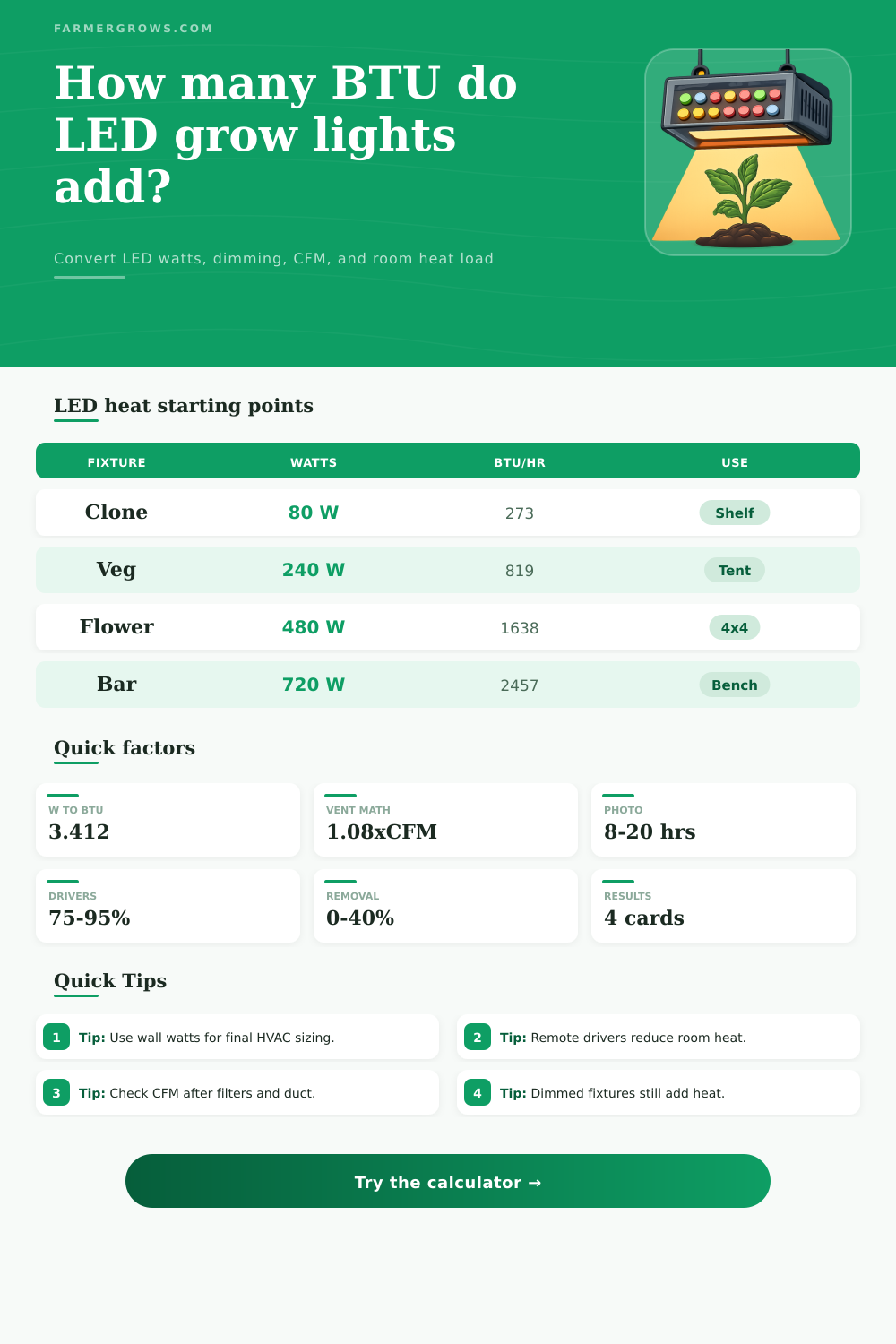
| 100 W | 341 BTU/hr | 0.10 kW | Seedlings and clones |
| 250 W | 853 BTU/hr | 0.25 kW | Veg tent or shelf |
| 500 W | 1,706 BTU/hr | 0.50 kW | 4x4 flower canopy |
| 1,000 W | 3,412 BTU/hr | 1.00 kW | Multi-fixture room |
| Airflow | At 5 deg F | At 10 deg F | At 15 deg F |
|---|---|---|---|
| 100 CFM | 540 BTU/hr | 1,080 BTU/hr | 1,620 BTU/hr |
| 250 CFM | 1,350 BTU/hr | 2,700 BTU/hr | 4,050 BTU/hr |
| 500 CFM | 2,700 BTU/hr | 5,400 BTU/hr | 8,100 BTU/hr |
| 1,000 CFM | 5,400 BTU/hr | 10,800 BTU/hr | 16,200 BTU/hr |
| Dimmer | Wall draw basis | Heat factor | Use case |
|---|---|---|---|
| 40% | Watts x 0.40 | 40% | Propagation and early veg |
| 60% | Watts x 0.60 | 60% | Vegetative growth |
| 80% | Watts x 0.80 | 80% | Flower ramp-up |
| 100% | Watts x 1.00 | 100% | Peak flower intensity |
| Schedule | Hours/day | Daily multiplier | Typical crop stage |
|---|---|---|---|
| Short day | 8 hr | Hourly x 8 | Hardening or trial runs |
| Flower | 12 hr | Hourly x 12 | Photoperiod flowering |
| Veg | 18 hr | Hourly x 18 | Vegetative growth |
| Long day | 20 hr | Hourly x 20 | Leafy greens and starts |
When you goes into a grow room, the air in the grow room will feel warmer then the air in the rest of the building. This warmth in the grow room is caused by the light in the grow room. All of the wattage of the lights in the grow room eventualy become heat.
Even if LED light are used, the lights will emit heat. This heat must be accounted for so that the grow room isnt too warm. There are several different factors that will impact the amount of heat that enter the grow room.
Why Grow Rooms Get Hot and How to Cool Them
The rating of the light fixture is just one of the factors. The efficiency of the driver will impact the amount of heat that is created. For instance, if the driver is 90% efficient in the grow room, then 10% of the power will be released as heat.
If the driver is inside of the grow room, this heat will enter the grow room. However, if the driver is outside of the grow room, the heat will remain outside of the grow room. The dimming level of the lights will also impact the heat that is released into the grow room.
For instance, if the lights are only running at 60% of their power, then they will only release 60% of the heat that they produces at 100% power. Ventilation is used to remove the heat from the grow room. The effectiveness of the ventilation system will depend upon the amount of air that move through the grow room, as well as the difference in the temperatures between the grow room and the outside air.
The more air that moves through the grow room, the more heat will be able to be removed from the grow room. However, the actual air movement that will occur in the grow room may be less than the airflow of the fans that are rated for the grow room. This is due to the static pressure that the filters and the ducting of the ventilation system create.
If this is not accounted for when setting up the grow room, the ventilation system may not effective remove the heat from the grow room. The volume of the grow room will also impact the change of the temperature within the grow room. A grow room that is small in relation to the amount of area that the plants occupy will change temperature more quick than a grow room that is large in relation to the amount of area that the plants occupy.
A large grow room will require more ventilation to move the same amount of air as a small grow room. However, a grow room that is small in relation to the amount of area that the plants occupy may actualy be easier to cool. In either case, growers will want to maintain the temperature within the grow room; consistent temperatures within the grow room are more beneficial to the plants than changing temperature within the grow room.
One way to reduce the total heat load within the grow room is to manage the drivers of the lights. The drivers can be mounted externally to the grow room, or the heat from the drivers can be vented outside the grow room. By doing so, the total amount of heat that must be released outside of the grow room will be less.
This will allow for growers to better manage the net heat load within the grow room. Another factor that will impact the total amount of heat that is released into the grow room is the length of the light cycle. For instance, an eighteen-hour light cycle will create more heat within the grow room over time than a twelve hour light cycle.
This is due to the length of time that the lights are turned on. Thus, the ventilation system will have to work more often within an eighteen hour cycle than within a twelve hour cycle. However, the dark portion of the cycle can be used to remove heat from the grow room.
The total amount of heat that will be released into the grow room will depend upon the length of time that the lights are turned on. The calculator included in this article can help growers to calculate the amount of heat that will be within the grow room. The wattage of the lights from the wall can be entered into the calculator to determine the gross amount of heat that the lights will create.
Additionally, the calculator can determine the amount of heat that will actually enter the grow room. The calculator can also determine the capacity of the grow rooms airflow, and show whether there is a surplus or shortfall of the grow rooms cooling system. The calculator can also show how each of the variable for the grow room impact the total amount of heat that will be within the grow room.
Many people often make mistakes when setting up their grow rooms. One mistake is to assume that the fans will move the same amount of air as the fans are rated to move, even when there is ducting for the grow room. Another mistake is to only size the grow rooms ventilation systems to handle the peak output of the grow room.
These mistake can be avoided by using the calculator to understand how the grow rooms variables will impact the grow rooms heat output. There are a variety of different choice that can be made to manage the heat within the grow room. For instance, the dimming level of the lights can be lowered.
Additionally, the airflow of the ventilation system can be increased. Furthermore, the driver can be mounted outside of the grow room. Each of these choice will come with a cost for the grower in terms of the electricity that is used by the grow room, and the amount and type of equipment that may be needed for the grow room.
The calculation allows for growers to understand these cost. The calculations presented in this article may change if any variable within the grow room are changed. For instance, if a grower changes the filter in the ventilation system, if they change the lights cycle for the grow room, or if the outside temperature in the grow room change, the heat load that enters the grow room may change.
Thus, growers must monitor the grow room’s heat load to ensure that the temperature within the grow room remains steady.