Leaf Lettuce Growth Time Calculator
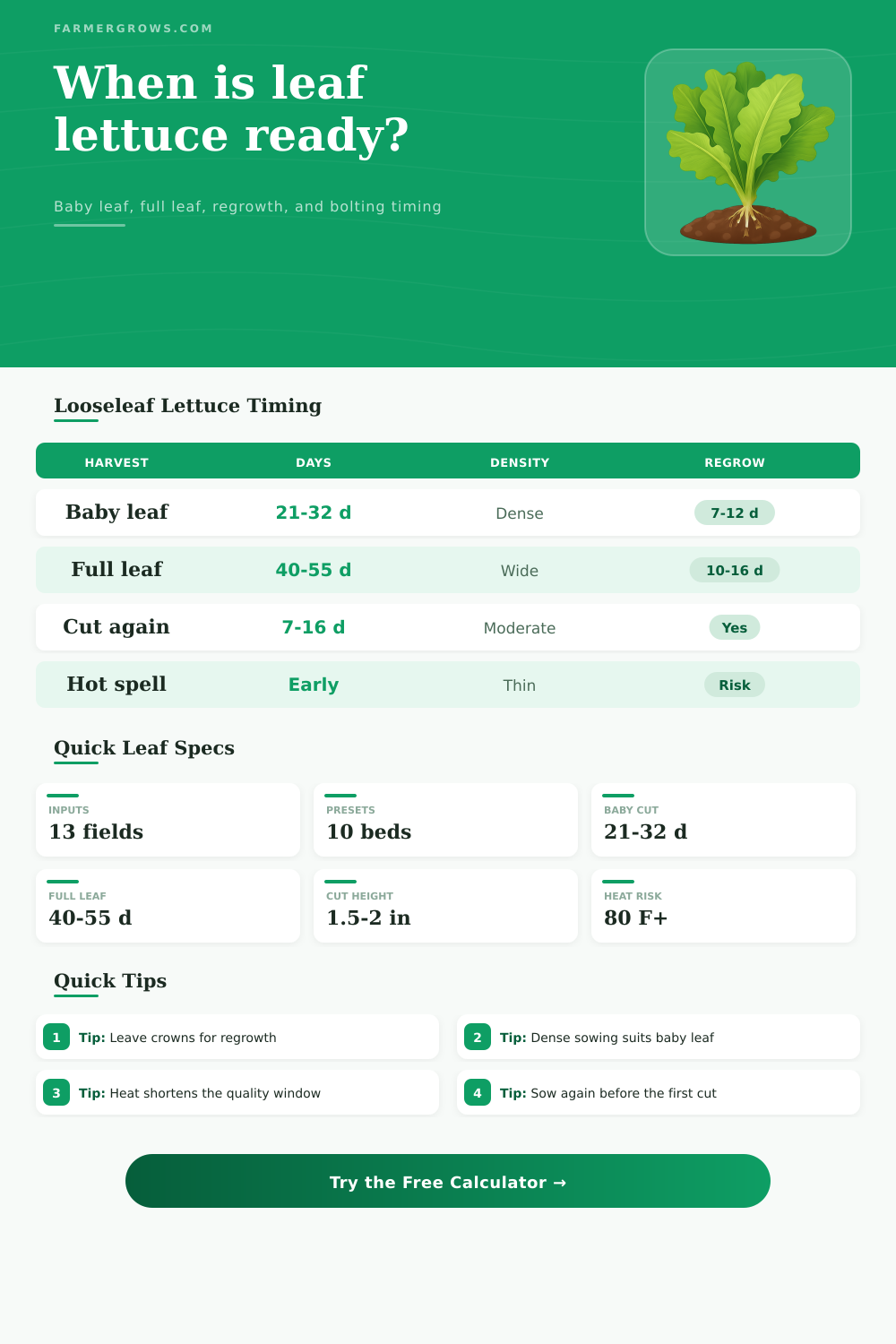
Estimate looseleaf lettuce timing for baby leaf cuts, full-size leaves, cut-and-come-again regrowth, dense sowing, heat bolting pressure, and succession planting.
This calculator is for looseleaf lettuce grown for individual leaves or repeated cuts. It is not a romaine head, iceberg head, butterhead, hydroponic channel, or seed-germination-only schedule.
Looseleaf Harvest Plan
Enter a looseleaf lettuce setup to estimate harvest and regrowth timing.
| Looseleaf type | Best season | First baby cut | Full leaf timing | Regrowth habit |
|---|---|---|---|---|
| Green Oakleaf | Cool spring or fall | 23 to 30 days | 42 to 50 days | Good repeat cuts if crowns stay intact |
| Red Oakleaf | Cool bright weather | 25 to 32 days | 45 to 55 days | Moderate regrowth, slower in cold shade |
| Lollo or frilly leaf | Spring, fall, protected winter | 26 to 34 days | 45 to 58 days | Frilly leaves regrow well after high cuts |
| Black Seeded Simpson | Fast spring windows | 20 to 28 days | 38 to 48 days | Quick regrowth, quick to bolt in heat |
| Red Sails | Shoulder season with shade | 24 to 32 days | 44 to 54 days | Reliable after one or two careful cuts |
| Deer Tongue | Fall and cool spring | 26 to 35 days | 46 to 56 days | Best with outer-leaf harvest or tall cuts |
| Harvest style | Seed density | Final spacing | Row or band spacing | Best timing use |
|---|---|---|---|---|
| Baby leaf broadcast | 80 to 250 seeds/ft² | No final spacing | Solid bed or 2 to 4 in bands | Fast cut, often one or two harvests |
| Baby leaf rows | 40 to 120 seeds/ft² | 1 to 2 in after thinning | 4 to 6 in rows | Cleaner cutting and easier regrowth |
| Cut-and-come-again | 20 to 70 seeds/ft² | 2 to 5 in | 5 to 8 in rows | Best balance for repeated leaf cuts |
| Full loose leaves | 6 to 25 seeds/ft² | 6 to 10 in | 8 to 14 in rows | Large leaves, slower first harvest |
| Transplant looseleaf | Plug count only | 6 to 12 in | 8 to 15 in rows | Earlier field harvest and clean spacing |
| Temperature pattern | Timing effect | Bolting pressure | Looseleaf response |
|---|---|---|---|
| 45 to 55°F mean | Slow growth, sweet leaves | Low | Add days but keep regrowth quality high |
| 55 to 68°F mean | Fast steady growth | Low to moderate | Best window for repeated cuts |
| 68 to 74°F mean | Quick first cut | Moderate | Harvest younger and shorten succession |
| 75°F mean or warm nights | Quality drops sooner | High | Use shade and baby leaf harvest |
| 80°F+ hot spells | Bolting can outrun regrowth | Very high | Cut early, resow for a cooler window |
| Cut height | Expected recovery | Best for | Regrowth warning |
|---|---|---|---|
| Under 1 in | Slow or poor | Single baby cut only | Growing point may be damaged |
| 1 to 1.5 in | 10 to 18 days | Dense baby beds | Watch heat and dry crowns |
| 1.5 to 2.25 in | 7 to 14 days | Cut-and-come-again rows | Best balance of yield and recovery |
| 2.25 to 3 in | 6 to 12 days | Fast second cut | Leaves may be smaller per cut |
| Outer leaf picking | Continuous checks | Full looseleaf plants | Remove older leaves before bitterness |
Cut for regrowth: For cut-and-come-again lettuce, leave the crown and at least 1.5 inches of stem tissue. A low scalping cut may look clean but often slows or ends the next cycle.
Plan succession early: Sow the next looseleaf round before the first bed is finished. Heat, dense sowing, and repeated cuts all shorten the reliable harvest window.
When it comes to salad greens, the gardens all green but that salad bowl is still empty, and you’re in panic mode. Yeah, sure, you sowed on schedule and kept things well-watered, and peered at those germinating seeds as they pushes their way into the earth with roots. And then, oops! Here comes the heat, or maybe the rain. So do you pick now, or next week? With greens, it can be a matter of days, not weeks; knowing which day is critical.
Unlike iceberg types, leaf lettuces has no armor. They tell you fast what shape they’re in; and wilt if forced to guess about how long to wait. With greens, it’s more than calendar days: it’s a matter of light exposure and thermal units, a matter of precision management different than guesswork.
How to Pick Your Salad Greens at the Right Time
After entering what you want to harvest, and your weather conditions, the calculator does the math, no guesswork about whether all your seedlings is going to bolt due to a heat wave! What most people don’t think about when they look at seed packets, but should: Planting style (direct sowing vs. Whether you direct sow or transplant changes how much time you have.
Racing to keep plants from bolting (going to seed prematurely) is different when you plant baby-leaf-size seeds directly in the ground compared with starting out with bigger plants that you’ve transplanted. Whether you began with transplants or scattered seeds around will adjusts the day count. Direct seeding give you maximum leaf area but requires more patience during early stages. Starting with transplants allows for less time in the field, but less total area. It’s a balance between getting them up quick versus getting them dense fast.
It varies by harvest window. Density is important. Most weekend gardeners are unaware of this, but it’s critical for the “keep ’em coming” factor. When growing baby greens, sow thickly and snip baby leaves at 21 days, or even less. To turn over fast (keeping salads plentiful when we need them most). Otherwise, those plants will grow too big for their boots, slow way down when competed with, and no one win.
This isn’t called thinning just because they need elbow room; it’s also about re-starting the growth clock. Seed-to-harvest timing charts (tables) link seed density with final harvest timing. Have an especially productive bed of babies? Or do you have a somewhat less full-leaf stand? You rarely get both from one planting unless you divide the row.
Looseleaf lettuce dislikes heat: It shortens the life of the leaves and quicken bolting. Once day-time temps regularly top eighty degrees Fahrenheit, the plant starts moving resources away from producing leaves and toward seed production. That’s a biologically triggered switch that typically becomes irreversible when the stem starts lengthening itself.
That means hot days (predictions are key) become essential inputs into any kind of planning tool like this one; perhaps you decide to cover plants with some shade cloth to gain a week or two more tender time on them, or simply pick and be done before things get tough? Because cool nights also slow down bolting even if days has been warm, the calculator incorporates both day- and night-time temperatures into its assessment of the risk, helping us see how things could play out.
When the going gets tough in high summer (meaning: I give up on starting anything from seed), there’s always the fallback plan of the regrow cycle. Just snip them off right at ground level. You could even go a couple inches higher above the crowns so you should of not lose the growing point. Then, new leaves appear in a week or two. You’ll have slightly smaller leaves with each repetition. However, it prolongs your cut-and-come-again harvest season.
This means no more sowing space is needed, and you’ll have food to eat anyway. And the trick? Leave some stem behind, because we waste that precious inch for the sake of tidiness, as many beginning gardeners do. But that’s what it takes to grow back. An inch makes all the difference between another successful cut and nothing but a bare area where green things once grew.
Time is a changing resource (not a fixed rule) when growing leaf lettuces successfully. Master gardeners work out their succession plans so each bed are being finished about the moment the new one starts maturing. This works no matter what the weather does, and they therefore have lettuce all along. Balancing your harvest targets, temperature expectations, and available growing space creates a reliable salad engine instead of a chaotic garden.
Turns out, endless greens aren’t about just sun and water… Knowing when to finally stop waiting and get cutting is the secret.