Lawn Lime Requirement Calculator
Estimate lime for a lawn from turf species pH target, current pH, buffer pH, soil texture, lawn area, lime CCE and ECCE, application cap, split timing, and bag size.
Start with a lawn situation, then tune the soil-test pH, buffer pH, texture, lime label, lawn size, bag size, and maximum surface rate.
Lawn Lime Results
Your lime recommendation will appear here.
Calculation Breakdown
Best for established lawns. Keep each pass within the cap, water in pelletized lime, and expect gradual pH movement from the soil surface.
Useful before a heavier correction. Aeration holes improve soil contact while keeping the turf canopy intact.
Best before seeding, sod, or major grading. Mixing lime into the correction layer reduces the need for several surface passes.
Fits lawns already near target pH. Use a new soil test instead of repeating the same lime rate every season.
| Turf species | Common target pH | Lime priority | Planning note |
|---|---|---|---|
| Kentucky bluegrass | 6.2 to 6.8 | High if below 5.8 | Renovation seedings benefit from correcting pH early. |
| Tall fescue | 6.0 to 6.5 | Medium high | Clay lawns often need split applications. |
| Fine fescue | 5.8 to 6.3 | Medium | Do not over-lime shaded, low-input areas. |
| Bermudagrass and zoysia | 6.0 to 6.5 | Medium | Correct acidic soils before heavy summer feeding. |
| St Augustinegrass | 6.0 to 6.5 | Medium | Use local guidance on coastal or alkaline soils. |
| Centipedegrass | 5.0 to 6.0 | Low unless very acidic | Over-liming can create nutrient issues. |
| Buffer pH | Reserve acidity | Expected lime need | Calculator factor |
|---|---|---|---|
| 7.2 | Very low | Light correction | 0.70x |
| 7.0 | Low | Modest correction | 0.85x |
| 6.8 | Medium | Normal loam baseline | 1.00x |
| 6.6 | Moderately high | Raised correction | 1.18x |
| 6.4 | High | Heavy correction | 1.42x |
| 6.2 or lower | Very high | Use lab calibration | 1.70x plus |
| Texture or CEC | Relative factor | Surface cap cue | Best practice |
|---|---|---|---|
| Sand or loamy sand | 0.70 | 25 to 35 lb/1,000 | Use smaller corrections and retest. |
| Sandy loam | 0.85 | 35 to 45 lb/1,000 | Good drainage, moderate buffering. |
| Loam | 1.00 | 50 lb/1,000 | Standard lawn planning baseline. |
| Silt loam | 1.12 | 50 lb/1,000 | Often benefits from split surface rates. |
| Clay loam or clay | 1.35 to 1.55 | 50 lb/1,000 | Split high rates and allow reaction time. |
| CEC above 18 | Adds reserve acidity | Use split planning | Confirm high rates with the soil lab. |
| Lime label item | What it means | Calculator use | Rate effect |
|---|---|---|---|
| CCE | Neutralizing value versus pure calcium carbonate | Shown for label audit | Higher CCE lowers product pounds. |
| ECCE or ENV | Effective lime value after fineness is considered | Main product-quality divisor | Lower ECCE means more bags. |
| Pelletized lime | Fine lime formed into spreadable pellets | Often high ECCE | Good for homeowner spreaders. |
| Coarse lime | More large particles and slower reaction | Lower preset ECCE | May need higher total pounds. |
| Moisture or handling | Practical allowance for damp bags and skips | Adds to final product weight | Raises total order slightly. |
Use the buffer pH when the lab gives it. Current pH tells how acidic the lawn is today, while buffer pH estimates how much lime the soil needs to move safely.
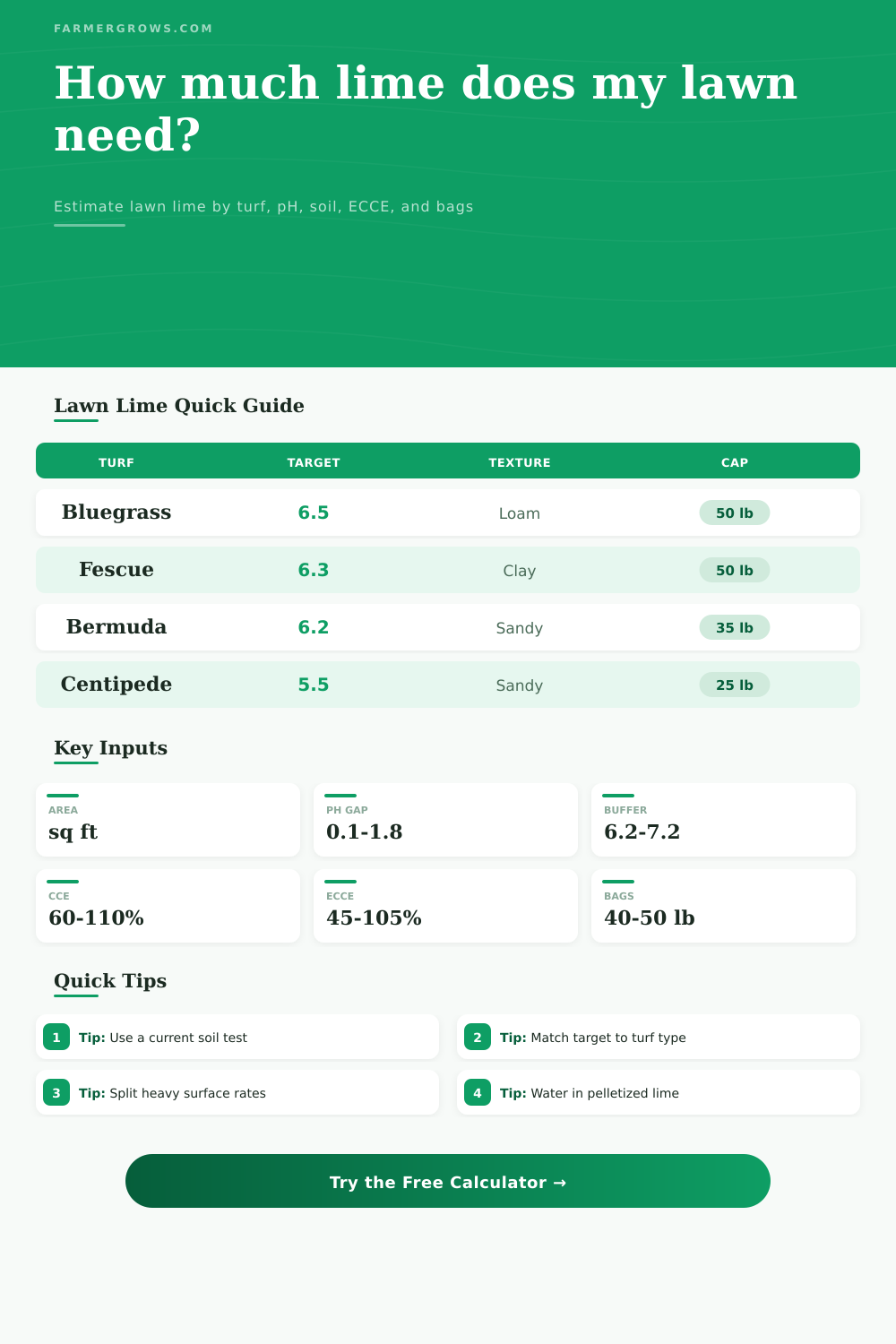
Respect turf-specific targets. Kentucky bluegrass and fescue usually like a higher target than centipedegrass, so matching the species prevents over-liming.
Even if your soil’s not lacking certain nutrients, there’s always room for lime on your lawn applied each spring. What typically goes wrong: how lime gets used (the guessing game). Homeowners treats it as they would a fertilizer, more is more; throw down fast, then voila, the soil will be less acidic. No. Lime isn’t food; it’s a slow-moving soil conditioner that vary in its action based off what else is in the ground.
That’s where the calculator ties to what’s really needed in your turf. It begins with your lawn size and the ideal pH for your turf, specifically for your grass type. For example, centipedegrass grows best in acidic soil, while Kentucky bluegrass prefer more alkaline soil. Aiming for neutral (pH 7) means starving warm-season turf or never addressing the excess acidity underneath cool-season roots. The calculator sets the starting point according to such biological tendencies. That way you’re actualy working with real biology below-ground rather than simply a reading on paper.
How to Use a Lime Calculator
The math gets trickier if you know the soil type. Sandy soils drains quickly but retain almost no lime. Heavy clay holds on tight to nutrients and may need a bigger dose to adjust the pH. To fine-tune the guess: It takes texture and cation exchange capacity into account to refine the estimate.
If your soil test results were low in buffer pH, it indicates there is lots of reserve acidity. This is a hidden reservoir of hydrogen ions ready to pull your pH downward again. The calculator adjusts up to match. Reserve acidity is the invisible storehouse of hydrogen ions eager to pull your pH back down. If you don’t account for it, all your applied lime goes straight to soil profile but never alters the available pH.
And there’s more: You will get better results if your purchased lime is good lime. It varies from bag to bag. There’s an “effective calcium carbonate equivalent” rating that adjusts both for the particle size (coarse or pulverized) and for the actual chemical purity of what you’re buying. Fine pelletized lime spreads easily and uniformly; coarse crushed lime may have less effective value, since the big particles takes years to break down. A low-cost, coarse product with a lower effectiveness rating costs you money in terms of weight but not so much in terms of performance. Instead of telling you just how many pounds to apply, the calculator tells you exactly how much neutralizing power you’ll get, how many pounds divided by this effective value.
The last piece is timing and split applications. Don’t drop 50 pounds of lime onto a thousand square feet all at once. The surface of the soil can’t soak it up that fast; much will run off or just sit on top of grass blades. The tool divides the overall need into practical passes. Often it recommends an initial pass in fall when there’s some moisture to get the lime into the root zone. It also makes allowance for minor handling losses, providing a slight buffer so there’s enough product to fill any blank spots in your spreader pattern.
But here’s the key: precision, and then patience. Lime doesn’t act fast. It takes months; it alters things more different than days. Use the amounts from your calculations to apply it slowly making sure to water it in well. Wait. To know for sure that it worked, retest your soil in a year or two. It’s an expensive thing to do blindly. You should of done it smartly; do it precisely.