Lavender Seed Germination Time Calculator
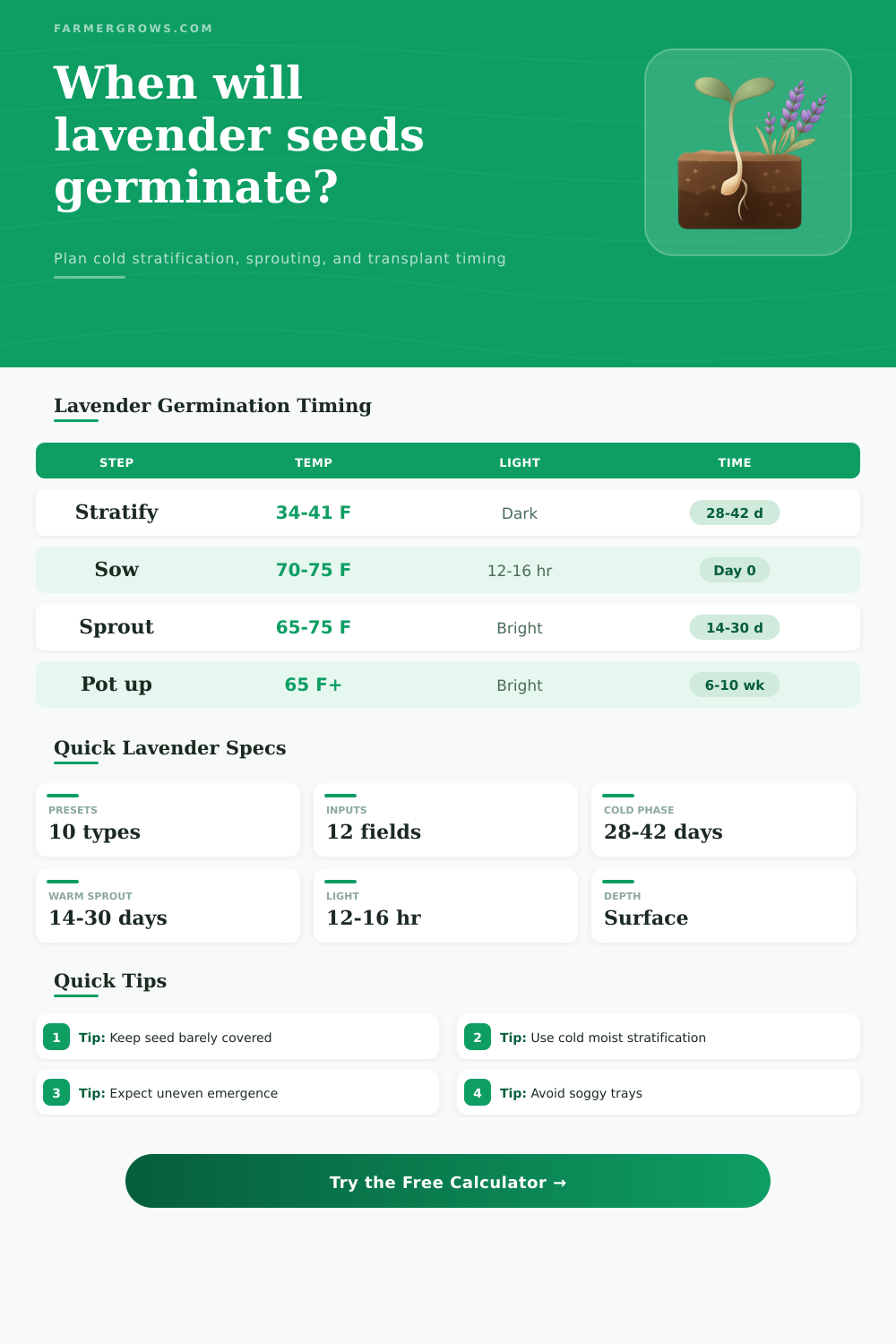
Plan the cold moist stratification period, warm sowing window, slow lavender emergence, pot-up readiness, and expected usable seedlings from a real seed count.
Lavender is slower and less uniform than vegetables such as basil or tomato. This calculator treats cold treatment, light exposure, sowing depth, temperature, cultivar type, and seedling losses as timing inputs, then turns them into dates you can put on a nursery bench calendar.
Often the most seed-friendly group. Expect uneven but workable sprouting after a proper chill.
steady baselineCan be less uniform from seed and may run slower. Extra seedlings help cover weak emergence.
slow trialFine compost blended with sand, perlite, or grit keeps the surface moist without staying soggy.
best mediumLavender seed should be pressed in or barely covered because light improves germination response.
12-16 hrLavender Germination Results
| Lavender type | Seed behavior | Useful cold treatment | Warm germination estimate | Calculator effect |
|---|---|---|---|---|
| Munstead | Common English cultivar, generally reliable for home trays | 28 to 42 days at 34 to 41°F | About 12 to 28 days when warm and bright | Slightly faster than baseline |
| Hidcote | English cultivar with slower, uneven seedling starts | 35 to 42 days at 34 to 41°F | About 16 to 34 days in trays | Small delay and rate reduction |
| Vera or true lavender | Good seed choice where uniformity is not critical | 28 to 42 days at 34 to 41°F | About 14 to 30 days | Baseline timing |
| Lavandin or Grosso | Seed-grown batches can be variable and less predictable | 42 days is a safer trial target | About 18 to 38 days | Slower and fewer usable plants |
| Spanish or French lavender | Often grown from seed, but warmth and light still matter | 21 to 35 days may help evenness | About 16 to 34 days | Moderate delay |
| Condition after sowing | Best range | If too low | If too high or deep | Practical bench note |
|---|---|---|---|---|
| Warm germination temperature | 70 to 75°F | Slower sprouting below 65°F | Stress and drying risk above 80°F | Use gentle bottom heat if the room is cool |
| Daily light | 12 to 16 hours | Delayed and stretched seedlings | Heat buildup if lights are too close | Press seed into the surface instead of burying |
| Surface moisture | Evenly damp, never wet | Dry seed pauses before radicle growth | Soggy media raises damping-off risk | Mist or bottom-water very lightly |
| Air movement | Gentle after emergence | Stale trays invite fungal loss | Strong airflow dries exposed seed | Vent domes once green hooks appear |
| Medium or method | Moisture control | Lavender advantage | Risk to watch | Good use |
|---|---|---|---|---|
| Fine seed mix with sand or perlite | Moderate and airy | Supports light surface sowing | Can dry at the surface | Most indoor trays |
| Sterile peat or coir plugs | Even if not compressed | Easy transplant handling | Too much water around crowns | Plug trays and small batches |
| Rich compost-heavy mix | Holds water longer | Feeds later growth | Higher damping-off pressure | Only when blended with grit |
| Paper towel stratification | Easy to inspect | Shows early cracking clearly | Roots are fragile when moved | Small germination tests |
| Outdoor winter-sown container | Weather driven | Natural cold cycle | Late, uneven spring emergence | Hardy low-labor starts |
| Formula item | Formula used | Why it matters | Lavender-specific adjustment |
|---|---|---|---|
| Stratification end | Start date + cold moist days | Sets the warm sowing date | Cold days below 28 reduce evenness |
| First emergence | Sowing date + adjusted minimum days | Earliest date to stop worrying | Light, depth, temperature, and cultivar shift it |
| Final emergence | Sowing date + adjusted maximum days | Lavender can keep emerging for weeks | Slow conditions widen the window |
| Usable seedlings | Seeds x adjusted germination x survival | Estimates plants worth potting up | Nursery loss is applied after sprouting |
| Readiness date | Median emergence + seedling weeks + hardening | Shows when roots and true leaves may be ready | Deep plugs hold seedlings longer |
Cold phase: Keep stratification moist, not wet. Seeds should have steady refrigerator cold, but standing water and sealed warmth can rot them before sowing.
Slow emergence: Do not discard the tray at day 14. Lavender often sprouts in waves, especially when light is weak, seed is older, or the medium is cool.
To begin with, lavender is not an easy thing to start from seed; it’s not meant for a nice warm house but a rugged Mediterranean life on crumbly soil (or a tray of soil). It won’t hurry up just because you want it too. Its seeds has thick coats and various built-in safeguards against sprouting too early. It will do things in its own time.
Understanding how long all this takes help you make good use of your nursery space. This way, you won’t waste precious hours worrying about a few empty cells when you could be enjoying the results of your efforts. This guide is all about starting lavender from seed.
How to Grow Lavender from Seeds
But first, there is a critical part called cold moist stratification, which means pretending there is a gentle winter. For that, all seeds requires about four to six weeks at fridge temperature, with soil kept barely damp but not sodden. Why? This tricks them into coming out of dormancy by breaking down inhibitor compounds in the seed coat. Without it many seeds simply won’t cooperate.
With this tool, you enter your starting date and get an actual end date for the wait time. It transforms what was previous unclear guesswork into something real on the calendar. This gives you something you can truly plan around so you know just when to shift those seed-starting tray from the cold place to the warm place.
When the cold phase is over, the world has changed completely and it’s all about light and heat. Germinating lavender seeds needs a very bright spot. Press them onto surface but don’t bury them deep underground. They will die if you do as they use up their precious energy stores. Sprinkling them lightly with some vermiculite or fine sand holds them fast but doesn’t block the rays. Temperatures around 70ish F give things a metabolic kick-start for the sprint that follows the crawl. From darkness to daylight, from chilly to warm, the change shocks everything to life.
Even under ideal circumstances, emergence isn’t necessarily simultaneous; some seeds will emerge in two weeks, for instance, but others may take a month or longer. That’s the nature of things and although it can be maddening, consider it part of the process. The reference table indicates that more temperamental lavandins are less predictable then the English types. Knowing this allows you to set your expectations to match.
It also helps you not give up on a tray too early by thinking all hope is lost just because nothing seem to be happening. Just keep surface slightly moist, and wait it out. Don’t create a soaked mess that tempts fungal rot. There’s also planning for loss in there, because not all those seedling make it into their own containers. Sow more than you think you’ll need to account for reasonable rates of nursery loss.
The calculator takes your desired number of plants and works backward to tell you how many seeds you’ll have to get started. This prevents nasty surprises when it is time to divide them among your garden beds and you are only left with a few puny plants. Better to go overstocked than understocked on the lavender front.
Those precious young plants will also need another week or two in slightly tougher conditions indoors. They will be slowly adjusted to life outdoors, which will happen soon. But first! The last part helps harden them off for big move outside (and prevents shock once they are there).
If your goal is strong plants, it’s all spread out over a few months, from refrigeration to flowering, realy. And it takes time: Slow and steady makes for stronger, more resilient plants; not rush-rush, but care-full. When you plot out every phase of the journey, what looks like a jumble of “oh crap!” moments becomes instead a choreography of steps to take.
If you want many plants or specific varieties, like growing lavender from seed, you get to decide how many or which ones, but that power comes with responsibility of following details. You’re conducting a concert involving moisture, light and temperature in the exact sequence needed to bring plants out of their dormant state. When you know the beat, the long wait doesn’t feel so long, and more like building up to something. It happens slowly. One day at a time: It’s all actualy as it should of been with the seeds.