
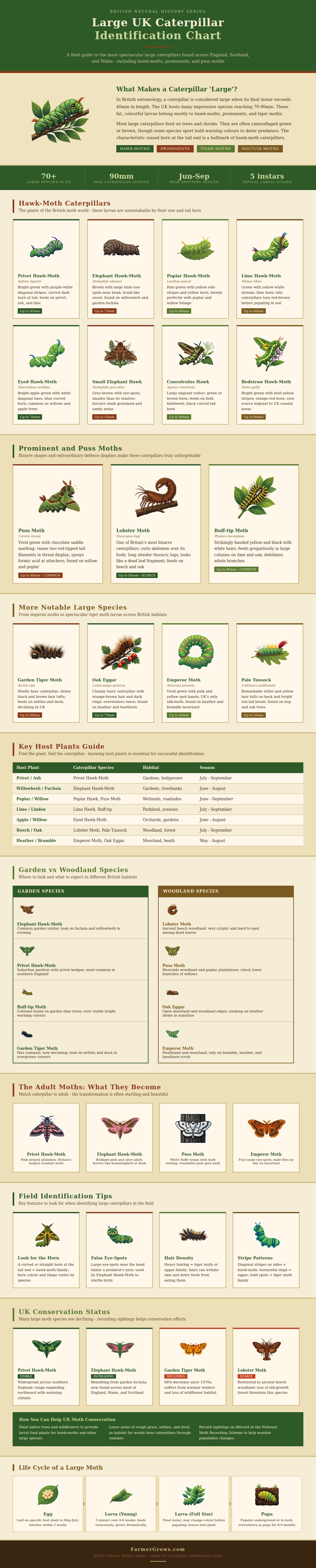
During summers in britain, there’s sometimes this feeling that something big is lurking inside my fuchsia shrub. Then comes knowledge: Someone about thumb-size long has been nibbling away at its foliage. These bugs are not just interesting to entomologists; knowing them also helps you understand what’s going on based off your own land.
Above is a list of the most obvious ones in Britain (England, Scotland, and Wales). Use it to identify who they are so you can find them before they change back into pupae.
Big Caterpillars in British Gardens
In british entomology, there’s a precise definition for what counts as a big caterpillar. To qualify, a caterpillar must be larger than forty millimeters when in its last phase (called the larval or final instar). And even then, a 40mm-long caterpillar might feel puny compared to one crawling along on your privet hedge which can measure up to 90mm long. Not exactly the little green worms you step over without notice while weeding, no?
No, those are substantial larvae primarily of tiger moths, prominent moths and hawk-moths. They’re mostly shrub- and tree-feeders, and you’ll encounter most of them in woodland and garden settings, not out on low-growing herbs. Their coloration blends well into their surroundings, typically using shades of brown and green. Some species is boldly colored to warn potential predators that they don’t make a good meal.
The biggest of all: What do you know about hawk-moths? If you have seen one, a telltale sign are that they have a raised horn on the tail end, which is why they have their common name. One that’s probably visiting your place: a Privet Hawk-Moth, whose bright green larvae is marked by purple-white diagonal stripes and a curved dark horn, as shown here. Reaching up to 85mm, they’re among the biggest of garden gang.
Another frequent flier is the Elephant Hawk-Moth (above). It has big fake eye-spots just below its head that trick birds into thinking it is not a tasty-looking creature. They pop, and off the caterpillar scurries… Buying it time to get away while the bird looks somewhere else.
Other giant caterpillars don’t go for eyespots and horns but instead have other tricks to stay safe. Naturalists love the Puss Moth for its odd behavior: “On being disturbed, it will raise its two red-tipped tail filaments and squirt formic acid into the face of any assailant.” (Talk about brave, an insect shaped something like a chocolate-marked green slug.)
And then there are Lobster Moths, one of the most unusual of our British larvae. It tucks its abdomen onto its back and looks like a scrap of leaf curled into a ball. Even when it eats, it uses its long, thin legs to stay in this pose. If you find it feeding on oaks and beeches in ancient woodlands, which it does, it’s not easy to see amid the leaf litter.
So how do you know where to hunt? According to the guide’s identifications, one clue is that host plants are important. Search fuchsia and willowherb for Elephant Hawk-Moths, for instance. Look along privet hedges, especially in southern England, for the Privet Hawk-Moth. In the woods, watch for Lobster Moths on beech trees, and perhaps some rare Emperor Moth larvae on bramble patches.
And it’s timed; the chart reminds us to expect to see them between June and September. There is a twist regarding conservation status. Many of our moths, such as the Elephant Hawk-Moth, are on the increase, thanks to all those garden plants around. Others are not doing so well. Since the 1970s, the Garden Tiger Moth has been in serious decline, largely because of habitat loss, and also warmer winter weather that throws off their life cycle. Keeping records of what you see can contribute to tracking these shifts; even casual observations becomes important scientific information.
The next time you notice something moving among your shrubs out there, take a second look. It could be a caterpillar on its way to becoming one of Britain’s most stunning moth. Getting to know their names makes a casual stroll a mini-survey of the natural world around us, and links you directly to your local ecosystem in some meaningful way. You should of known it is a small thing, but it matters.