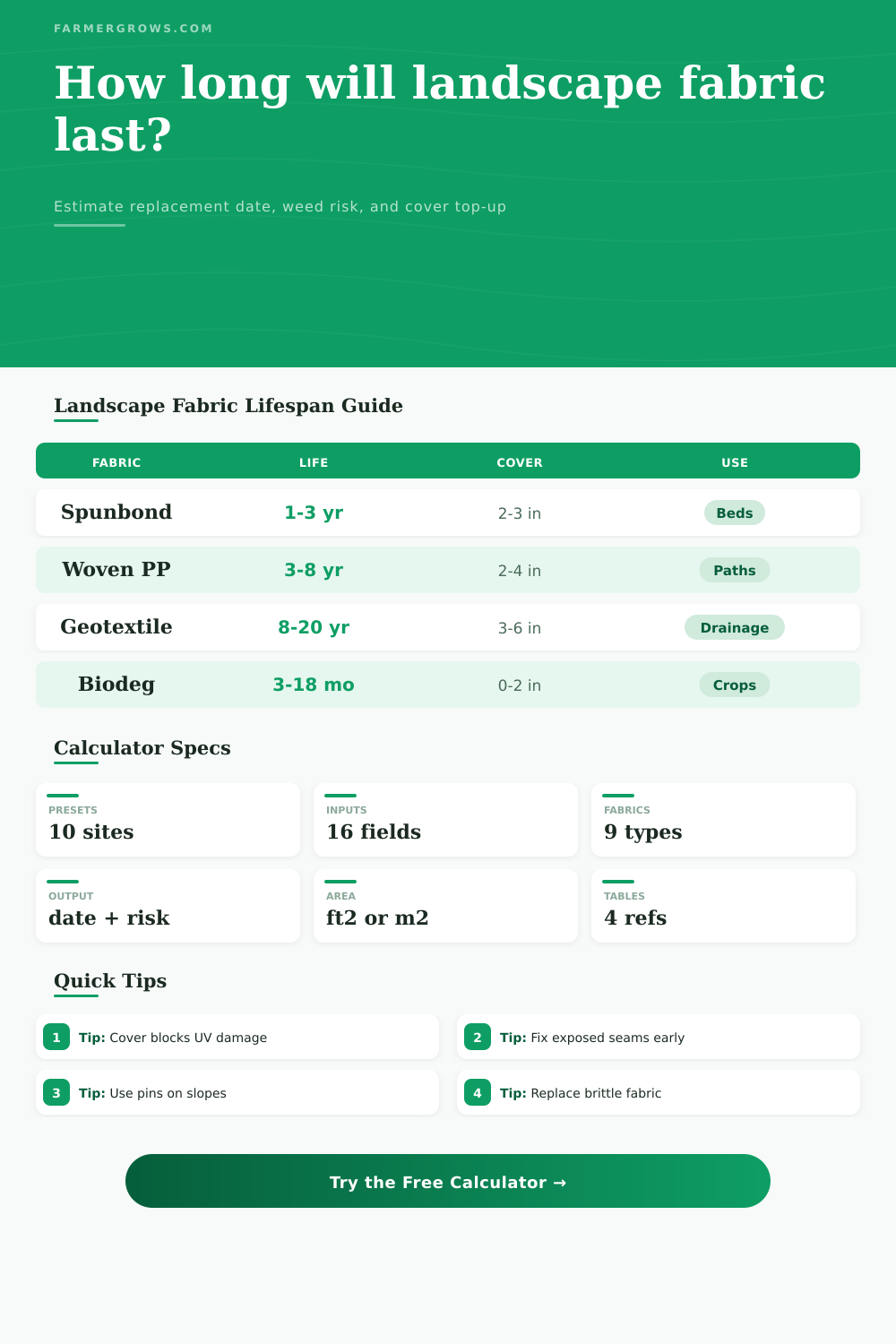
Landscape Fabric Lifespan Calculator
Estimate how many seasons landscape fabric may keep working before replacement, how much life is left, where weed breakthrough risk is rising, and how much cover material is needed to protect exposed fabric.
Load a bed, path, orchard strip, drainage layer, or crop row scenario, then adjust fabric type, exposure, cover, damage, pins, and weed breakthrough for your site.
Landscape Fabric Lifespan Estimate
Enter the site details to estimate fabric life.
Sun exposure makes many plastics brittle and weakens cut edges.
Low mulch or stone depth lets light reach seams and old holes.
Paths, dragged tools, and mower edges widen tears over time.
Loose seams and missing pins often fail before the fabric sheet does.
| Site factor | Low stress | Moderate stress | High stress |
|---|---|---|---|
| Fabric exposure | Covered fabric: 0.82x wear | Seams exposed: 1.10x wear | Open sun: 1.75x wear |
| Traffic | Quiet bed: 0.92x wear | Weeding: 1.08x wear | Dragged tools: 1.50x wear |
| Drainage | Dry bed: 0.94x wear | Normal moisture: 1.00x wear | Ponding: 1.32x wear |
| Weed pressure | Annual weeds: 0.90x risk | Mixed weeds: 1.00x risk | Rhizomes: 1.34x risk |
| Seams and pins | Tight overlap: 0.92x risk | Minor gaps: 1.08x risk | Open seams: 1.42x risk |
| Cover depth | UV shielding | Weed control | Best use |
|---|---|---|---|
| 0 to 0.5 in | Poor | Very low | Temporary crop fabric only |
| 1 to 1.5 in | Fair | Light | Fresh topdress on tidy beds |
| 2 to 3 in | Good | Good | Mulched ornamental beds |
| 3 to 4 in | Strong | Strong | Coarse mulch, paths, slopes |
| 4 to 6 in | Very strong | High | Gravel separation or deep chips |
| Area | Add 1 in cover | 2 cu ft bags | Pin check target |
|---|---|---|---|
| 50 sq ft | 0.15 yd³ | 3 bags | 12 to 18 pins |
| 100 sq ft | 0.31 yd³ | 5 bags | 25 to 35 pins |
| 250 sq ft | 0.77 yd³ | 11 bags | 60 to 85 pins |
| 500 sq ft | 1.54 yd³ | 21 bags | 125 to 170 pins |
| 1000 sq ft | 3.09 yd³ | 42 bags | 250 to 335 pins |
| Observed condition | Repair | Replace | Calculator signal |
|---|---|---|---|
| Fabric flexible, few holes | Patch cuts and top up cover | Not usually | Score above 70 |
| Edges lifting, weeds at seams | Re-pin and overlap patch strips | If age is high | Score 55 to 70 |
| Many tears, brittle surface | Only temporary patches | Likely soon | Score 35 to 55 |
| Rhizomes through fabric | Remove roots first | Often needed | High weed risk |
| Clogged drainage fabric | Expose and inspect stone layer | If water ponds | High wetness stress |
Look at the weak points first. Most fabric jobs fail at cuts, seams, and exposed edges before the center of the roll fully wears out.
Top-up cover can add service life. If the fabric is still flexible, restoring 2 to 3 inches of mulch or stone can reduce UV, weeds, and edge movement.
Landscape fabric prevents weeds; saves your back; holds mulch in place, neat! This can happen if stuff rips apart, gets buried, or allows weeds to puncture holes in it. In other words, that is what typicaly happens.
What’s the secret to going from a weed-war-zone bed to a pristine-looking bed? A lot of it has to do with knowing how fabric will degrade over time…and what conditions it faces day after day after day. Not so much when it was installed… The label on the landscape fabric roll says “5-8 years,” and everyone believes that’s set in concrete; that is what its life must be. The number in quotes varies depending on where the catalog got its information; they don’t know your conditions.
How to Make Landscape Fabric Last Longer
I’ve designed a calculator (above) to do the work for you. Once you enter your location data, it spares you from guessing which variables will affects how long it lasts most.
Ultraviolet light is the silent assassin here, sunshine degrades polymer chain links over time, making flexible plastic go brittle and break up into dusty nothingness. Landscape fabric protect under three inches of stone or mulch stays intact. Exposed edges or loss of cover due to washout? Goodbye, quick. Enter that detail into tool above, because cover isn’t just cosmetic, it’s armor.
Traffic is another large variable. If left alone on an ornamental bed, landscape fabric can rest in peace. However, if it are installed across a gravel walkway, it is constantly punctured and worn down by things like wheelbarrow wheels. And if it gets nicked by mower blades (or shoes gets scuffed against it), you’ll find the resulting tear widening as time go by.
This table on facing page lays all that out in terms you can understand. You will see tearing where a mower nicks the fabric or shoes scuff it, or anywhere there is even moderate traffic. The table also reveals how increased stress speed up wear rates; heavy traffic calls for a stronger geotextile or at least a stronger weave. A lightweight spunbond may cost less initially, but underfoot it won’t last a year. Your savings dissapears in having to buy again.
The problem typically begin at seams and edges. Why? Because if the middle of that roll was going to rot, most fabric projects wouldn’t have survived this long. They’ve failed because they lifted at the edges, providing a foothold for weeds. Then a weed root goes underneath a seam, widening it out. These little things, seam condition, pin security, is what make up the entire integrity of the installation. The calculator factors in these elements. Looseness in overlap or absence of pins? Your landscape fabric will move as soil moves; that movement will create gaps. A small detail, but one that makes all the difference in how long project lasts.
Of course, weather and weed pressure factor into when the landscape fabric fail as well. For example, if you’re fighting tree suckers or an aggressive rhizome, it will find its way through any weak points. That’s where the tool adjusts to give you a risk score, a heads-up before it’s too late that you’re in trouble. Inspect if your risk score is high; it may only need topping up with mulch or re-pin edges of fabric to add several more seasons life to the material. Don’t wait til the weeds starts towering above your perennials!
Bottom line: Landscape fabric isn’t the answer to everything, but then, nothing ever is. Treated properly, with care and understanding… And even replaced when necessary, it will remain a useful part of your landscape routine. Replace the stuff that’s gotten brittle, re-tighten the edges and check that the cover is still thick enough. Know how nature will pick at it so you can plan to rip it out again (before it gets embarrassing) and lay down something new. No more shocking weed eruptions, no more messy garden. That’s how you make the most of any landscape fabric you may own.