Koi Pond Salt Calculator
Estimate how much non-iodized pond salt to add after a water change, current salinity reading, target salt percentage, koi load, salt purity, treatment duration, safe range, and dose steps.
1 Koi pond salt presets
Choose a starting point, then adjust gallons, current salt reading, target range, water change amount, koi load, product purity, duration, and dose steps.
Salt dosing result
Enter pond conditions to estimate salt needed, dose steps, and final salinity range.
Detailed salt breakdown
2 Enter koi pond salt details
3 Live dose checkpoints
4 Salt treatment comparison grid
Use the comparison grid as a planning reference. Always verify salinity with a meter, and do not combine salt with medications unless the product label or aquatic veterinarian says it is compatible.
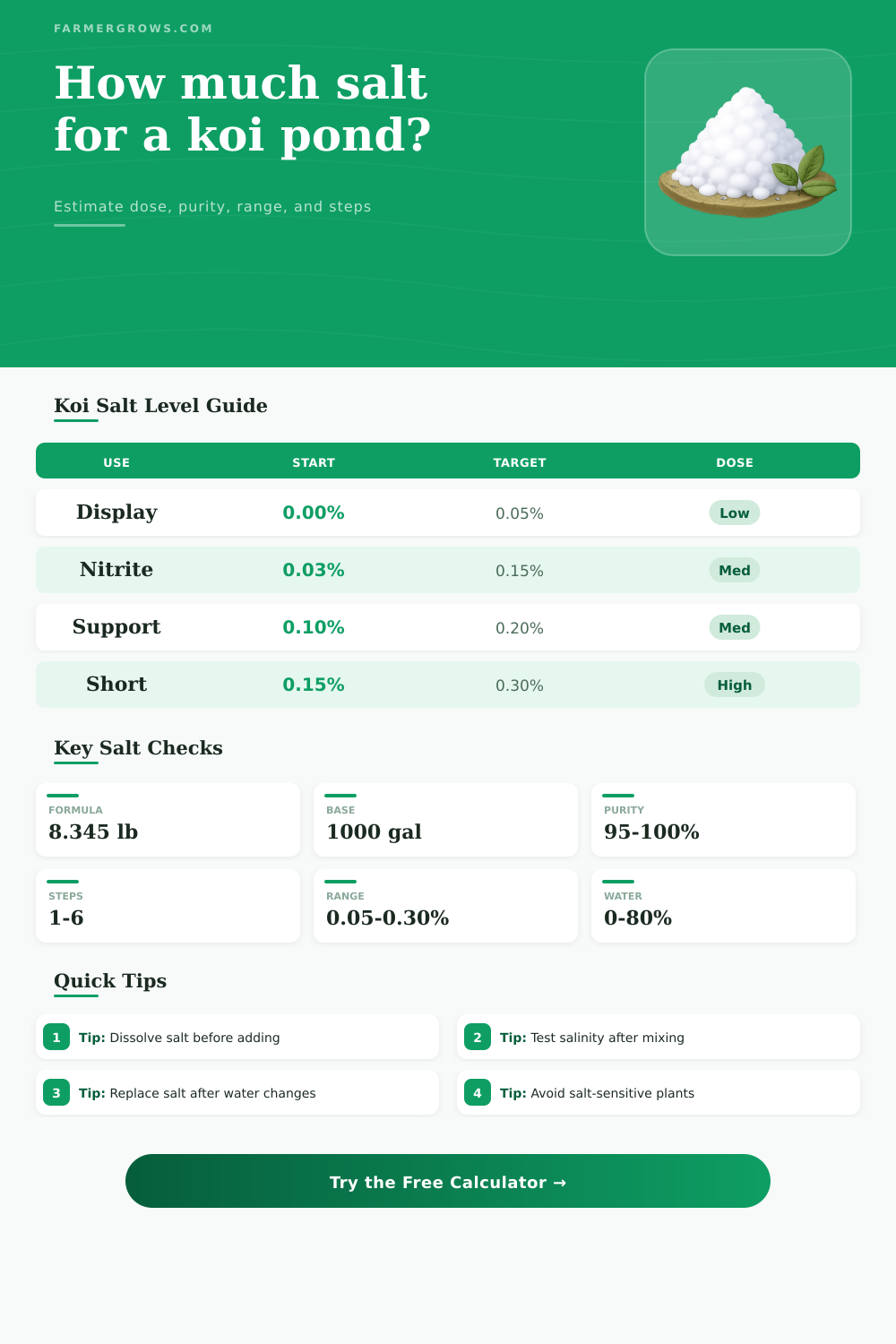
5 Salt percentage conversion table
| Salt percentage | ppt equivalent | Pure salt per 1,000 gal | Common planning note |
|---|---|---|---|
| 0.03% | 0.3 ppt | 2.50 lb | Small replacement or low-level background salt. |
| 0.05% | 0.5 ppt | 4.17 lb | Low support level used by some koi keepers. |
| 0.10% | 1.0 ppt | 8.35 lb | Conservative starting point for many non-planted koi ponds. |
| 0.15% | 1.5 ppt | 12.52 lb | Common nitrite-protection range while water quality is corrected. |
| 0.20% | 2.0 ppt | 16.69 lb | Short monitored support; check plants and medication labels. |
| 0.30% | 3.0 ppt | 25.04 lb | Higher short-term range that should be supervised and measured. |
6 Water change replacement table
| Water change | Starting salt | Salt level after change | Replacement idea |
|---|---|---|---|
| 10% | 0.10% | 0.09% | Add enough salt to raise 0.01% if the same target is needed. |
| 20% | 0.10% | 0.08% | Replace the removed fraction instead of redosing the full pond. |
| 25% | 0.15% | 0.1125% | Measure after mixing; top up only the difference to target. |
| 40% | 0.20% | 0.12% | Large water changes can sharply dilute treatment levels. |
| 50% | 0.30% | 0.15% | Half the salt remains if replacement water has no salt. |
7 Koi load and salt range table
| Koi pond situation | Range to review | Caution point | Before dosing |
|---|---|---|---|
| Plant-heavy mixed pond | 0.03% to 0.10% | Many pond plants dislike sustained salt. | Move sensitive plants or use a lower target. |
| Light koi load | 0.05% to 0.15% | Salt is not a substitute for filtration. | Check ammonia, nitrite, KH, and oxygen. |
| Heavy koi load | 0.10% to 0.20% | Warm water and crowding raise oxygen demand. | Add aeration and verify turnover. |
| Quarantine tank | 0.15% to 0.30% | Small volumes swing quickly after changes. | Measure volume and salinity carefully. |
| Medication period | Product label governs | Some treatments should not be mixed with salt. | Read the label or ask a koi veterinarian. |
8 Dose step timing table
| Total salinity rise | Suggested steps | Spacing idea | Practical check |
|---|---|---|---|
| 0.01% to 0.05% | 1 step | After dissolving | Retest once the pond has circulated. |
| 0.06% to 0.10% | 2 steps | Same day or next day | Watch koi behavior and dissolved oxygen. |
| 0.11% to 0.20% | 3 to 4 steps | Across 1 to 3 days | Use strong aeration and verify the target. |
| Above 0.20% | 4 to 6 steps | Supervised schedule | Use only when compatible with the treatment plan. |
9 Two practical koi salt tips
Premix salt in a clean bucket of pond water, then pour around high-flow areas. Do not dump crystals directly onto fish, liner folds, plants, or filter media.
Rock displacement, filter volume, rain, and water changes all shift salinity. Allow the pond to circulate, measure again, and only top up the confirmed difference.
This calculator is for estimating plain pond salt only. It does not diagnose disease, replace water quality correction, or override medication labels, plant sensitivity, or veterinary guidance.
A koi pond is a living system. Yet, a koi pond is also a garden feature. Salt is a tool that a person can use to maintains the balance in there koi pond.
Small amounts of salt help to reduce the osmotic stress that is placed upon the fishes. Additionally, small amounts of salt can help to blunt the effect of rising nitrite levels. Salt can also replace the salt that leaves the koi pond during water changes.
How to Use a Salt Calculator for a Koi Pond
However, adding to much salt to a koi pond can create various problems. Adding too little salt to the pond can also lead to problems. Because salt can create problems if the amount that is added is not correct, many use a koi pond salt calculator to determine the exact amount of salt that should be added to the pond.
Such a tool is used to ensure that a person dont have to guess at the amount of salt that their koi pond require. A koi pond salt calculator require several pieces of information in order to calculate the amount of salt that should be added to the pond. The information include the volume of the pond, the current salinity of the pond, the percentage of the pond’s water that will be changed, the purity of the salt that will be added, the duration of the addition process, the step count, and the load of the pond.
None of these factors will change the calculations of the amount of salt that will be required for the koi pond. People are unaware of how much salt leaves the pond during water changes. For example, if a person changes twenty percent of the water in their pond, twenty percent of the dissolved salt will also leave the pond.
If a person uses a salt calculator to determine how much salt to add to their pond, the calculator will show the small amount of salt that is require to replace the amount of salt that has left the pond with the water change. Adding to much salt without calculating the amount that leaves the pond will lead to salt levels that are too high for the koi pond. The salt calculator will have reference tables that allow the person to view the range of salinity levels for the pond.
Salinity levels of zero point zero five percent is considered to be low levels of salt that provide some support to the fish in the pond. Salinity levels of zero point one five percent pond owners often use as a means of buffering the levels of nitrites in the pond water. Higher levels are used in the supervised treatment of illnesses in the fish.
However, these higher levels of salt require the maintenance of strong aeration in the pond. The high levels of salt may also be harmful to sensitive plants that are growing in the pond. The salinity level for a koi pond do not need to be any one specific number.
Rather, it needs to be matched to the conditions of the pond. A koi pond salt calculator will display the amount of salt that is required, as well as an amount that has been rounded. The amount of salt that is mathematically calculated is the exact dose of salt.
The rounded amount of salt may be required because the person does not have a tool to measure salt in fractions of a pound. The amount of salt can also be used to plan when to add salt to the pond. For example, splitting the addition of salt over several days provides time for the koi fish to adjust to the salt in their systems.
Additionally, splitting the addition of salt allows the person to test the water prior to adding more salt to the pond. Despite the seemingly great function of a salt calculator for koi ponds, there are limitation to its abilities. A salt calculator does not have the abilities to physically inspect the koi pond.
For example, a salt calculator does not know if a person has recently cleaned the fish pond filter. Additionally, the calculator does not have the abilities to measure the temperature of the water in the pond. Finally, the salt calculator does not have the abilities to measure the amount of dissolved oxygen that is present in the pond.
Therefore, a person using such a tool will have to physically view the pond and test the salinity of the water in the pond. The salt calculator is simply a tool that calculates the amount of salt to be added to a koi pond. However, if use correctly, the tool will ensure that salt continues to be a measured tool for such ponds.