Knapsack Sprayer Calibration Calculator
Calibrate a backpack, battery, compression, or hand sprayer from a timed catch test, walked test strip, swath width, tank size, and label rate before mixing crop protection products.
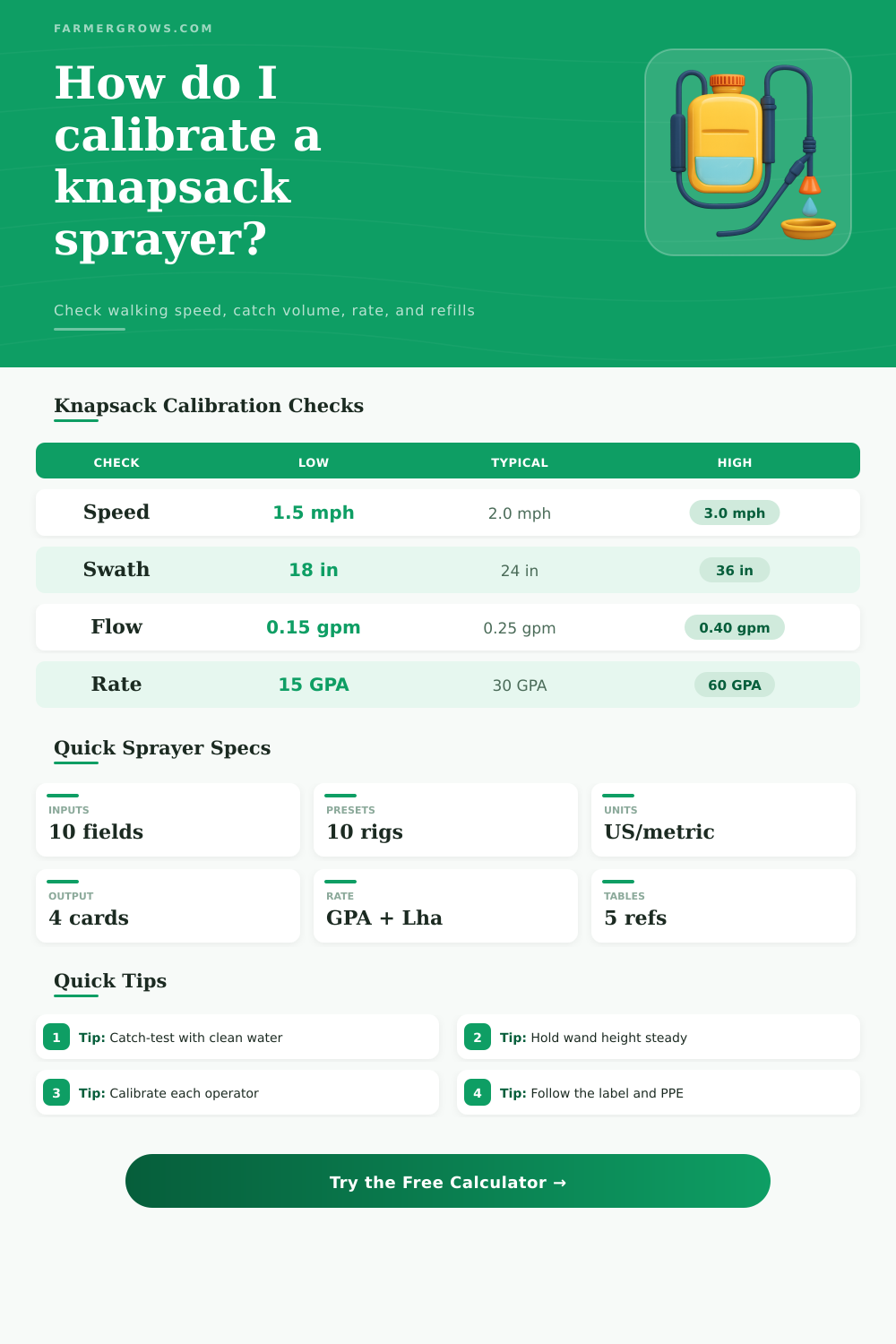
This tool turns a real calibration run into an application rate. Measure the nozzle output with clean water, walk the test distance at normal spraying pace, and use the actual swath width created by your wand height and nozzle pattern.
Calibration Result
Results use your timed catch volume, walked pace, measured swath, tank size, and overlap allowance.
| 100 ft test time | Speed | 30 m test time | Speed | Use note |
|---|---|---|---|---|
| 60 sec | 1.14 mph | 60 sec | 1.80 km/h | Slow, careful spot work around obstacles. |
| 45 sec | 1.52 mph | 45 sec | 2.40 km/h | Common careful pace for beds and greenhouse aisles. |
| 34 sec | 2.01 mph | 34 sec | 3.18 km/h | Typical steady backpack calibration pace. |
| 27 sec | 2.52 mph | 27 sec | 4.00 km/h | Brisk walking; coverage can become uneven. |
| 23 sec | 2.96 mph | 23 sec | 4.70 km/h | Fast for hand spraying; check wand control. |
| Nozzle or wand | Typical swath | 60 sec catch | Pattern quality | Calibration note |
|---|---|---|---|---|
| XR or standard flat fan | 18-30 in | 15-35 fl oz | Even band with overlap | Keep fan angle square to the travel path. |
| Air-induction flat fan | 20-36 in | 20-45 fl oz | Coarser droplets | Good drift control if label allows coarse spray. |
| Hollow cone | 18-30 in | 18-40 fl oz | Canopy coverage | Use consistent wand distance from foliage. |
| Adjustable cone | 12-36 in | 10-50 fl oz | Variable | Lock the setting before measuring catch. |
| Flood or deflector | 30-60 in | 35-80 fl oz | Wide coarse band | Useful for soil or nonselective work. |
| Flow | Speed | Swath | US rate | Metric rate | What it suggests |
|---|---|---|---|---|---|
| 0.15 gpm | 2.0 mph | 24 in | 22 GPA | 206 L/ha | Low to moderate broadcast carrier. |
| 0.25 gpm | 2.0 mph | 24 in | 37 GPA | 347 L/ha | Common backpack herbicide range. |
| 0.35 gpm | 2.0 mph | 24 in | 52 GPA | 487 L/ha | High carrier or canopy work. |
| 0.25 gpm | 2.5 mph | 30 in | 24 GPA | 225 L/ha | Wider/faster pass lowers carrier rate. |
| 0.40 gpm | 1.5 mph | 18 in | 88 GPA | 823 L/ha | Very wet; check label and runoff risk. |
| Tank size | At 20 GPA | At 30 GPA | At 50 GPA | Nozzle choice clue |
|---|---|---|---|---|
| 1 gal hand sprayer | 0.050 ac | 0.033 ac | 0.020 ac | Spot nozzle or small adjustable cone. |
| 2 gal compression | 0.100 ac | 0.067 ac | 0.040 ac | Fan tip for paths, cone for spot canopy. |
| 4 gal backpack | 0.200 ac | 0.133 ac | 0.080 ac | 11002 to 11004 style fans are common. |
| 4.75 gal backpack | 0.238 ac | 0.158 ac | 0.095 ac | Match flow to operator pace and label. |
| 16 L backpack | 0.211 ac | 0.141 ac | 0.084 ac | Metric work often targets 200-500 L/ha. |
Repeatability check: Run at least two catch tests and two walking passes. If the numbers differ by more than about 5%, fix pressure, pace, wand height, or nozzle condition before mixing product.
Application check: A backpack sprayer is only calibrated for the operator, nozzle, pressure, swath, and walking pace tested. Changing any one of those can change GPA or L/ha enough to miss the label rate.
How much is sprayed onto your target? On a knapsack sprayer, that’s controlled by you: treated width, walking speed, etc. Unless you know some exact numbers, those are educated guesses. And guesswork result in either overdosing or underdosing. Enter your test-run measurements into the calculator, and it does all the math for you. So now you know exactly what you’re getting with that nozzle at that pace.
What do all these inputs mean? They’re measurements of what you can control out there in the field. Catch volume is amount of liquid that comes out of the nozzle at working pressure. Speed is walking time converted to a pace over a measured swath. Swath width is what’s actualy being treated once the spray has settled down. Block area and tank size translate those rates into real-world fill-up questions.
Why You Should Calibrate Your Sprayer
Each part are easy enough on its own, but they work together to show whether the sprayer is hitting label rate.
There’s also the matter of nozzle choice. For consistent height, a flat fan emit an even band for paths and rows. A hollow cone emits fine droplets that spread over foliage for contact work, but this can increase drift on breezy days. An adjustable cone provides versatility, though changing settings between tests can alter the pattern. When you plug in numbers, the calculator displays results of your choices. That helps determine whether switching to a different tip is worthwhile.
Once you see the numbers, common errors emerge rapidly. Walking faster then the testing speed reduces the rate without changing anything else. Holding the wand up increases swaths but decreases deposit in center of it. Nozzle wear can absorbs liquid pressure. Often you won’t notice until you’ve done some damage. Calibrating first with clean water eliminates urge to skip it if your time is tight.
The overlap allowance and refills are necessary for the exact same reason. At the end of each pass, you turn around and add the treated area that doesn’t get picked up in the basic rate. The calculator will include that additional coverage in the coverage-per-tank calculation to keep refill count realistic. Otherwise, you’ll complete the block only to realize there’s one more section that requires another mix.
The calibration isn’t a set-and-forget deal: If you swap nozzles, the numbers change. Switch out the operator and they will vary. Move from a row crop to fruit orchard and you’ve changed the output. Change the nozzle again, or adjust spray pressure. Repeat the test after any of these, and you’ll have your application back on track to match what’s expected by label.
You would of had more confidence that the product is working where intended and fewer surprises in the field.