Kale Plants Per Acre Calculator
Estimate kale plant population from acreage, bed centers, rows per bed, in-row spacing, stand survival, seed or plug buffer, and harvest assumptions for baby leaf, bunching, curly, red, and lacinato kale.
Use net planted acres when possible. Kale density changes sharply between baby leaf beds and bunching kale rows, so this calculator keeps field use, bed rows, row-end loss, stand survival, germination, and harvest cuts separate.
Kale Acre Plan
Enter a field size and spacing plan to estimate kale plants per acre.
| Bed or row center | Rows per bed | Plant spacing | Approx. plants per planted acre |
|---|---|---|---|
| 60 in bed | 2 lines | 12 in | 17,424 stations/ac before stand adjustment |
| 60 in bed | 2 lines | 8 in | 26,136 stations/ac before stand adjustment |
| 48 in bed | 3 lines | 8 in | 49,005 stations/ac before stand adjustment |
| 42 in row | 1 line | 18 in | 8,297 stations/ac before stand adjustment |
| 60 in bed | 4 lines | 4 in | 104,544 stations/ac before stand adjustment |
| 72 in bed | 6 lines | 3 in | 174,240 stations/ac before stand adjustment |
| Plan | Typical layout | Best use | Planning note |
|---|---|---|---|
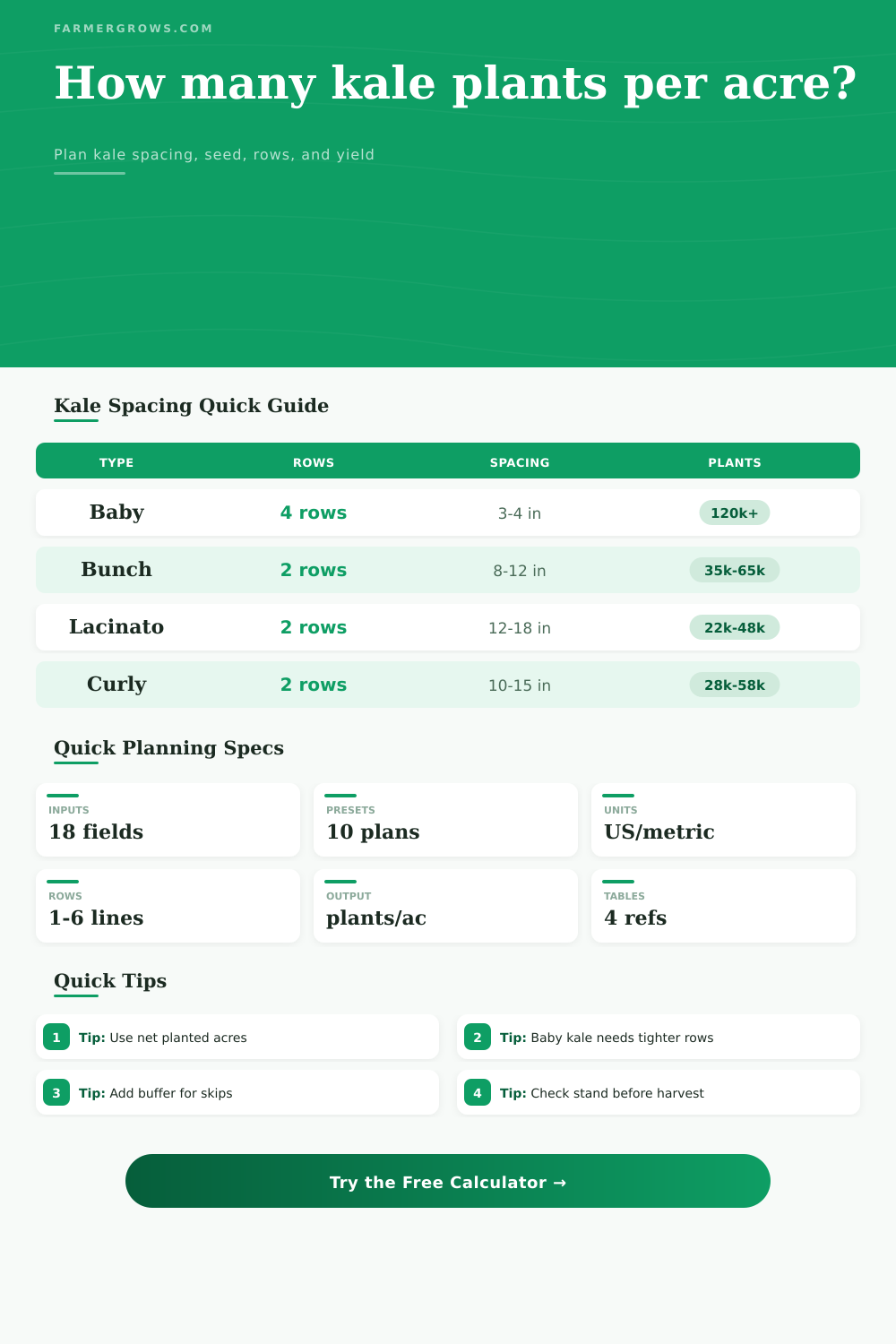
| Curly bunch kale | 2 rows, 10-12 in | Fresh bunch harvest | Balances count, leaf size, and harvest speed. |
| Lacinato kale | 2 rows, 12-18 in | Long leaf bundles | Wider spacing improves airflow and picking access. |
| Baby leaf kale | 4-6 rows, 3-4 in | Cut greens | Use stand counts after thinning or emergence. |
| Red Russian kale | 2 rows, 8-12 in | Tender bunches | Can be planted slightly tighter than tall curly types. |
| Winter production | 1-2 rows, 15-18 in | Overwintered plants | Extra space helps durable plants and repeated harvests. |
| Mechanical cultivation | 1 row, 36-42 in | Tractor cultivation | Population drops, but weed control access improves. |
| Planning item | Common unit | Formula used | Field use |
|---|---|---|---|
| Planned stations | Seed spots or plugs | Total row feet x 12 / spacing | Initial plant map before losses. |
| Live stand | Established plants | Stations x plants per station x stand rate | Plants expected after emergence or transplanting. |
| Seed order | Seeds or ounces | Stations x seeds / germination x buffer | Direct seeding and greenhouse sowing. |
| Plug trays | Tray count | Order quantity / tray cells | Buying or filling transplant trays. |
| Stand check | Plants per 100 ft | 100 / spacing x rows x stand rate | Quick in-field scouting after establishment. |
| Harvest style | Typical cuts | Yield assumption | Use case |
|---|---|---|---|
| Baby leaf | 2-4 cuts | 0.4-0.8 oz per plant per cut | Dense beds sold as loose greens. |
| Curly bunch | 3-6 cuts | 2-4 oz per plant per cut | Repeated leaf stripping or bunch harvest. |
| Lacinato | 3-5 cuts | 2.5-4.5 oz per plant per cut | Long-leaf bunches with moderate spacing. |
| Overwintered kale | 2-4 cuts | 3-6 oz per plant per cut | Large plants with lower acre density. |
Separate gross and planted acres. Kale beds with alleys, headlands, wash lanes, or irrigation headers may have much less planted area than the block size on a map.
Density changes harvest style. Baby kale, bunching kale, and overwintered kale can all be correct at very different plant populations, so match spacing to the selling format first.
How many seed packets do I need to purchase? It sounds like such a straightforward question: You stare at the blank spot on your map and think, “I have this much acreage, so how many plant can I grow?” Then you realize the answer require information about harvest yield, germination rate, row width, and bed width. You also need to decide if you want to plant every inch of that mapped-out land or leave some headland space, which is actual space where you’ll plant something.
Most farmers assume that one acre equal one acre. No matter what other factors might be limiting their planting area. They forget about the irrigation headers, the wash lanes, the headlands where tractors turn around and where plants never get sown. That’s money lost, before you ever till a single shovel full of dirt. But the calculator draws those facts apart for you.
How Many Kale Plants Do You Need?
It requires you to consider how many planting lines is running within each bed, and where those lines are centered. That’s important. Because kale won’t often be planted in one big even row all the way down a big field, but rather perhaps four or six super-tight lines on a big bed (if you’re growing baby leaf kale for multiple successive cuttings), you can get your plant count far north of a hundred thousand per acre.
This is great because it pushes up that canopy so it smothers weeds aggressively, but it also require some serious feeding attention. If you’re growing dinosaur Lacinato kale, destined to make a few long, durable bunches from each plant, then you want air circulation. This also gives those upright leaves some space. This help prevent fungal issues since they stand straight up, and it allow harvest crews to reach in and work on them without damaging the stems.
You can switch back and forth with this style. It calculates the math based off what you want to achieve with your harvest, rather than forcing a one-size-fits-all number of plants.
Most growers trip on the logistics of ordering seed, typically because they have forgotten how variable germination can be… And how many stand get lost. One seed does not equal one mature plant. Planting seeds involves expecting some won’t come up; some will get eaten; some will never make it out of the ground.
There are fields in the calculator for both your expected germination rate and also for an order buffer, so yes, you’re going to buy more seeds. Fifteen percent may be necessary as a buffer if your soil conditions aren’t ideal, or your seed lot is old. Without such a buffer, you’ll find yourself replanting skips at the end of the night when you really could of wasted time.
The same applies to transplant planning, except now there’s the number of trays in the mix. For purchased plant in plug form, you want to be certain how many tray to order. Each tray will have a specific number of cells depending on cell size. Then, figure in the percentage of plants you expect to establish. Obviously, a 288-cell micro-tray isn’t the same thing in terms of budget as a standard 128-cell tray, and neither is the time involved to plant them!
The page includes reference tables for common scenarios, such as comparing the typical plant density of curly bunch kale to an open-spaced row used for mechanical cultivation. Those numbers are a sanity check. If your calculation turns up a wildly different population then is normal for your kind of crop, check again against your spacing assumptions.
How much do they produce? This will depend on their marketable weight (how much of the plant can be sold) and the number of times you intend to cut them back. Kale has an interesting feature: Many varieties produce more than one cut from a single plant, which means extending your income over several months rather than just a few. But each cut reduces the vigor of that plant a little bit, which means it’s likely to have fewer heads to sell with each following cut. Don’t get too optimistic when making your projections, factor in that decrease. The first cut may be big, and then you’ll have to baby along the later cuts, really trying to keep them looking good.
In the end, how many kale plants will work best depends as much on what you can manage (in terms of time/labor) and sell, as on getting an exact number right. Are you aiming at tightly packed baby greens, or at wide-open bunches? The point remains: Each square inch of ground should be paying its fair share.
Calculate from the area you have (usable); tweak according to your harvest method; follow the math where it leads; then order seed accordingly. It is a little thing, and yet it is so important when you are looking to make dirt pay dollars.