Jalapeno Plant Lifespan Calculator
Estimate how long a jalapeno plant can stay productive from growing setup, USDA zone, root space, overwintering plan, fruit load, pruning, disease pressure, heat stress, cold nights, and harvest cycles.
📋Jalapeno lifespan presets
Choose a realistic starting point for patio pots, raised beds, mild-winter gardens, indoor overwintering, heavy fruit load, pruning recovery, heat stress, and disease pressure.
🌱Plant age, setup, and winter plan
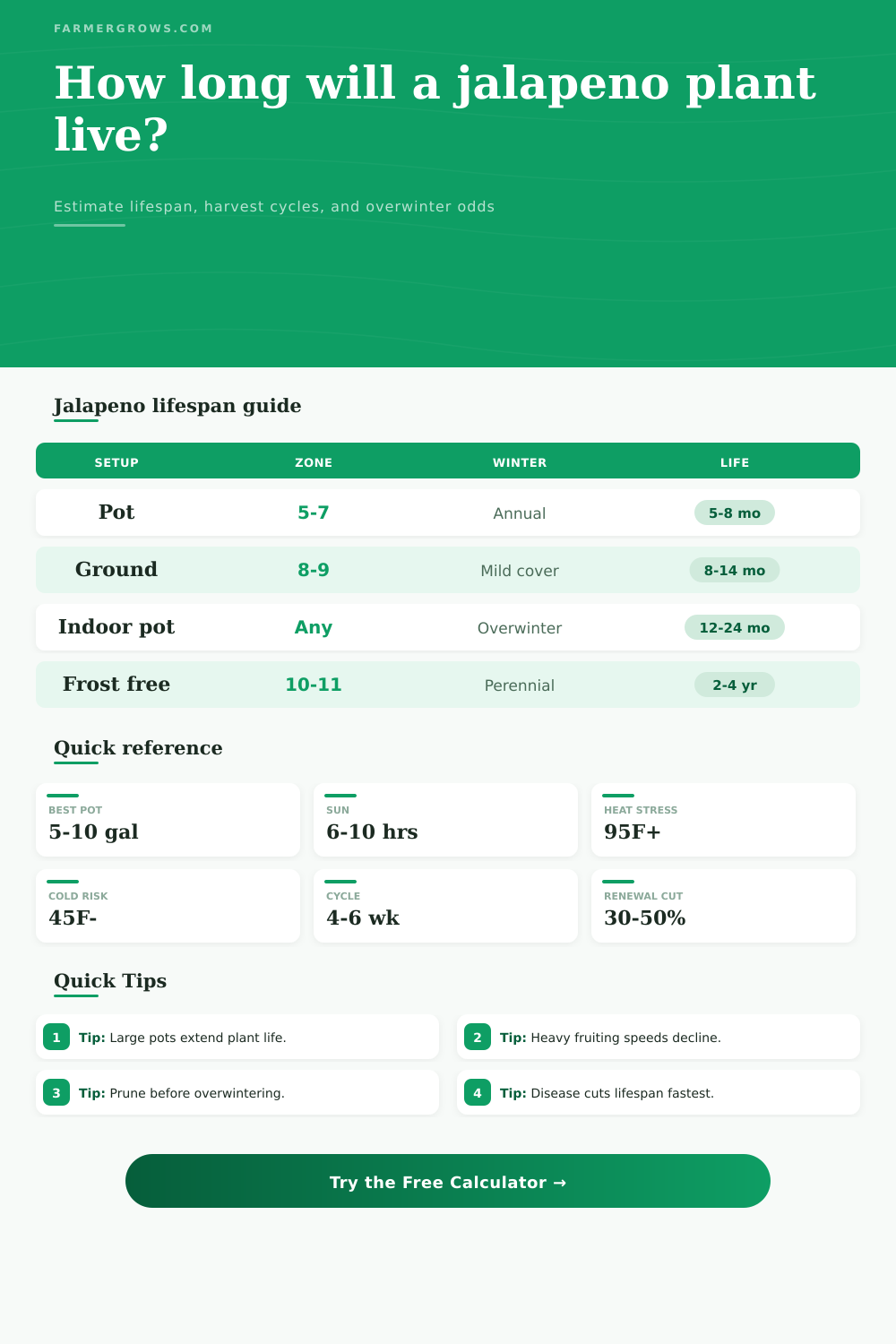
Jalapeno plants are tender perennials, but frost, small containers, depleted roots, heavy fruiting, and disease often turn them into one-season crops.
🌶Fruit load, pruning, and harvest cycle
A plant loaded with ripe peppers can be very productive but still age quickly. Pruning, steady harvests, and balanced nutrition help keep new flowering wood active.
⚠Weather stress and disease pressure
Heat, cold, wet roots, mites, bacterial leaf spot, wilt, and root disease shorten lifespan faster than age alone.
Estimated jalapeno lifespan
Calculated from setup, zone, overwintering, stress, pruning, disease, and harvest load.
Detailed lifespan breakdown
📊Plant vigor summary
📚Jalapeno lifespan reference tables
| Setup | Typical life | Main limiter |
|---|---|---|
| Small pot under 3 gal | 4-7 months | Fast root stress |
| 5-10 gal container | 7-18 months | Winter light and roots |
| Raised bed | 6-14 months | Frost and disease carryover |
| In-ground frost-free | 2-4 years | Woody decline and pests |
| Heated greenhouse | 18-36 months | Pruning and disease control |
| Zone | Outdoor result | Best plan |
|---|---|---|
| 3-5 | Annual outdoors | Lift pot before frost |
| 6-7 | Annual unless protected | Indoor grow light |
| 8-9 | Possible mild overwinter | Mulch plus frost cloth |
| 10 | Often perennial | Renewal prune yearly |
| 11+ | Perennial with care | Manage pests and heat |
| Cycle stage | Common timing | Lifespan effect |
|---|---|---|
| First fruit set | 2-3 months | Plant enters prime |
| Peak flushes | 4-8 months | Best yield window |
| Late season | 8-12 months | Woody growth increases |
| Overwinter rest | 12-18 months | Low fruit, low feed |
| Second-year rebound | 14-24 months | Fast early flowers |
| Factor | Warning sign | Action |
|---|---|---|
| Heavy fruit load | Small new leaves | Harvest and feed |
| Heat over 95 F | Flower drop | Shade afternoon sun |
| Cold below 45 F | Purple slow growth | Move or cover plant |
| Root disease | Wilt in wet mix | Refresh soil if possible |
| Mites or leaf spot | Defoliation | Prune infected growth |
A jalapeno plant with clean roots, strong new shoots, and a manageable fruit load is usually worth overwintering, especially in a 5 gallon or larger container.
Replace a plant when wilt, crown rot, severe leaf loss, or tiny post-pruning regrowth persists. Seedlings often outperform sick second-year plants.
The jalapeno is technicaly a tender perennial, but most of us grow it like an annual since frost will kill the plant. If you didn’t pick on it, they’d continue producing peppers for years. Chances are that this isn’t even a genetic thing, but rather exhaustion from heavy fruiting plus root confinement in a too-small space combined with winter darkness. Knowing where your plant falls avoid nursing along a dying thing (or worse, throwing out perfectly good wood), which can save you.
After entering your set-up and zone (no more guessing about overwintering!), the calculator do the math for you. The calculator compares the realities of a plant in 3 gallons against its root volume in the ground, then combines this with your local winter severity to provide a time frame. For example: A potted jalapeño on a north-facing city balcony will be different than one planted out in Florida. It calculates these variables to find your local ceiling. It also provides “probability of overwintering” score and a lifespan estimate so you can get a sense of it.
How to Make Jalapeno Plants Live Longer
Container peppers are silent victims of root space. If the plant exhausts its room to grow, it will stop concentrating on getting big and instead just muddle along in survival mode. Feed and water as well as you like; if there’s no place for roots to spread, the plant will age up faster than it needs to. This is why the calculator allows you to enter volume of soil (or even the actual pot size) that the pepper has to live in. For most varieties, a five-gallon pot proves to be the sweet spot: plenty of room for good hard production all year long, whereas anything smaller tend to run out of steam by summertime.
Then there’s overwintering, where you’ve got another level of complication: Now light is limiting. Bring that thing inside and warm it up all you want, but unless it gets enough light, it’s going to start stretching out, weakening itself and inviting spider mite infestations. And the tool accounts for how much light exposure you have when it tweaks its odds of survival. A lot of growers take a chainsaw to their plants before they bring them indoors, creating just a skeletal structure that needs fewer resources to sustain through the dark months. That way, the roots can recover from the season’s exertions… A tradeoff between short- and long-term viability, with the latter yielding more in the long run.
You don’t hear much about this one, but yes: heat also shorten a life. Over time, long exposure to temps higher than ninety-five degrees will weaken the plant’s structure, causing such issues as sunscald and even flower drop. Extreme weather events (cold nights or high heat days) build up; they add up to cumulative damage that may not appear as an easy-to-see disease, but that hastens the aging process. A plant exposed to several heat spikes won’t rebound quite so vigorously in year two, no matter what you feed it.
The wild card is disease, which can wipe away all your theory-based life span in an instant. Who cares if you pruned it on time if bacterial wilt strikes? Or what about root rot? The roots will give up before running out of room in the pot or the garden bed. A poorly-draining spot (or a soil mix that’s holding more water than is good) will suffocate the roots and that’s the end of them. Setting realistic expectations means considering disease pressure with this tool. Often a plant appear perfectly healthy but has lost its roots slowly because of some sneaky fungal problem.
Jalapenos aren’t living longer; they’re less stressed. A jalapeno doesn’t get bigger because you feed it; it gets bigger despite what you do. That is why the best way to extend its shelf-life is not to encourage growth, but to manage stress on the plants. If you want a mother plant for years, not just months or weeks, then focus on making sure it’s getting lots of light and maintaining healthy roots more than you worry about producing as much fruit as possible each growing season. The calculator illustrates that trade-off (and lets you see how each input changes the curve). With that awareness of what your system will hold, you can make better choices now. These choices helps your jalapenos produce sooner or last longer into the fall, or both. It makes planning instead of gambling.