Jalapeno Peppers Per Plant Calculator
Estimate jalapeno peppers per plant, total pods, fresh harvest weight, picking rounds, seedling reserve, and a practical low-to-high yield range from your growing setup.
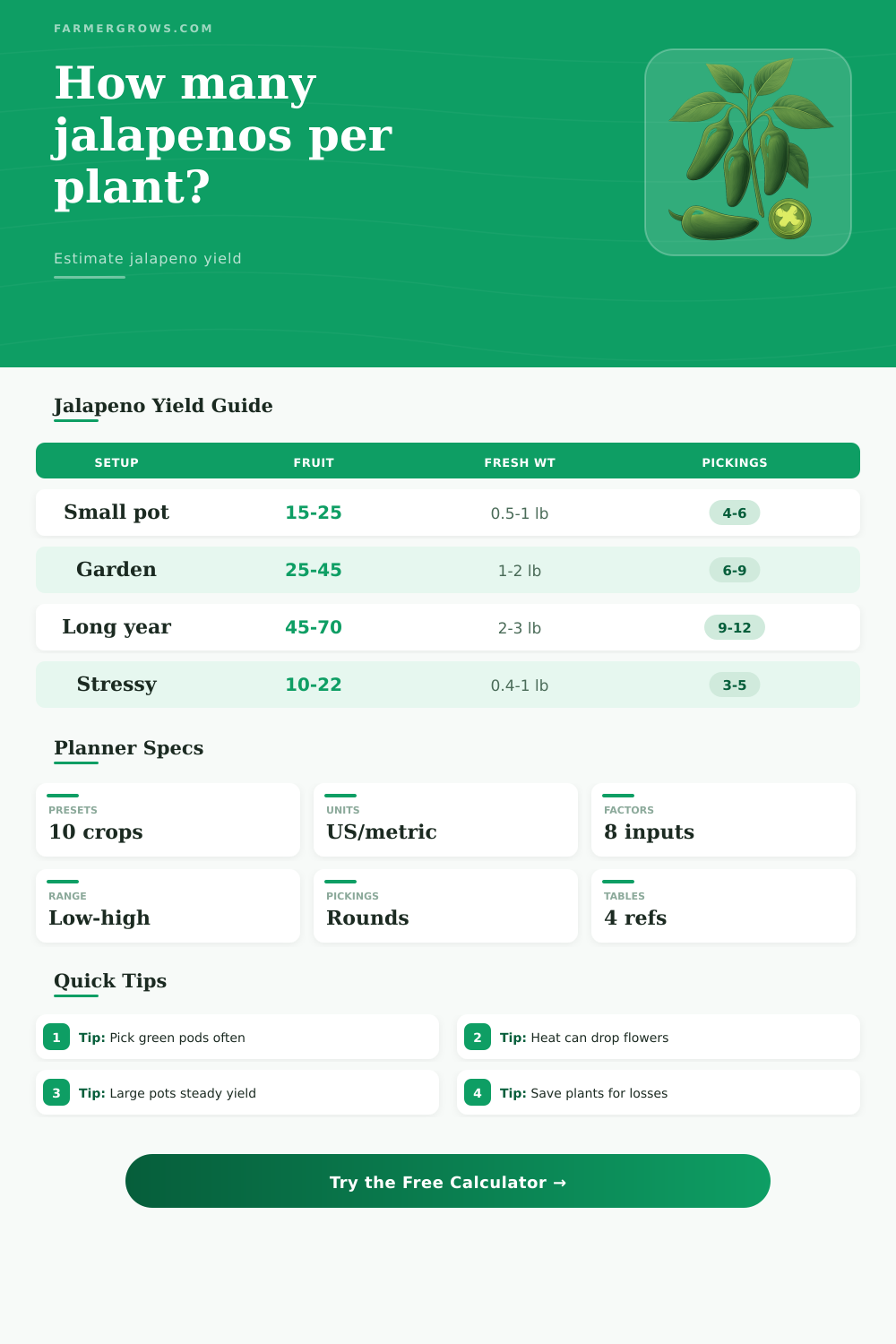
Jalapenos often yield about 25 to 45 harvestable pods per healthy outdoor plant, but the final number moves with plant size, picking stage, heat, pot volume, feeding, and how often ripe pods are removed.
Jalapeno yield snapshot
Enter your crop details to estimate harvestable jalapenos per plant.
| Growing setup | Typical pods per plant | Fresh weight per plant | Best use |
|---|---|---|---|
| Small patio pot | 15 to 25 | 0.5 to 1.1 lb | Fresh eating, small salsa batches |
| Large container or grow bag | 22 to 38 | 0.9 to 1.8 lb | Home kitchen harvests |
| In-ground raised bed | 25 to 45 | 1.0 to 2.2 lb | Steady green jalapeno picking |
| Long warm season | 45 to 70 | 1.8 to 3.4 lb | Pickling, freezing, drying |
| Red ripe harvest | 18 to 34 | 0.9 to 2.0 lb | Hot sauce, powder, chipotle drying |
| Harvest stage | Pod count effect | Weight effect | Planning note |
|---|---|---|---|
| Green, picked often | Higher count | Slightly lighter pods | Best for maximum peppers per plant. |
| Mixed green and red | Baseline count | Baseline weight | Good all-purpose estimate. |
| Mostly red ripe | Lower count | Slightly heavier pods | More time on plant slows new sets. |
| Red ripe for drying | Lowest count | Higher dry quality | Useful for chipotle or chili powder planning. |
| Planting pattern | Spacing | Plants in 10 ft row | Yield note |
|---|---|---|---|
| Compact close row | 12 in apart | 10 plants | Works with strong fertility and airflow. |
| Standard garden row | 18 in apart | 6 to 7 plants | Good balance of canopy and access. |
| Wide warm climate row | 24 in apart | 5 plants | Better airflow in humid or long seasons. |
| Large container | 1 plant | 5 gal or larger | Keep moisture steady for pod fill. |
| Use | Fresh jalapenos | Approx fresh weight | Calculator cue |
|---|---|---|---|
| Small salsa day | 10 to 18 pods | 0.5 to 0.9 lb | Watch weekly pod output. |
| Pickling batch | 35 to 55 pods | 1.5 to 2.6 lb | Plan several pickings together. |
| Freezer stash | 70 to 110 pods | 3 to 5 lb | Use the total fresh harvest card. |
| Dried flakes | 100+ pods | 4.5+ lb fresh | Use dried yield with red harvest stage. |
If early harvests are much smaller than expected, lower the baseline pod count or increase the cull loss before planning preserving batches.
Leaving many jalapenos to ripen red can improve flavor for drying, but it usually slows the next round of flowers.
Not to disappoint, but there’s a particular letdown when a jalapeno plant that was in good condition suddenly fails to set any more fruit. You’ve given it plenty of sun and regular watering, but instead of fat fruiting clusters, there are just bare spots on the canopy. That’s why we encourage you to estimate your future yield before purchasing seed, rather then making a guess, and do the math yourself with our calculator (above).
Instead of wondering if your jalapeno-growing conditions will produce enough for a salsa batch, or if they’re realy only up for garnish duty, the calculator does it for you. Jalapenos are another pepper where most people think they’ll get X amount from each plant (biology says otherwise). A healthy garden plant can yield thirty to forty pods during the growing season; a stressed-out container plant may barely reach twenty because of its lack of thermal stability and lack of root volume.
How to Get More Jalapenos
Typically, that’s what separates the winners and losers: root volume, and thermal stability. When you choose your set-up in the tool, you tell the system the size of the root volume. This determine how many nutrients and water it can grabs. If there isn’t enough, then the plant will drop flowers (as opposed to waste energy on fruit it cannot sustain). Why? Because it’s a survival mechanism… The way the plant deals with a small pot drying out quicker than ground. So, watering consistency is as important an input as type of soil.
Another factor affecting the yield dynamic: when you choose to pick. If you leave them to ripen fully (red in the case of Jalapeños), metabolism slows way down, even though each individual fruit may be bigger or tastier for drying by then. This mean the plant perceives a need to replace what was removed, which keeps its metabolic engine running. So it shuts down its metabolic engine a bit. But if you go and pick green, the plant still thinks it needs to keep going, since all those pods is intact and ready. It’s a quality vs. It is a quantity thing. That’s clear from the table I’ve got on the page, which shows the trade off you’re making with red ripe harvesting; getting more intense fruit at the expense of fewer total ones. Volume vs. It is a matter of virtue. Call it whatever you want.
And then there’s one more level of frustration: Heat stress. You can do all the right things to try to avoid it and still get whacked with some high-heat days anyway. In fact, the higher the capsaicin, the lower the flower retention (meaning when it gets super-hot, like during a heatwave, even if capsaicin production goes up, flowers will go down). If you’re located in an area that routinely hits 90+ degrees in the summer, this lets you dial in for that stress factor and helps keep you from overplanting assuming those perfect growing conditions will ever show themselves in your microclimate. Better to underplan conservatively than to be shocked into a quiet season.
Another benefit is considering the number of seedlings that don’t survive, those that die from transplant shock or fall prey to early pests. It’s easy to forget how many plant may be lost during this transition period when we’re first figuring out what to start. By including an extra percentage of seedlings as a safety margin, we ensure we’ll have sufficient mature plants to get our desired fresh weight harvests. Otherwise, losing a couple (or even three) plant means going from a bumper crop to a cupboard bare.
For people who plan for their winter crops, using the dried yield metric allows them to put the harvest weight into context. This translates fresh weight into a form that is more stable for long-term storage. All told: Growing jalapeños is mostly about keeping things steady, not pushing too hard for more, more, more (as with any crop), but finding the right set of circumstances in which the plant will be content.
Sure, you’re gambling on the weather, but you’re not entirely powerless; you can manage picking frequency, pot size and amount of space between each plant. If you understand those factors before planting, you’ll shift from guessing at the outcome to setting up a plan. Will you want a pint of pickles or a whole freezer stash? Knowing what you’re getting will help you adjust your actions beforehand instead of just reacting to the results after everything is finished.
More isn’t always better. Predictable is better. Choose peppers that match what you planned for your kitchen, and don’t waste space or effort on plants whose fruit you should of really got to.