Jackfruit Trees Per Acre Calculator
Estimate jackfruit tree count from block area, spacing, planting pattern, alleys, headlands, unusable ground, and replacement stock for orchard planning.
Choose a real jackfruit spacing scenario, then adjust the block dimensions, tree pattern, service area, and reserve trees for your planting plan.
Jackfruit Tree Spacing Results
Estimated planting density for the selected jackfruit orchard block.
Best for vigorous seedlings, low-input orchards, livestock shade, and long-term canopy spread.
Useful default for grafted jackfruit where mature canopy access and fruit harvest matter.
Fits smaller farms that can prune regularly and reserve alleys for spraying and harvest carts.
Higher early tree count, but it needs cultivar discipline, canopy training, and possible thinning.
| Planting system | Typical spacing | Approx trees per acre | Best fit |
|---|---|---|---|
| Very wide seedling orchard | 40 ft × 40 ft | 27 trees/ac | Large unmanaged canopies, shade, and low-density mixed farms |
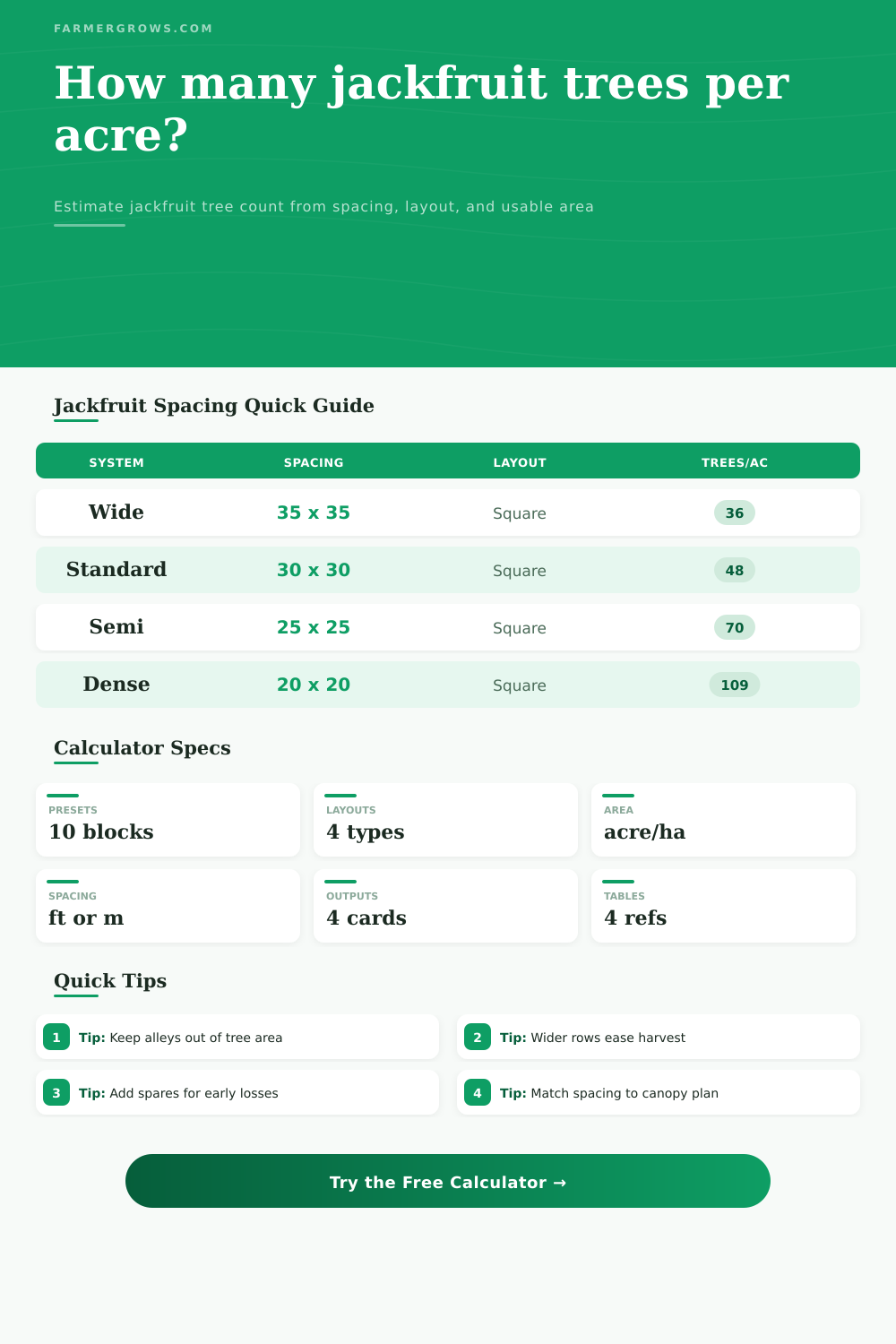
| Wide full-canopy block | 35 ft × 35 ft | 36 trees/ac | Vigorous seedlings or humid sites with strong vegetative growth |
| Standard jackfruit orchard | 30 ft × 30 ft | 48 trees/ac | Balanced long-term spacing for many grafted and local trees |
| Moderate grafted spacing | 28 ft × 28 ft | 56 trees/ac | Managed blocks with harvest access and moderate pruning |
| Semi-dense grafted spacing | 25 ft × 25 ft | 70 trees/ac | Commercial blocks with canopy training and planned alley space |
| Compact pruned spacing | 22 ft × 22 ft | 90 trees/ac | Small farms using frequent pruning to preserve light and access |
| High-density planting | 20 ft × 20 ft | 109 trees/ac | Early yield focus, dwarfing habit, or later thinning plan |
| Intensive trial block | 18 ft × 18 ft | 134 trees/ac | Experimental compact systems with strict annual canopy control |
| Spacing | Square grid | Triangular layout | Metric equivalent |
|---|---|---|---|
| 35 ft × 35 ft | 36 trees/ac | 41 trees/ac | 10.7 m × 10.7 m |
| 30 ft × 30 ft | 48 trees/ac | 56 trees/ac | 9.1 m × 9.1 m |
| 28 ft × 28 ft | 56 trees/ac | 64 trees/ac | 8.5 m × 8.5 m |
| 25 ft × 25 ft | 70 trees/ac | 80 trees/ac | 7.6 m × 7.6 m |
| 22 ft × 22 ft | 90 trees/ac | 104 trees/ac | 6.7 m × 6.7 m |
| 20 ft × 20 ft | 109 trees/ac | 126 trees/ac | 6.1 m × 6.1 m |
| Allowance item | Typical range | Calculator effect | Planning note |
|---|---|---|---|
| Farm road or turning lane | 4%–10% | Reduces productive area | Use more on blocks reached by tractors or fruit carts |
| Drainage and contour strips | 3%–12% | Reduces tree positions | Important on wet tropical soils and sloped land |
| Shade, rocks, buildings | 2%–15% | Reduces usable acres | Map exclusions before ordering grafted plants |
| Replacement stock | 5%–15% | Adds spare trees | Useful for first-year losses, weak starts, or graft failure |
| Headland clearance | 10–25 ft | Shortens row count estimate | Leave room for sprayers, harvest bins, and turning |
| Block example | Area | Spacing assumption | Estimated trees |
|---|---|---|---|
| Quarter-acre home orchard | 0.25 acre | 30 ft × 30 ft, 10% reserve | 12 planting spots, 14 trees ordered |
| Half-acre homestead plot | 0.50 acre | 28 ft × 28 ft, 12% area allowance | 25 planting spots, 28 trees ordered |
| One-acre standard block | 1.00 acre | 30 ft × 30 ft, 12% area allowance | 43 planting spots, 48 trees ordered |
| Two-acre grafted orchard | 2.00 acres | 25 ft × 25 ft, 15% area allowance | 118 planting spots, 130 trees ordered |
| One-hectare metric block | 2.47 acres | 8 m × 8 m, 14% area allowance | 133 planting spots, 147 trees ordered |
Separate tree spacing from access space. A 30 ft spacing may calculate 48 trees per acre on paper, but roads, drains, headlands, and shade gaps often reduce the orderable planting positions.
Choose density around canopy management. Jackfruit trees can become broad and heavy-fruited, so closer systems need pruning, clear harvest lanes, and a plan for thinning if canopies close.
You are buying a piece of real estate for a tree that might take three years to fruit, and one which will splay out far and wide. New growers tend to think in straight-line terms. But forget the three-dimensional truth of canopies as they expands. They use theoretical density to buy plant, forgetting there is no place to put a wheelbarrow when it is time to harvest.
The calculator does math for you… But it requires an honest assessment of yourself. What sort of jackfruit do you want? Do you want vigorous seedlings. Or grafted ones? Grafted ones tolerates closer spacing, perhaps twenty feet or so between trunks, instead of thirty-five feet or more for seedling types, allowing the jacks space to breathe.
Plan Your Jackfruit Spacing
The tool assumes either a triangular layout, or a square one, adjusting the number of tree accordingly. The triangular layout is tighter, with roughly fifteen percent more trees because the trees are staggered like bricks. When your budget is tight and you’re striving to get every last bit of production from land, that increased density counts.
But raw density is useless unless you can reach the fruit: Headlands, drains, and roads are places that no tree can grows. They’re the places where you’ll make turns or park a cart. To compensate, subtract a percentage from total for this service area. It feels wasteful, but really, you’re purchasing sanity down the road. Without allowing for alley space, your orchard will be a jungle of trees you can’t get into or back out of carrying something.
Using conventional 30-by-30 foot spacing, reference table shows there will be roughly forty-eight tree per acre of such an orchard. Subtracting corner-space that’s unworkable and carving out room for infrastructure reduces that figure. Think about what kind of tools you have, and how much land. If it’s sloping, the contour approach (above) will make more sense different than the rigid grid, even if it wastes a bit of space in the process while helping prevent erosion.
You can specify length of rows and dimensions of blocks, as well as account for other odd things with the calculator. It includes a percentage reserve for replacement trees, too; a must, since not all the seedlings that arrive survives their first year outdoors. That’s insurance… Not pessimism. Order extras. And it does so with a total tree count and a net density, which is actualy the final output.
But the best part is breakdown of spacing. This is where you see how many trees will fits on one row and what each foot of space looks like. What’s its footprint? Look at it as a way to see your workflow. Can you walk around the tree? Can you spray? Can you pick them without bruising fruit? If the answer is no, you need more space and must be careful or your tree count will drop.
It’ll seem like you’re putting down fewer assets, but you’re creating a working farm. To sum up: Mistakes with spacing at this stage are costly; there’s no way to slide an adult jackfruit tree. Either kill it or cut it down and hope for something better. Don’t dig that first hole until you’ve got the plan down, so do spend some time getting it right on paper. (The calculator tells you how many; your map and eyeballs tell you why.) Plan on the future tree… Not the potted one you have now. If you’re leaving empty space for an alley, it isn’t dead space, it’s the space between a harvest and a hazard. You should of thought about this earlier to avoid luxurios mistakes based off bad math.