Field Capacity Calculator
Estimate plant-available soil water, current depletion, refill depth, and gross irrigation volume from root zone depth, soil texture, crop depletion fraction, and irrigation efficiency.
Field capacity is the water content after drainage slows, while permanent wilting point is the lower limit for crop extraction. This calculator uses volumetric water content, so storage depth equals water fraction multiplied by rooted soil depth.
Soil Water and Irrigation Results
Use the refill depth when current water is below field capacity; compare depletion to RAW before the next irrigation.
| Texture | Field capacity | Wilting point | Available water | Bulk density |
|---|---|---|---|---|
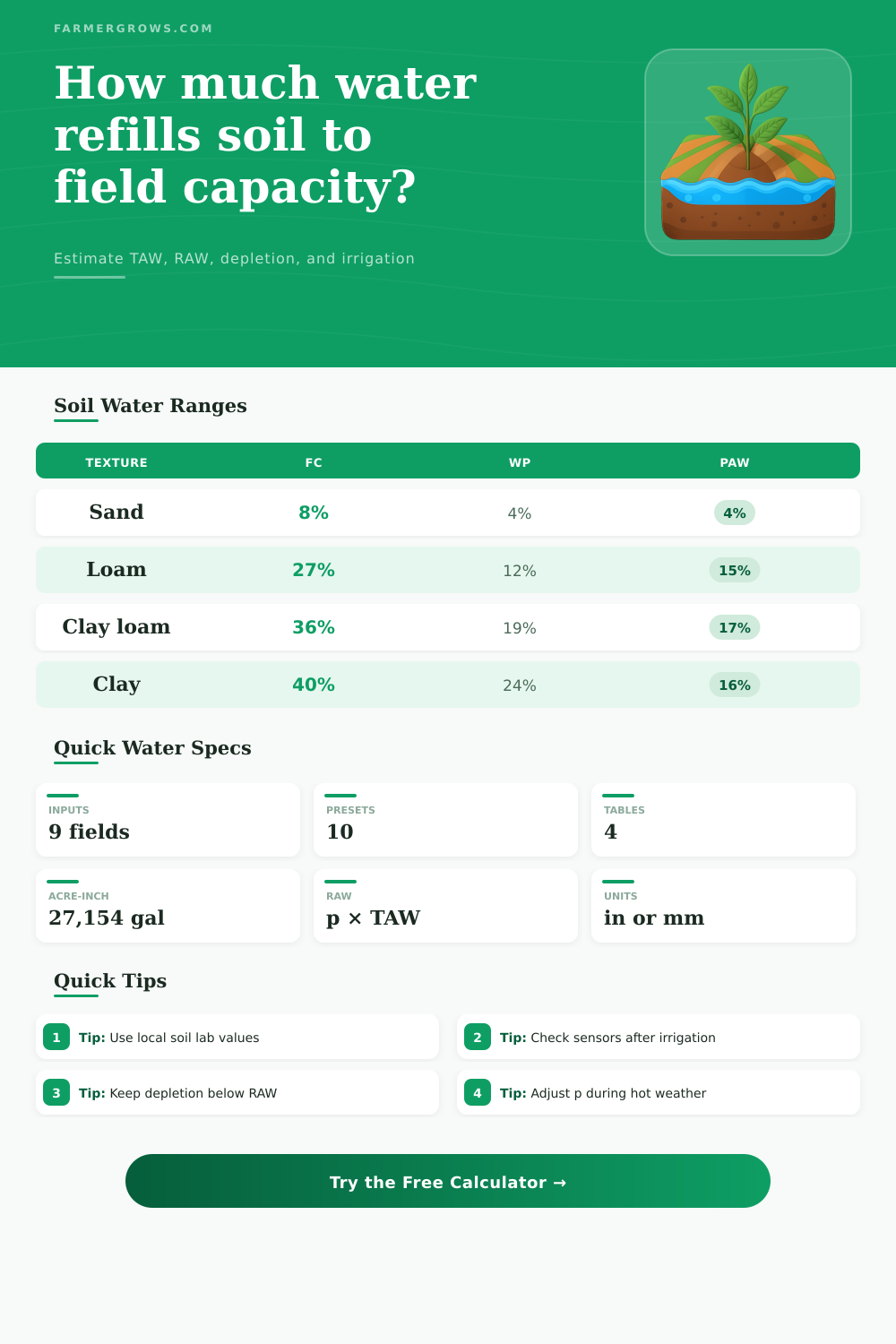
| Sand | 8% | 4% | 4% by volume | 1.60 g/cm³ |
| Loamy sand | 12% | 6% | 6% by volume | 1.55 g/cm³ |
| Sandy loam | 18% | 8% | 10% by volume | 1.50 g/cm³ |
| Loam | 27% | 12% | 15% by volume | 1.35 g/cm³ |
| Silt loam | 32% | 15% | 17% by volume | 1.30 g/cm³ |
| Clay loam | 36% | 19% | 17% by volume | 1.35 g/cm³ |
| Silty clay | 40% | 22% | 18% by volume | 1.32 g/cm³ |
| Clay | 40% | 24% | 16% by volume | 1.30 g/cm³ |
| Crop group | Typical p | Root zone note | Scheduling use |
|---|---|---|---|
| Vegetables | 0.30 to 0.45 | Often shallow and sensitive | Irrigate before visible stress |
| Potato | 0.35 | Shallow effective roots | Keep moisture swings small |
| Corn / maize | 0.50 | Moderate to deep roots | Protect tasseling and grain fill |
| Wheat | 0.55 | Moderate roots when profile is open | Track depletion near heading |
| Pasture grass | 0.50 | Root depth depends on grazing pressure | Use lower p after close grazing |
| Orchards and vines | 0.45 to 0.55 | Deep roots, varied wetted patterns | Match root zone to emitter wetting |
| Alfalfa | 0.55 to 0.60 | Deep rooted on unrestricted soils | Refill after cutting stress |
| Water depth | Imperial volume | Metric volume | Useful conversion |
|---|---|---|---|
| 1 inch over 1 acre | 27,154 gallons | 102.79 m³ | 1 acre-inch |
| 1 mm over 1 hectare | 2,642 gallons | 10.00 m³ | 10 m³/ha-mm |
| 1 inch | 25.4 mm | 2.54 cm | Depth only |
| 1 acre | 43,560 ft² | 4,046.86 m² | 0.4047 hectare |
| 1 gallon | 0.1337 ft³ | 3.785 liters | 0.003785 m³ |
| System | Typical efficiency | When to use lower value | Gross depth example |
|---|---|---|---|
| Drip / micro | 85% to 95% | Clogging, poor pressure balance | 1.00 in net / 0.90 = 1.11 in |
| Center pivot | 75% to 90% | Wind drift or high evaporation | 1.00 in net / 0.85 = 1.18 in |
| Solid set sprinkler | 65% to 80% | Windy sets and poor uniformity | 1.00 in net / 0.75 = 1.33 in |
| Furrow / surface | 50% to 70% | Long runs or deep percolation | 1.00 in net / 0.60 = 1.67 in |
| Hand watering beds | 60% to 80% | Uneven passes or runoff | 1.00 in net / 0.70 = 1.43 in |
Use measured limits when available. Texture tables are useful planning values, but lab or well-calibrated sensor estimates of field capacity and wilting point make the depletion calculation much stronger.
Do not refill blindly to the full profile. If roots only occupy part of the wetted soil, use the active root zone depth and reduce the depletion fraction during heat, flowering, transplanting, or shallow rooting.
Field capacity is a critical measurement that every irrigator should aware of in the decision to irrigate. Field capacity is the measurement of how much water a soil can hold after the excess water has drained away due to gravity. The field capacity of a soil is the amount of water that remains in that soil that are available to the crops until the next rain or irrigation event.
When the amount of water in the soil is low, the crops will begin to slowing in their growth prior to the crops showing any signs of wilting. The calculator make it possible to utilize the concept of field capacity, and allows the user to determine the amount of water that is remaining in the root zone of the active crops, as well as the amount of water that must be added to those crops prior to the crops beginning to experience water stress. The first step in determining field capacity is to select the type of soil in which the crops will be grown.
Field Capacity and How to Use an Irrigation Calculator
The texture of the soil will help to provide an estimate of the field capacity and the permanent wilting point of that soil. Soils that contain more sand will allow for the water to drain quickly from those soils, indicating that those soils will hold very little water. Therefore, vegetables will need to be watered every other day in hot weather.
Soils that are of a loam texture will hold enough water to allow for a growth period between watering events, but will allow air to reach the roots of the crops. Soils that contain more clay will hold more water than loam and sandy soils, but will release that water at a slower rate. Furthermore, if the clay soils contain shallow-rooted plants, it is possible to hide the signs of water stress in those crops.
The calculator will load the typical field capacity values for each soil texture, but you can adjust those values based on measurement of that soil. Once the soil is selected, the type of crop that will be grown in that soil will determine how much the soil should be allowed to dry prior to watering. A value of 0.5 for the depletion fraction will allow the soil to dry out 50% of the total amount of water that is available to the crops to be filled with water.
Vegetables and potatoes will require a lower depletion fraction than other types of crops. This is due to the shallow-rooted nature of vegetables and potatoes, as well as the need for the vegetable crops to maintain high market quality. Depletion fractions of 0.55 or higher are assigned to alfalfa and orchard crops, as the roots of those types of crops are deeper within the soil.
By entering this value into the calculator, the readily available water line is displayed for that soil. The current water content of the soil is a value that will change each day. By entering the current water content of the soil into the calculator, along with field capacity and the wilting point of that soil, it is possible to determine the amount of water that should be added to the soil to refill the depleted soil.
The irrigation calculator displays the amount of water that should be added to the soil in the depth box. By dividing that depth value by the efficiency of the irrigation system, it is possible to determine the amount of water that should be applied to the pump or irrigation valve to provide that much water to the crops. The amount of depth for the root zone should be considered carefully when setting up the irrigation system.
It is easy to overstate the depth of the root zone of the crops. For instance, corn that is planted in silt loam soils may require a root zone depth of 36” when the soil is dry, but the root zone depth of only 24” may be sufficient in dry periods. The depth of the root zone can be changed at any time in the irrigation management zone.
The area that will be irrigated and the efficiency of that irrigation system will impact the amount of water that is applied to that system. For instance, 40 acres of center pivot irrigation systems will require less water than 40 acres of furrow irrigation systems. The irrigation calculator calculates the depth of water that can be expressed in gallons or cubic meters.
Additionally, the amount of water in acre-inches is displayed, as acre-inches is the unit of measure for most irrigation districts. The concept of field capacity changes over time. For instance, the bulk density of the soil will change the volumetric readings to gravimetric readings.
Compaction of the soil will increase the bulk density. The temperature of the soil and the evaporation of the water in the soil will change the depletion fraction of the soil. For instance, if the soil temperatures are high, it may be better to use a depletion fraction that is much higher than for periods of cooler weather.
These factors will change over time, but the irrigation calculator will allow for planning of those changes. Common mistakes with field capacity include using a measurement of field capacity that is determined from a soil sample that was taken in an incorrect manner. For instance, if field capacity measurements are taken when the soil is too dry, or if the sensors are placed in areas of the field that are frequently wetted by irrigation, incorrect measurements will result.
Furthermore, watering the entire soil profile when only part of the soil profile contains active roots will waste water and potentially cause wilting of those crops. However, by using the percentage depth calculation, it is easier to determine whether only a portion of the root system should be refilled with water. The reference tables located on the calculator will assist in making the irrigation decisions.
The reference tables indicate the field capacity, wilting point and bulk densities of soils of each texture. Additionally, the tables indicate the depletion fractions for each type of crop. These reference tables can be used as starting points for irrigation calculations, but can be adjusted according to the actual measurements of water and soil within the fields where the crops are to be grown.
Finally, the irrigation efficiencies of the different types of irrigation systems is also listed in the tables, providing insight into how much water may be required for irrigation according to efficiency. Regular use of the irrigation calculator will allow the growers to think in terms of water being stored in the soil rather than after how many days the crops should be watered. For instance, sandy loam soils will require more water to be added after rain events than clay loam soils.
Additionally, after irrigating the fields every few days for a full season, the grower will have gained an understanding of how much water to apply to each acre to meet the needs of those crops. Furthermore, should there be any changes to the field or the crops, the calculator will still be of use. For instance, during periods of high heat or after performing cultivation of the fields, the irrigation schedule can be adjusted with the irrigation calculator.