Acreage Calculator Irregular Shape
Estimate gross acres, usable acres, surface acreage, and boundary length from GPS-style coordinates, trapezoid strips, triangle segments, direct survey area, buffers, slope, scale, and exclusion zones.
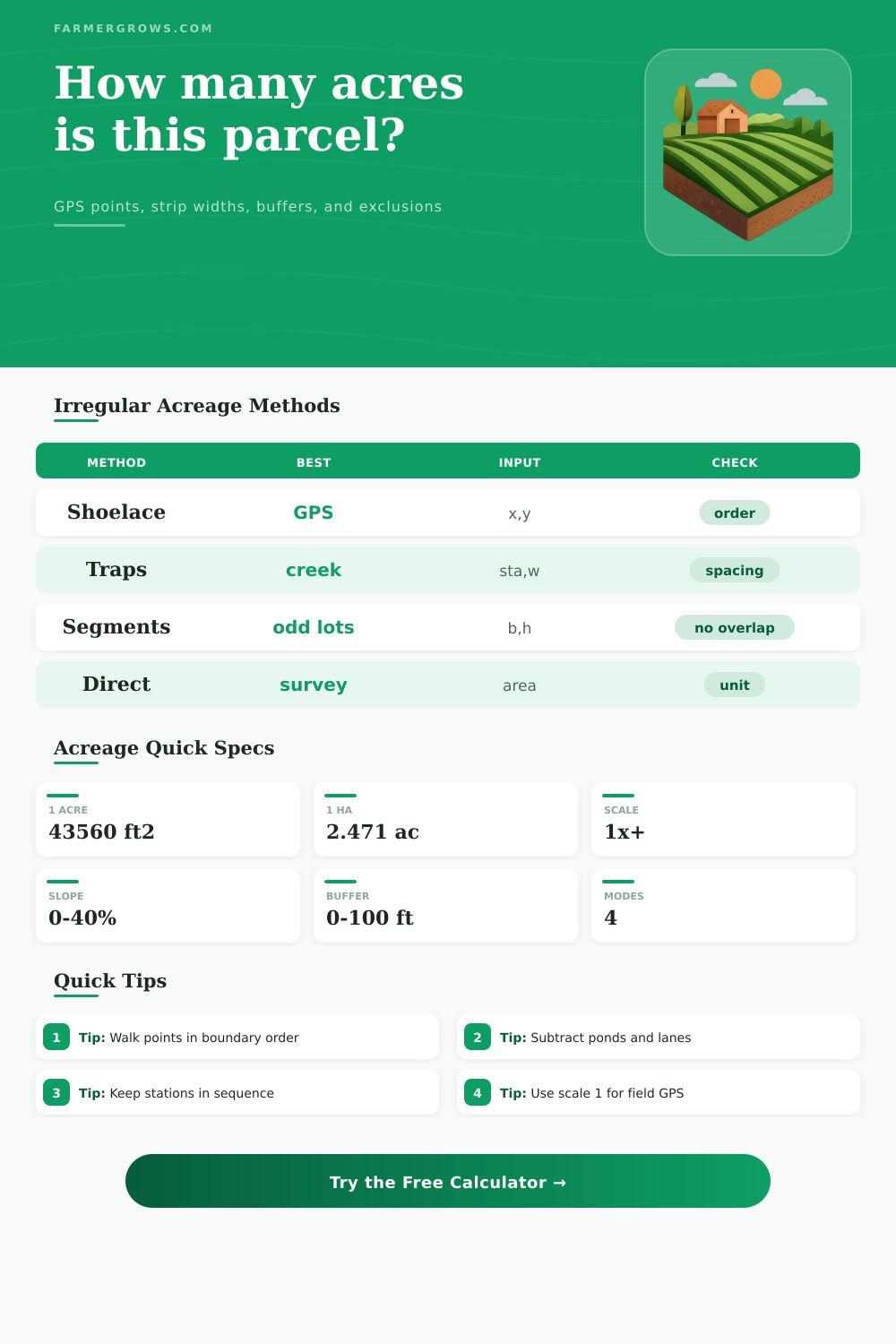
Best for GPS, map, and grid points. Enter points in boundary order; the calculator applies the polygon shoelace formula.
Best for creek edges and curved parcels. Stations and widths are averaged into strip panels.
Best when you split an odd parcel into measured triangle or rectangle pieces and add the non-overlapping areas.
Best when a deed, GIS export, or survey gives area already. Use the calculator for buffer, slope, and exclusions.
Use scale factor 1 for field measurements. For a drawn or GPS-exported map, enter the real feet or meters represented by one entered unit. Exclusion zones are subtracted before usable percent is applied.
📊 Acreage Results
Gross area is the horizontal parcel area. Slope-adjusted surface acreage and final usable acreage apply your slope, buffer, exclusions, and usable percent.
| Unit | Equals | Formula | Field Use |
|---|---|---|---|
| 1 acre | 43,560 sq ft | sq ft / 43,560 | US parcel acreage |
| 1 hectare | 10,000 sq m | sq m / 10,000 | Metric land records |
| 1 sq meter | 10.7639 sq ft | sq m x 10.7639 | Metric field mapping |
| 1 acre | 0.404686 ha | acres x 0.404686 | Mixed unit reporting |
| Mode | Example | Meaning | Quality Check |
|---|---|---|---|
| Coordinates | 240,25 | x east, y north point | Keep points in boundary order |
| Trapezoids | 100,112 | station 100, offset width 112 | Stations should increase |
| Pieces | tri,180,90 | triangle base 180, height 90 | Pieces should not overlap |
| Direct area | 8.25 acres | known survey or GIS acreage | Add perimeter for buffer math |
| Adjustment | Typical Range | Effect | Use When |
|---|---|---|---|
| Slope 0% | Flat ground | No surface increase | Crop plan area only |
| Slope 15% | Rolling ground | About 1.1% more surface | Seed, spray, and cover estimates |
| Buffer 10 ft | Small edge strip | Subtracts boundary x width | Headlands, lanes, setbacks |
| Usable 85% | Mixed field | Reduces remaining acres | Rocky, wet, or shaded pockets |
| Method | Strength | Watch Out For | Best Accuracy Habit |
|---|---|---|---|
| GPS coordinates | Works for many corners | Phone drift near trees | Average repeated corner readings |
| Trapezoid strips | Handles curved boundaries | Wide station spacing | Add stations where the edge bends |
| Segment pieces | Easy with tape measurements | Overlapping sketches | Draw each piece before adding |
| Direct survey | Fastest when area is known | Old or rounded records | Check units and parcel version |
Use the right subtraction order: calculate gross acres first, subtract exclusions and boundary buffer second, then apply usable percent for the practical working acreage.
Scale and units decide everything: if your points come from a map grid, set the scale before entering exclusions so both the parcel and deductions stay in the same unit system.
An acreage calculator for irregular shape can calculate the actual surface area of a parcel of land. Parcels of land often has irregular shapes that make measuring the land challenging. The shapes of land use curves to follow natural features on the land, such as creeks or hillsides.
Because the parcel of land may be irregular in shape and size, the area of the land that are listed on the deed may differ from the actual area of the land that can be used for agricultural purposes. Using an acreage calculator for irregularly shaped parcels of land makes it possible to calculate the area that can be used for agriculture for that parcel of land. This calculation make it possible for individuals to make decisions regarding ordering agricultural seed or crews to work on the land.
How to Calculate Acres for Irregular Land
An acreage calculator for irregularly shaped parcels of land calculates the area of the land using various methods. The method that should be used depends on the data that is collect about the land. For example, if a phone or a handheld GPS collecting device surveys the land using GPS data, the shoelace method can be used to calculate the area of the land.
A survey of the land might discover that the boundary of the land features a curving feature, such as a creek or a boundary fence. In this case, the trapezoid strip method is used to calculate the area. If the land feature several triangular and rectangular areas that a tape measuring tool surveyed, the segment method can be used to calculate the area of the land parcel.
Finally, if a survey of the land or a GIS export of the land data is available, the direct area option can be used to calculate the area of the land. After calculating the gross area of the land using one of the methods described above, various adjustments must be made to the area measurement to provide an accurate measurement of the area that can be used for agriculture. The first of these adjustments is the boundary buffer, which calculates the area of the land that is lost to hedges or other features along the boundary of the land.
This area is subtracted from the gross area to calculate the area of the land that is to be used for agriculture. Another adjustment is the slope adjustment, which takes into account the area of land slopes. The area of slopes is often greater than the area of the land that is calculated from flat land maps.
This adjustment is used when calculating seed or spray requirements for the land. Another adjustment is the area of land that is to be excluded from agricultural use; this area might include ponds, sheds, or lanes. The area of this feature of the land is subtracted from the area of the land to calculate the area that is to be used for agriculture.
Finally, another adjustment is the percentage of the land that will be usable for agriculture. This percentage accounts for rocks or areas that are shaded from the sun, which can be essential for agriculture. This percentage can be used to calculate the final acreage that can be used for agricultural purposes.
An acreage calculator that calculates the area of irregularly shaped parcels of land provides several different measurements of the area of that land. The acreage calculator will provide the gross area of the land. The acreage calculator can also calculate the slope-adjusted area of the land.
The acreage calculator can also calculate the acres that are removed from the land due to adjustments such as boundary buffer, slope, and exclusions. Finally, the acreage calculator will calculate the total area of the land that can be used for agricultural purposes. An acreage calculator for irregularly shaped parcels of land also includes reference tables that explain the measurements to the landowner.
These reference tables makes it easy for the landowner to understand what each number on the acreage calculator means. The reference tables can also provide examples of common conversions for the area of land and the various adjustments to that area. These tables can also display the effect that common grades of slope or boundary buffer have on the area of the land.
These reference tables can assist the landowner in making decisions regarding the slope of the land or the width of any boundary buffer. When calculating the area of a parcel of land, it is easy to underestimate the area that can be used for agriculture. For instance, a parcel of land that appear to contain eight acres may only have seven acres that can be used for agriculture.
If the slope of the land is ignored in calculating the area of the land, the area that is calculated will be less than the actual area of the lands surface. Underestimating the area of a parcel of land results in purchasing less seed than is actualy require for that land. The acreage calculator for irregularly shaped parcels of land calculates the various adjustments to the area of land that will be used for agriculture.
The accuracy of the acreage calculator for irregularly shaped parcels of land depends on the accuracy of the data that the landowner enters. In order to recieve the best results from an acreage calculator for irregularly shaped parcels of land, the data on the land should be collected in a similar manner to the way that the land is to be used. For instance, if the land is to be divided into strips for agricultural use, the land should be surveyed in a way that reflect its division into strips.
If the land is to be seeded, the usable percent can be applied to the total area of the land after the area of any features that will not be used for agriculture (exclusions) is subtracted from the total area of the land. The results of the acreage calculator for irregularly shaped parcels of land will only be accurate if these various inputs is entered into the acreage calculator in an accurate manner. Ensuring the accuracy of these entries will ensure that the calculated area of the land will become a number that can be used in planning for the parcel of land.