
Feeding plants requires precision; it isn’t intuitive and goes against the grain of the “natural” way we think about soil-garden care. Often our failure to get things right comes down to the soil’s chemistry, not bad luck, but a lack of knowledge about how to care for the roots.
What not to do. When you plant a seed, it’s typically out of good intent. But sometimes it just doesn’t work out. It stops in its tracks or gets sallow-looking. How come? Because you didn’t know how to feed the root. And maybe even gave up on the plant before it had time to fail.
How to Feed Your Plants
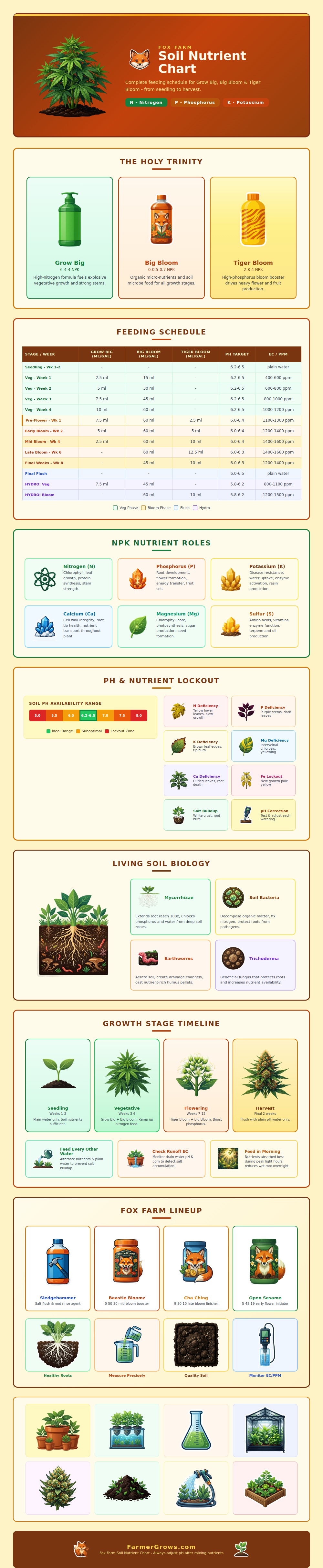
This is a three-product system, and I think you can see from the chart (above) when to apply which nutrients in what quantities. Three products, one plan. There’s a base formula that are applied from the beginning of your plant’s life until its end to build and maintain good soil. This has no macronutrients; instead it has amino acids and beneficial microbes, things that will help the plant take up other nutrients.
Then there’s a vegetative booster, this is where you want to give some nitrogen to get leaves growing. And then there’s a flowering formula. Here you’ll want some phosphorus for flowers to develop. It isn’t just a choice between a veg-only or bloom-only system; it is a layering of systems. You will keep the base going all the time and adjust the other two depending on what stage your plant are in.
I know it’s tempting to feed as soon as they push through, but don’t! Use nothing but plain water for the initial couple of weeks according to the chart. Young plants gets going with what’s left in good soil. Too-early fertilizing can burn tender roots. It’s simply too much for their roots until they strengthens up a bit. Water alone allow the seedling to concentrate its energy on developing a strong root system.
In this phase, the nitrogen come gradually. On the very first day, don’t give full strength of what’s suggested. Give just a little bit. Increase by a tiny bit each week. That matches how plants encounter nutrients naturaly. When you dump a big slug of concentrated nutrients all at once, the plant can’t absorbs them that quickly.
Soil gets salty. Salty soil is a silent killer of many indoor garden. Salts coat the root surface and prevent the roots from taking up water. Even when you soak the pot, the plant will look like it needs water.
When it comes time to flower, you switch up your regimen. You decrease the N-heavy mix and increase the P of the bloom booster. That’s because P fuels the plants’ transfer of energy. That’s necessary when forming heavy fruiting bodies or flowers. Now potassium takes center stage too. It supports cell wall strength and regulates water movement throughout the plant.
The amount of supplement stay the same. Consistency creates a solid microbial home. Macronutrients adjust according to what the plant want to do: reproduce.
But remember, you don’t want to worry about only the nutrients. You also need to watch your pH. Too alkaline? Too acidic? The roots can’t take in the nutrients. Feed, feed, feed, what’s the point if the plants can’t get at them? A slight acidity in the runoff will keep iron, magnesium, and calcium available. That little change prevents lockout issues. Often these look like deficiency symptoms but they are really availability symptoms.
Finally, flush the system prior to harvest. Stop any nutrient input two weeks or so prior to cutting the plant back so that it can use what’s left in reserve within itself. Flushing removes extra salts from the plant’s tissues to improve its quality and flavor.
It’s all about growing together, it’s a partnership between you and the soil. You give it the proper ingredients at the proper time. Let the biology do the work. Let the plants teach you what they want. They show you through their leaves. Trust the process and witness what happens as the roots breathe.