
Fruit trees is islands. They are solitary ones, at least if most home gardeners are typical. You plant the tree, put down some mulch, and let the ground around it go bare or get sown with thirsty lawn grass. No wonder they requires lots of care, and produce small crops.
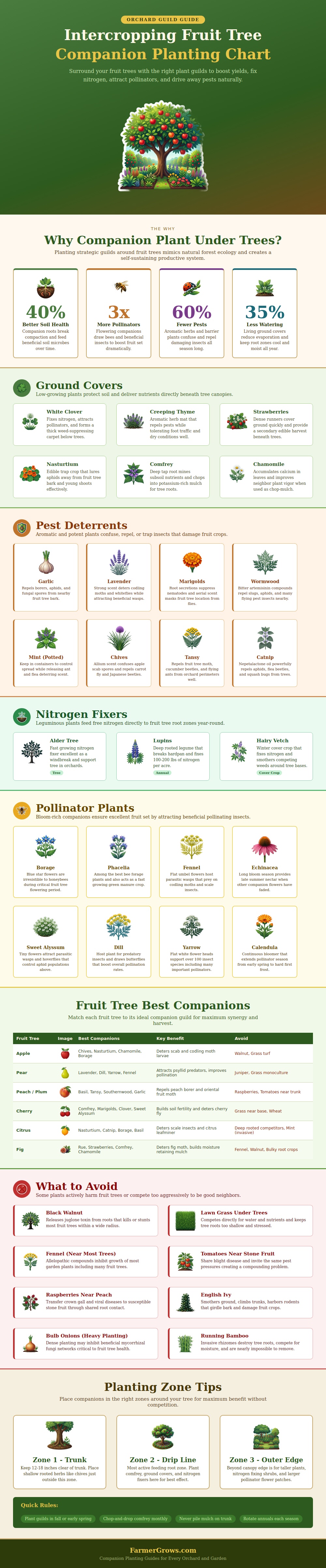
What’s needed? You need to think of the area as not empty dirt but an ecosystem. A guild (a word I am using here in its looser sense) are a group of plants whose combined efforts increase tree health. The key is to surround your trees with these plants. Particular plants has different functions under the canopy, too, says the infographic. And no: that’s not all about making do with what fills up empty spots. The infographic is all about the how-to of it, function over form.
How to Make Fruit Trees Grow Better
A living carpet of ground covers such as creeping thyme (or even white clover) fixes nitrogen in the soil, keeps root zones cool, smothers weeds and help reduce evaporation a lot, meaning less afternoon watering for you. In fact, it can reduces your watering needs by well over one-third, according to the data, a huge help at the height of summer heat when municipal watering restrictions are usualy at their most severe.
You can uses aromatic and vertical defenses by thinking beyond just ground cover. Fruit trees in particular is irresistible to many pests, because they smell deliciously like an easy meal. Confusing the scent profile with things like planting chives or garlic around your apples make it more difficult for insects to identify where their host is. There is a reason for this. Garlic and onion scents drown out the chemical signals aphids need to find vulnerable bark. Marigolds release chemicals from their roots that stops nematodes. It is the same idea. Basically you’re creating a barrier of chemicals, no spray involved.
What you put in there matters, but so does WHERE. Zones: Keep the immediate area near the trunk clear and move outward to the drip line; those spots are prime real estate for vetch or other nitrogen fixers, and also for comfrey, which has a special value because it mines deeply for nutrients in the subsoil layers beyond the reach of shallower roots. Drop the chopped-up leaves as mulch, and recycle those minerals right back to the tree’s reach. Beyond that zone, reaching to the edge of the dripline where most active tree roots grow, is more prime real estate. But keep the immediate area around the bark clear, to promote good air circulation and discourage rot.
Others aren’t so friendly, though; in fact, they’re downright hostile. Certain trees such as black walnuts emit a toxic substance called juglone that inhibits growth (or even kills) other plants within a wide radius. This include many fruits, which means putting them near any black walnut tree is asking for trouble. The next most popular mistake is lawn grass. Aside from being competitive with both nutrients and water, it maintain a dry, warm surface and keeps the underlying soil unfriendly to fruit-tree roots. Out with the turf, yes, this means you, and in with a healthy orchard.
It’s a self-sustaining loop. Bees are attracted to phacelia or other pollinator plants like borage during key bloom times. More pollinators results in improved fruit set. Beneficial insects hunt down problem pests while lavender, mint, or another pest deterrent protects the crop. It’s a trade of labor for ecology. Instead of spending time constantly weeding or spraying chemicals, you maintain a system that maintains itself.
Begin small. This season add a nitrogen fixer and a ground cover. Observe what happens to the soil. The trees will tell you if it’s working. You should of started sooner.