Iceberg Lettuce Growth Time Calculator
Estimate crisphead harvest timing from variety, start method, cool-season temperatures, spacing, wrapper leaf condition, head size goal, and heat-bolting pressure.
🌱Named Iceberg Presets
Choose a crisphead scenario, then tune the weather, spacing, and wrapper leaf health for your bed, field row, or tunnel block.
🥬Crisphead Formation Focus
Iceberg needs a broad, clean wrapper leaf skirt before the center can fold and fill into a dense head.
Head fill is most reliable with mild days and nights. Hot afternoons can tighten the calendar but lower quality.
Close spacing can make smaller heads. Wider spacing gives wrapper leaves room to feed a firm crisphead.
⚙Iceberg Lettuce Inputs
Iceberg Crisphead Timing
Adjust the inputs to estimate head fill and harvest timing.
📊Iceberg Variety, Season, and Head Size Grid
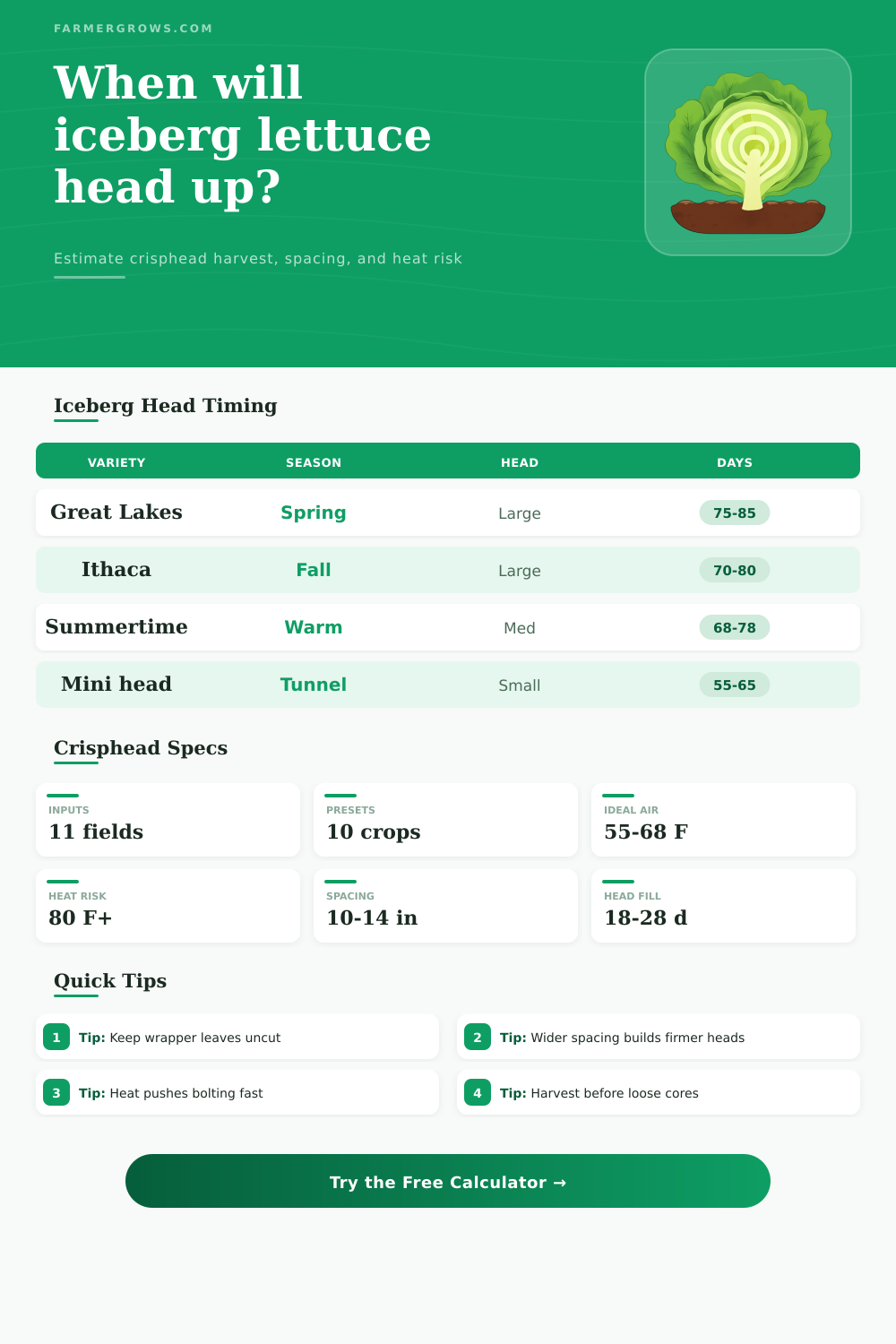
| Iceberg type | Best season | Typical head size | Planning days |
|---|---|---|---|
| Great Lakes type | Cool spring or fall | Large, dense crisphead | 75-85 days from seed, about 50-60 from transplant |
| Ithaca | Fall and steady cool beds | Large head with strong wrapper leaves | 70-80 days from seed, about 48-58 from transplant |
| Summertime | Mild warm-season edge | Medium to large if shaded | 68-78 days from seed, about 45-55 from transplant |
| Mini crisphead | Tunnel, container, close bed | Small firm head | 55-65 days from seed, about 35-45 from transplant |
🌡Temperature Effect Reference
| Air pattern | Head fill effect | Bolting pressure | Crop note |
|---|---|---|---|
| 50-60°F days, cool nights | Slower but dense and sweet | Low | Allow extra calendar days but expect good head quality. |
| 60-68°F days, 45-55°F nights | Ideal crisphead fill | Low | Best range for wrapper leaves feeding a firm center. |
| 70-78°F days | Faster leaves, looser core risk | Medium | Use shade, steady water, and harvest promptly. |
| 80°F+ heat spells | Quality window shrinks | High | Bolting, bitterness, and puffy heads become likely. |
📏Spacing and Head Size Table
| Plant spacing | Row spacing | Head goal | Timing effect |
|---|---|---|---|
| 8-10 in | 10-12 in | Mini or small heads | Earlier harvest, but less wrapper leaf area per plant. |
| 10-12 in | 12-14 in | Medium market heads | Balanced timing for home beds and small farms. |
| 12-14 in | 14-18 in | Large dense heads | May add a few days but improves firmness and weight. |
| Too close | Too narrow | Loose or oval heads | Competition delays fill and increases disease risk. |
🔍Field Cues by Growth Stage
| Stage | What to look for | Calendar signal | Action |
|---|---|---|---|
| Wrapper leaf build | Wide outer leaves cover the soil | First 25-35 adjusted days | Keep moisture steady and avoid cutting outer leaves. |
| Cupping begins | Center leaves fold inward | About 18-28 days before harvest | Check spacing and water stress before fill starts. |
| Head fill | Head feels springy but no tall core | Final 2-3 weeks | Shade during heat and watch for tipburn. |
| Harvest ready | Firm head, wrapper leaves still green | Before hot spell or bolting | Cut in the morning for best crispness. |
📌Quick Crisphead Benchmarks
💡Iceberg Growing Tips
Protect the wrapper leaves. Iceberg lettuce is not a cut-and-come-again crop. The outside leaves power head fill, so avoid harvesting them and keep soil splash down.
Plan around heat, not just days. If a hot spell lands during cupping or head fill, harvest slightly early, use shade cloth, or shift the next succession into a cooler window.
When you have iceberg lettuce, pay attention to when it bolts in mid-summer. That’s when the outer leaf go pale and that central shoot leaps upward like an asparagus spear. Time for salad? No; time to grow seed. It’s biology, which is why growing these types of lettuce (the so-called crispheads) can be tricky.
Unlike loose-leaf lettuce, they’re fussy: They need a tight temperature range to get their heads tightly packed. Then input your local weather and variety into the calculator up top, and let it do all the math for you: no more conversions, no more coefficients. No guessing.
Why Iceberg Lettuce is Hard to Grow
Iceberg lettuce’s a cool-season crop, and doesn’t do so well in warming climates. Knowing roughly when its heads will be filled, and thus vulnerable to any predicted heat wave. Is important. This tool adjusts to each variety’s unique genetics. Some varieties is best sown in spring, while others were chosen because they can handle the autumn chill or even grow in tunnels.
The first variable most gardeners mess up is spacing. Lettuce is no one-size-fits-all thing. Iceberg requires much more space different than looser leafy types. Those peripheral wrapper leaves aren’t there for nothing; they’re solar panels, producing energy and sugars. That energy gets pumped into the heart of the plant, creating a dense, firm core. When planted too closely, the outside leaf can never stretch out properly.
Then what? The plant has difficulty filling head. What happens next? You end up with a loose crop that doesn’t hold up well in refrigerator and lacks texture.
Growing conditions are similarly critical to the eventual success or failure of any crop you’ll get. For crispheads specifically, optimal growing temperatures falls between 55 and 68 degrees Fahrenheit by day. In that bracket, the plant gains density while not rushing into flowering mode. Beyond about eighty degrees, high daytime temperatures put stress on the plant, prompting rapid decline in quality. Although lettuce may grow quickly under such heat, it’s also prone to bolting early and going bitter. As temperature chart on the page shows, higher temperatures increase pressure toward bolting. Cooler temps slow growth but improve firmness and sweetness.
Another secret ingredient is consistent moisture. High-water-content iceberg lettuce has a shallow root system and doesn’t like stop-start watering. It may shrug it off if grown alongside carrots and dill, which do better with less. When conditions are dry, the plant stalls out. Inconsistent amounts of watering (too little one day, too much another) can result in poor head integrity or a condition called hollow hearts. You can calibrate the calculator’s output for soil moisture conditions. Even fertility yields a far more dependable time line then erratic care does.
Don’t look at the number of days, since that can change a lot. Instead, think of growth as several processes or phases. The plant builds up its canopy (the wrapper leaves). Next it starts cupping (inner leaf folding toward itself). Lastly, head fills tightly until all is packed together. These phases has unique vulnerabilities. Initially, you’re battling for leaf area. As time goes by, you’re battling to avoid heat and things that trigger bolting. Understanding this progression helps you understand your results better.
Sure, maybe you’ll get there faster than predicted, which sounds great. But perhaps they’ll come when summertime’s peaking in full heat? Fast isn’t always good. With iceberg, success has as much to do with timing. Getting the planting right based off nature’s clock, as it does with forcing the plant: making it behave when you’d rather it did. The tool lets you plot out the factors and move beyond fretting day by day toward plotting strategy. It teaches you to check the thermometer instead of just the almanac, and to be patient with those wrapper leaves. The crunch at dawn will be sweeter for being able to say just what made the cool, crisp head work.
You should of checked the temp earlier. Actualy, it’s a moddern way to garden. If you want a luxurius crop, don’t miss out on this. It dissapears fastly.