Hydroponic Lettuce Growth Time Calculator
Estimate harvest timing for NFT channels, DWC buckets, raft beds, towers, and Kratky jars from plug age, variety, EC, pH, light DLI, temperature, spacing, and target head weight.
Use this for hydroponic lettuce grow-out planning after germination: plug readiness, channel or raft time, nutrient strength, light intensity, and harvest weight. It intentionally avoids field romaine, iceberg heading, and seed-only germination schedules.
Hydroponic Lettuce Harvest Estimate
Adjust the inputs and calculate to see your harvest window.
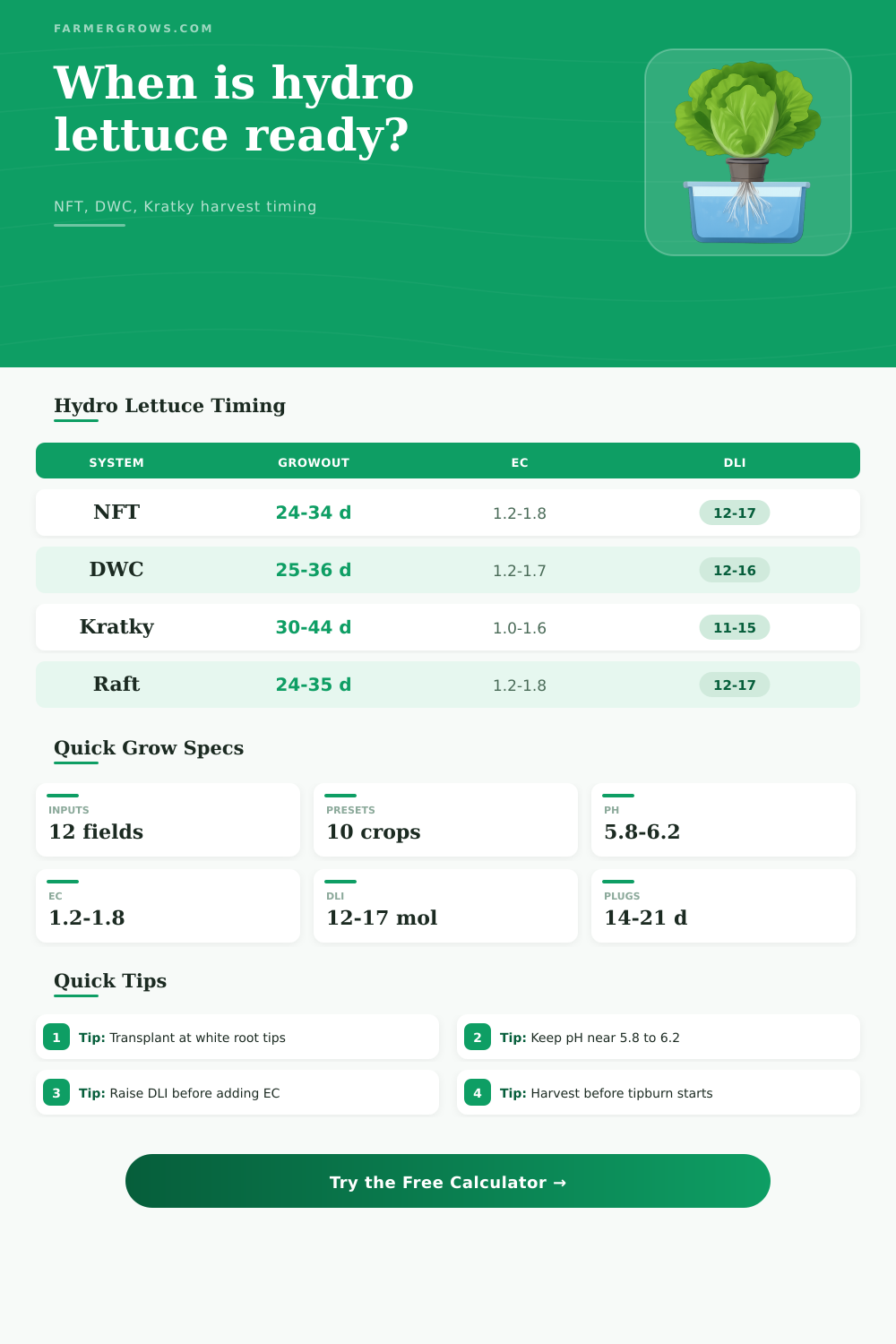
| System | Typical transplant-to-harvest | Timing effect | Best use |
|---|---|---|---|
| NFT channel | 24 to 34 days | Fast when flow is clean and oxygenated | Looseleaf, butterhead, Salanova |
| DWC bucket or tote | 25 to 36 days | Stable roots; watch water temperature | Butterhead and compact heads |
| Kratky passive jar | 30 to 44 days | Slower if reservoir volume is small | Home heads and small batches |
| Floating raft | 24 to 35 days | Consistent if raft spacing is adequate | Market heads and greenhouse beds |
| Vertical tower | 28 to 40 days | Can delay dry pockets or lower-tier shade | Compact looseleaf varieties |
| Ebb-and-flow tray | 27 to 39 days | Depends on flood timing and media moisture | Plug trays and bench crops |
| Hydro lettuce type | Base grow-out | Common head weight | Timing note |
|---|---|---|---|
| Green Oakleaf looseleaf | 30 days | 4 to 6 oz | Fast, open canopy, easy NFT crop |
| Buttercrunch butterhead | 36 days | 5 to 7 oz | Needs space to cup and fill |
| Salanova cut-and-core | 29 days | 4 to 6 oz | Quick uniform head for rafts |
| Lollo Rossa looseleaf | 34 days | 3.5 to 5.5 oz | Color improves under strong light |
| Rex butterhead | 37 days | 5 to 7 oz | Good enclosed hydro leaf texture |
| Muir summercrisp | 40 days | 6 to 9 oz | Heavier target, slower finish |
| Red Oakleaf looseleaf | 35 days | 4 to 6 oz | May need extra DLI for color |
| Baby leaf mix | 21 days | 1 to 3 oz | Cut young, not a full head schedule |
| Crop stage | EC range | pH range | DLI target |
|---|---|---|---|
| Seedling plug | 0.6 to 1.0 mS/cm | 5.8 to 6.3 | 8 to 12 mol/m2/day |
| New transplant | 1.0 to 1.3 mS/cm | 5.8 to 6.2 | 10 to 14 mol/m2/day |
| Main vegetative fill | 1.2 to 1.8 mS/cm | 5.7 to 6.3 | 12 to 17 mol/m2/day |
| Warm weather crop | 1.0 to 1.5 mS/cm | 5.8 to 6.4 | 11 to 15 mol/m2/day |
| Pre-harvest quality | 1.2 to 1.7 mS/cm | 5.8 to 6.2 | 13 to 17 mol/m2/day |
| Checkpoint | Fast crop | Standard head | Delay warning |
|---|---|---|---|
| Plug transplant age | 12 to 15 days | 16 to 21 days | Over 24 days can stall |
| Root cue | White tips showing | Roots touch solution | Brown roots add time |
| Spacing | 5 to 6 in baby | 7 to 10 in heads | Under 6 in limits weight |
| Harvest cue | Leaf size ready | Firm head, clean base | Tipburn or bolting risk |
| Batch planning | Cut in one pass | Harvest over 3 to 5 days | Stagger channels weekly |
Plug tip: Transplant when roots are white and just reaching from the plug. Overgrown plugs can sit still for several days after moving into NFT, DWC, or raft systems.
Light tip: If lettuce is slow but EC and pH are already in range, improve DLI, canopy temperature, or spacing before pushing nutrient strength higher.
Most people begin well-intentioned and hopeful, envisioning bright green heads in three short weeks. And then it happens: the leaves stay small, and the roots never turn snow-white, turning instead an unplesant shade of tan. Every harvest day pass by.
Typically this has nothing to do with lack of skill, or work. More often than not it’s an issue of environment and timing. If you have warm water, not enough light, or something else that doesn’t match what the recipe calls for, you can forget growing a butterhead lettuce in twenty-four hours.
Why Your Lettuce Is Not Growing Fast
Nature doesn’t operate on your clock; it only responds to persistent inputs. You also has to consider variety characteristics, nutrient conditions, and your system type. To put it another way: How does a fast-growing variety behave different than a slow one? And how do they differ between, say, a passive Kratky jar and a high-speed flow NFT channel?
The former is fully exposed to air; the latter isn’t. Oxygen changes everything. An NFT root gets a constant rush of water, drinking like crazy and growing quickly. In a Kratky jar, the reservoir sits still. So it has to relies on itself all along. This means the grow cycle take more days. I’m not talking about extra days added just because the plants are sitting there.
Knowing this prevents frustration when you pull up short stumps. You just didn’t had enough time (or use a better oxygenated system). First of all, there’s the matter of variety choice. Even without hardware, the base timeline vary depending on which varieties you select. Distance runners are butterhead and summercrisp varieties that take their sweet time to develop their desired dense structure, to cup up, and to fill out. Sprinters: Looseleaf (including Green Oakleaf) do not create a tight head. This allows them to get to marketable size faster. If you’re after speed, choose Salanova cut looseleaf varieties. For longer shelf life and quality, let the heads have some time. By adjusting for those genetics, we aren’t comparing apples to oranges.
So what about light? How much does it matter… And how much? Daily light integral (DLI) is measurement of the amount of photosynthetically active radiation (PAR) a plant gets per day for photosynthesis. Most people are focused on watts of their bulbs and distance from the canopy. Neither of those measures the thing that matters: the dose of light in 24 hours integrated through time. Run less DLI and your plant will slow down and stretch out. It invests in stems instead of leaves. This delays harvest quite a bit.
Usually the smarter play is to up the light first and then ramp up the nutrients. Using too much nutrients with too little light can lead to burn problems and lots of runoff but little biomass gain. Temperature control is the silent killer for all hydro cycles. Because lettuce’s a cool-season crop, it doesn’t like it when the air temperature exceed seventy-five degrees Fahrenheit. Plants may develop tipburn or bolt (meaning they’re attempting to produce seeds instead). They no longer grow new leaves. They stop producing new leaves. Your harvest window closes.
The calculator includes an estimate of average canopy temperature, which predicts when this slowdown occurs. Expect delays if your grow room runs hot. Lower the target weight or improve ventilation. Don’t simply add more fertilizer. That’ll make the stress worse. Another variable few consider is plug age when you transplant them. Ideally, you want healthy white roots that are barely filling out the cube. If your plug is overgrown, it will sit stagnant in the system for several days while it heals the root damage. It won’t take off as soon as others. If your plug is underdeveloped then it won’t be able to soak up nutrients right away.
There’s a sweet spot where the plugs are about 15-20 days since seeding. At this point, there should of been a smooth transition into vegetative growth. At the end of the day, hydroponic lettuce growing is a balancing act between biology and expectation management. Use the math to get an idea of what might happen; use the eyeballs to know when to pick. Firm heads with clean bases are where it’s at.
Watch for the lettuces to show any yellowing in their lowest leaves or tipburn early on. Let nature guide your timing by using your eyes instead of the calendar. If you match your garden space with how the plants grow, the greens will show themselves, crisp and waiting to be picked when they’re ready.